
Have you ever written disoriented and wondered whether disorientated would be more correct? You’re not alone. These two forms often confuse English learners and even experienced writers because they look different while carrying almost the same meaning. Both words describe a person who has lost their sense of direction, awareness, or understanding of a situation. The main difference comes from regional English, especially American English and British English.
In American English, disoriented is the more familiar and natural choice. In British English, disorientated is also widely established and commonly used. Neither form should automatically be treated as a spelling mistake or grammar error. Instead, the choice often depends on your English variety, writing style, target audience, and language conventions.
Understanding this distinction can make your professional writing, academic English, everyday communication, and formal documents sound more natural. Whether you’re describing physical confusion, mental confusion, loss of direction, or situational uncertainty, knowing when to use each form helps you communicate with greater precision.
This guide explores disoriented vs. disorientated, their meaning, usage, regional differences, grammar, word forms, and practical examples so you can choose confidently.
Disoriented vs. Disorientated: What Is the Difference?
Disoriented and disorientated generally have the same basic meaning. They describe someone who has lost their bearings or become confused about their surroundings, situation, or direction.
Consider these examples:
- After waking up in the unfamiliar hotel room, Maya felt disoriented.
- After waking up in the unfamiliar hotel room, Maya felt disorientated.
The meaning doesn’t fundamentally change.
The main distinction is regional usage and frequency.
| Feature | Disoriented | Disorientated |
| Basic meaning | Confused or lacking direction | Confused or lacking direction |
| American English | Very common | Less common |
| British English | Used | Common |
| Grammatical role | Adjective/past participle | Adjective/past participle |
| Meaning difference | Usually none | Usually none |
| Main distinction | Regional preference | Regional preference |
The important point is that disorientated isn’t simply a misspelling of disoriented. It is an established form.
Likewise, disoriented isn’t wrong British English. It is also used by British speakers and writers.
The easiest rule
If you’re writing for readers in the United States, disoriented is generally the safest natural choice.
If you’re writing specifically in British English, disorientated fits comfortably within that variety.
What Does “Disoriented” Mean?
Disoriented means confused about where you are, what is happening, or how to respond to a situation.
The word can describe literal physical confusion. For example, someone might become disoriented after walking through a large unfamiliar building.
It can also describe mental or situational confusion.
“The sudden change in plans left the team disoriented.”
Here, the team hasn’t necessarily lost its physical location. Instead, its members don’t know what to expect or what to do next.
The word comes from the idea of losing one’s orientation. When you’re oriented, you understand your position or situation. When you’re disoriented, that sense of understanding has been disrupted.
Quick Examples of “Disoriented”
Here are several natural examples:
- I felt disoriented when I stepped outside the dark theater.
- The tourist became disoriented after taking the wrong subway line.
- He looked disoriented after waking from a deep sleep.
- The sudden change in schedule left the students disoriented.
- She felt disoriented in the unfamiliar hospital.
- The new software initially left some employees disoriented.
- After the emergency evacuation, several people appeared disoriented.
Notice how the word works in both physical and figurative situations.
When “Disoriented” Works Best
Disoriented is especially natural in American English.
You’ll frequently see it in:
- Everyday conversation
- American journalism
- Medical and emergency descriptions
- Workplace communication
- Academic writing
- Fiction and storytelling
- Travel writing
- Descriptions of confusion or uncertainty
For example:
“When the lights suddenly went out, the audience became disoriented.”
That’s a natural sentence for American English.
The word also works well when you want something slightly more precise than confused.
Compare:
- “I was confused.”
- “I was disoriented.”
The first sentence can mean that you didn’t understand something. The second can suggest that you temporarily lost your bearings or sense of where you were.
That distinction can matter.
Why “Disoriented” Is So Common in American English
American English strongly favors the shorter disoriented form.
That doesn’t mean Americans can’t understand or use disorientated. They can. The difference is mainly one of established preference and frequency.
American readers encounter disoriented in many contexts, including news reports, fiction, workplace writing, and descriptions of medical or emergency situations.
For example:
“The driver appeared disoriented after the collision.”
The sentence sounds completely natural in American English.
A Cultural and Regional Note
English isn’t one single fixed system. American, British, Canadian, Australian, and other varieties often develop different preferences while remaining mutually understandable.
This happens with spelling, vocabulary, pronunciation, and grammar.
Consider familiar examples:
| American English | British English |
| apartment | flat |
| elevator | lift |
| vacation | holiday |
| sidewalk | pavement |
| organize | organise |
| traveled | travelled |
The difference between disoriented and disorientated belongs to this broader pattern of regional variation.
It isn’t useful to think of every difference as a battle between “correct” and “incorrect.” Sometimes English simply gives different communities more than one established form.
What Does “Disorientated” Mean?
Disorientated means essentially the same thing as disoriented.
It can describe someone who has lost their physical bearings or someone who feels confused by a situation.
For example:
- She became disorientated in the unfamiliar building.
- The sudden noise left him disorientated.
- After the long flight, I felt disorientated.
- The new environment made the children feel disorientated.
In British English, these sentences don’t sound unusual.
The longer form follows a familiar pattern in English in which verbs ending in -ate can form participles with -ated.
Quick Examples of “Disorientated”
Here are some examples that fit British-style usage:
“I felt completely disorientated when I came out of the underground station.”
“The unfamiliar surroundings left the visitors disorientated.”
“After the sudden change, the staff seemed disorientated.”
“He looked disorientated when he entered the unfamiliar room.”
Again, the meaning remains essentially the same as disoriented.
Where You’ll See “Disorientated”
The word appears in a variety of British English contexts.
You may encounter it in:
- British newspapers
- British fiction
- Everyday conversations
- Professional writing
- Travel descriptions
- Medical or emergency descriptions
- Academic writing
However, disoriented also appears in British English. Therefore, it would be misleading to claim that British speakers exclusively use disorientated.
The better description is that disorientated is a particularly established British preference, while disoriented is also recognized.
Why British English Uses “Disorientated”
British English has a long history of retaining and developing alternative verb forms. Disorientated fits naturally into that linguistic environment.
The important point isn’t that British English has a special meaning for the word. It doesn’t.
Instead, British usage gives the -ated form a stronger position than American usage generally does.
That means a British writer might naturally choose:
“The experience left him disorientated.”
An American writer might naturally write:
“The experience left him disoriented.”
Both sentences communicate the same basic idea.
Is “Disoriented” Wrong in British English?
No.
A British reader will understand disoriented, and the form is used in British English.
The same principle works in reverse. Disorientated isn’t meaningless or grammatically impossible in American English.
The issue is primarily which form sounds more natural for your intended variety of English.
The Historical Development of “Disoriented” and “Disorientated”
To understand why two forms exist, it helps to look at the history of the underlying word.
Early Origins of “Orient”
The word orient has a long connection with direction and the east.
The term ultimately relates to the Latin oriens, associated with the rising sun. Because the sun rises in the east, the idea of the “orient” became associated with the eastern direction.
Over time, orient developed broader meanings.
To orient yourself came to mean finding your position or understanding where you were in relation to your surroundings.
That meaning eventually expanded beyond physical geography.
Today, you can orient yourself to:
- A location
- A new environment
- A task
- A subject
- A system
- A situation
How “Disorient” Developed
Adding dis- creates a sense of reversal, removal, separation, or negation.
Therefore, disorient developed the meaning of causing someone to lose their bearings or sense of direction.
From that verb came participial forms including:
- disorienting
- disoriented
- disorientated
The -ing form describes something that causes confusion.
The -ed or -ated forms commonly describe the resulting state.
For example:
“The confusing maze was disorienting.”
But:
“The visitor became disoriented.”
And in British usage:
“The visitor became disorientated.”
That’s an important grammatical distinction.
Disoriented vs. Disorientated: Usage in Modern English
The difference becomes much easier when you separate meaning from preference.
American English Usage
In American English, disoriented is the normal everyday choice.
You can use it in casual writing:
“I got so disoriented in that mall.”
You can also use it in formal writing:
“The patient appeared disoriented during the examination.”
And you can use it figuratively:
“The sudden restructuring left employees disoriented.”
British English Usage
In British English, disorientated is a natural and established option.
For example:
“The passengers became disorientated after the train was diverted.”
But disoriented is not automatically wrong in British English.
A British publication may use either form depending on its style and editorial preferences.
Other Varieties of English
English varieties outside the United States and United Kingdom don’t always fit into neat boxes.
Canadian, Australian, New Zealand, Irish, and other Englishes can show overlapping preferences.
That’s why broad statements such as “Americans say this and British people say that” should be treated as general patterns rather than absolute rules.
Language isn’t a two-column spreadsheet.
Disoriented vs. Disorientated in Different Contexts
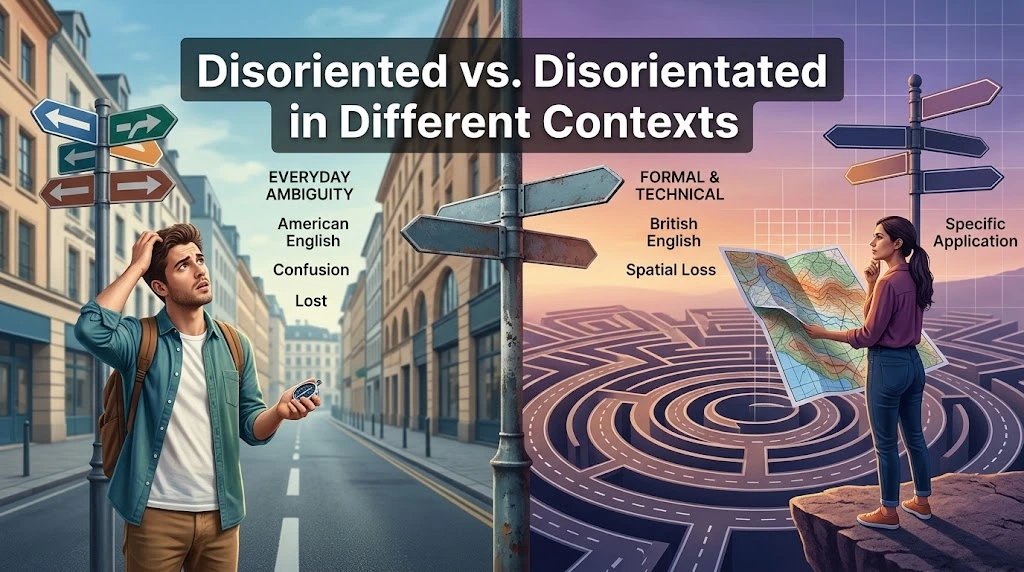
The words become particularly interesting when you examine real situations.
Travel and Navigation
Travel is probably the easiest context for understanding disoriented.
Imagine arriving at a huge airport after a long international flight. You walk through several corridors, follow signs that seem contradictory, and suddenly realize you don’t know where your gate is.
You might say:
“I was completely disoriented.”
A British speaker could naturally say:
“I was completely disorientated.”
Both sentences describe the same experience.
The word works especially well because the problem involves a literal loss of orientation.
Medical and Emergency Settings
Disoriented can also appear in medical or emergency contexts.
For example:
“The man appeared disoriented when emergency responders arrived.”
Here, the word describes an observable state of confusion or impaired awareness.
However, disoriented by itself isn’t a diagnosis.
A person can be disoriented for many reasons, including exhaustion, unfamiliar surroundings, injury, medication effects, or other circumstances. The word simply describes a state rather than identifying its cause.
British writing may use:
“The man appeared disorientated when emergency responders arrived.”
Again, the underlying meaning remains the same.
Education
Students can also become disoriented in a figurative sense.
Imagine a school introduces a completely new grading system without much explanation.
A student might say:
“The new system left me disoriented.”
This doesn’t mean the student literally lost their physical direction. It means they struggled to understand the new system.
In British English, disorientated could fill the same role.
Mental or Emotional States
The word can also describe a temporary sense of uncertainty.
For example:
“After moving to a new city, she felt disoriented by the unfamiliar routines.”
This sentence combines physical and emotional ideas. The person knows where she is geographically but hasn’t yet developed a comfortable sense of how the new environment works.
That’s one reason disoriented can be more useful than simply saying confused.
Workplace Situations
Organizational change provides another useful example.
Suppose a company replaces its internal software, changes reporting procedures, and moves several departments at once.
A manager might write:
“Employees initially felt disoriented by the rapid changes.”
Here, disoriented communicates more than simple confusion. It suggests that employees have temporarily lost their familiar framework.
Case Study: An Emergency Response
Imagine an emergency responder arrives at a crowded public event after an unexpected evacuation.
Several people are standing outside. Some are trying to locate family members. Others don’t know where they should go next.
One person appears calm but repeatedly asks where the exits are.
An observer might describe that person as disoriented.
In British English, the same person could be described as disorientated.
The word choice doesn’t change the person’s condition. It changes the regional flavor of the description.
This example also shows why context matters. In a real emergency report, precise observations are more useful than vague labels.
Instead of writing only:
“The person was disoriented.”
a detailed report might describe observable behavior:
“The person repeatedly asked where the exit was and appeared unsure of their location.”
The second description provides more information.
Common Mistakes With Disoriented and Disorientated
Mistake: Calling “Disorientated” Incorrect
This is one of the most common misconceptions.
Disorientated is an established English word.
It isn’t merely a typo created by adding extra letters to disoriented.
If you’re reading British English, you’ll encounter it naturally.
Mistake: Assuming the Words Have Different Meanings
In ordinary modern usage, the two forms generally mean the same thing.
The distinction is primarily regional.
If someone says:
“I felt disorientated.”
they generally aren’t communicating a different type of confusion from someone who says:
“I felt disoriented.”
Mistake: Using Both Forms Randomly
If you’re writing a long article, consistency matters.
Suppose the rest of your document clearly follows American English:
- color
- organize
- center
- traveled
Then suddenly using disorientated may create an unnecessary shift in style.
The word isn’t necessarily wrong. It may simply feel inconsistent with the rest of the document.
Mistake: Assuming “Confused” Always Means the Same Thing
Confused and disoriented overlap, but they aren’t perfect synonyms.
Compare:
“I was confused by the instructions.”
This suggests you didn’t understand the instructions.
Now compare:
“I was disoriented after leaving the dark room.”
This suggests you temporarily lost your sense of where you were.
The difference is subtle but useful.
Disoriented vs. Disorientated: How to Choose the Right Form
Choosing between the two doesn’t require a complicated grammar formula.
Start with your audience.
If You’re Writing for an American Audience
Choose disoriented as your default.
It will generally sound natural in:
- American blog posts
- Business documents
- School assignments
- News writing
- Emails
- Everyday conversation
- General nonfiction
If You’re Writing for a British Audience
Disorientated is a natural choice.
It fits British English comfortably, although disoriented is also understood and used.
If You’re Writing for an International Audience
Look at the style of the publication or organization.
If the document consistently follows American English, use disoriented.
If it follows British English, disorientated may fit better.
Consistency is often more important than trying to find a supposedly universal “correct” version.
If You’re Writing Professionally
Follow the organization’s established style guide when one exists.
A professional document should ideally maintain consistent spelling, vocabulary, and grammatical conventions throughout.
A Simple Decision Guide
Use this quick guide when you’re stuck:
| Your situation | Best practical choice |
| U.S. audience | Disoriented |
| British English audience | Disorientated is a natural option |
| British audience but house style uses “disoriented” | Disoriented |
| International publication | Follow its established style |
| Casual American conversation | Disoriented |
| British everyday conversation | Disorientated is common |
| Formal writing | Match the publication’s English variety |
| Unsure whether “disorientated” is valid | Yes, it is an established form |
Think of it this way:
American English → disoriented
British English → disorientated is especially natural
Neither form needs to be treated as a grammatical error simply because another variety prefers the alternative.
Disoriented vs. Disorientated: Real-World Sentence Comparison
Seeing the forms side by side makes the distinction clearer.
Getting Lost
American English:
“I became disoriented after taking the wrong exit.”
British English:
“I became disorientated after taking the wrong exit.”
After a Long Flight
American English:
“The long flight left me disoriented.”
British English:
“The long flight left me disorientated.”
New Workplace
American English:
“The new procedures left several employees disoriented.”
British English:
“The new procedures left several employees disorientated.”
Unfamiliar Building
American English:
“Visitors can become disoriented in the complex.”
British English:
“Visitors can become disorientated in the complex.”
The pattern stays remarkably consistent.
Related Words: Disorient, Disorienting, Oriented, and Orientation
Understanding the related forms makes disoriented vs. disorientated even easier.
Disorient
Disorient is the base verb.
It means to cause someone to lose their bearings or become confused.
“The maze disoriented the visitors.”
The verb focuses on the action.
Disorienting
Disorienting describes something that causes confusion or loss of direction.
“The sudden darkness was disorienting.”
The maze is causing the experience. Therefore, disorienting fits.
Disoriented
Disoriented describes the resulting state.
“The visitors felt disoriented.”
The visitors experience the confusion.
Disorientated
Disorientated performs essentially the same grammatical job as disoriented.
“The visitors felt disorientated.”
The main distinction is regional preference.
Oriented
Oriented expresses the opposite general idea.
“She quickly became oriented to her new surroundings.”
Someone who is oriented understands where they are or how a situation works.
Orientation
Orientation is the noun.
It can refer to the process of becoming familiar with something.
For example:
“The university held an orientation session for new students.”
The same underlying concept appears across all these forms: knowing where you are, understanding your surroundings, or becoming familiar with a situation.
Disoriented vs. Disorientated vs. Confused
These words overlap, but they aren’t always interchangeable.
| Word | Typical idea |
| Disoriented | Lost in direction, surroundings, or situation |
| Disorientated | Same basic meaning as disoriented |
| Confused | Unable to understand something clearly |
| Lost | Unable to determine where you are or how to proceed |
| Uncertain | Not confident about what is true or what to do |
| Disconcerted | Disturbed or unsettled by something unexpected |
Consider this situation:
“The instructions were confusing.”
You probably wouldn’t replace confusing with disorienting automatically.
But if a person is dropped into an unfamiliar environment and doesn’t know where to go, disoriented may be more precise.
That distinction helps prevent overusing the word.
Why Context Matters More Than the Suffix
The biggest lesson from disoriented vs. disorientated is that English isn’t always governed by one universal pattern.
Two forms can coexist while serving the same grammatical and semantic purpose.
Regional history, pronunciation preferences, spelling conventions, and established usage all influence which form people choose.
That doesn’t mean you need to memorize every regional difference in English.
Instead, develop a simple habit:
Know your audience, then stay consistent.
If your article targets American readers, disoriented is usually the smoothest choice.
If your publication uses British English, disorientated may sound more natural.
Read More : Too Early vs. To Early: Which Is Correct? A Clear Grammar Guide
Does “Disorientated” Sound More Formal?
Not necessarily.
Some writers assume the longer word disorientated sounds more formal because it contains additional syllables.
That’s not a reliable rule.
A British writer can use disorientated in casual conversation:
“I got completely disorientated in that shopping center.”
An American writer can use disoriented in highly formal writing:
“The individual appeared disoriented during the assessment.”
Formality depends much more on context, vocabulary, sentence structure, and purpose than on the number of syllables in the word.
Is “Disoriented” More Correct Than “Disorientated”?
There isn’t a useful universal ranking here.
For American English, disoriented is the standard and familiar choice.
For British English, disorientated is well established.
Both forms have legitimate usage.
The more useful question isn’t:
“Which word is correct?”
Instead, ask:
“Which form fits the English variety and audience I’m writing for?”
That question leads to a much clearer answer.
A Practical Writing Tip
If you regularly write for different audiences, create a small personal style checklist.
For American English, you might prefer:
- disoriented
- color
- center
- organize
- traveled
For British English, you may encounter:
- disorientated
- colour
- centre
- organise
- travelled
You don’t need to switch every word manually in every document. The important thing is to recognize the overall English variety you’re using.
Once that variety is clear, many vocabulary and spelling decisions become much easier.
Frequently Asked Questions About Disoriented vs. Disorientated
Is “Disorientated” a Correct Word?
Yes. Disorientated is an established English form. It is especially common in British English and is also understood elsewhere.
It should not automatically be marked as a spelling mistake.
Is “Disoriented” More Common in American English?
Yes. Disoriented is the more familiar and natural choice in American English.
American writers commonly use it in everyday, professional, academic, journalistic, and literary contexts.
Is “Disorientated” More Common in British English?
Disorientated has a strong presence in British English, although British speakers and writers also use disoriented.
Therefore, it is better to describe disorientated as a common British preference rather than an exclusive British form.
Do “Disoriented” and “Disorientated” Mean the Same Thing?
Generally, yes.
Both describe someone who has lost their bearings or become confused about their surroundings or circumstances.
The primary distinction is regional usage.
Can I Use “Disoriented” in British English?
Yes.
British English recognizes disoriented, even though disorientated is also a familiar form.
The choice may depend on the writer, publication, and house style.
Can I Use “Disorientated” in American English?
Yes, an American reader will generally understand it.
However, disoriented is usually the more natural choice for American English writing.
Which Form Should I Use in Formal Writing?
Use the form that matches your audience and style guide.
For American English, choose disoriented unless a specific house style says otherwise.
For British English, disorientated is a natural option.
Is “Disorientated” a Different Form of “Disoriented”?
Yes, in the sense that it is a different morphological form, but the two generally communicate the same meaning.
The practical difference is primarily regional preference, not a major semantic difference.
What Is the Difference Between “Disoriented” and “Disorienting”?
Disoriented describes the person experiencing the resulting state.
Disorienting describes something that causes that experience.
Compare:
“The traveler was disoriented.”
“The unfamiliar maze was disorienting.”
The traveler experiences the confusion. The maze causes it.
Is “Disoriented” the Same as “Confused”?
Not exactly.
Confused is broader. It can mean that someone doesn’t understand information, instructions, or an idea.
Disoriented more strongly suggests that someone has lost their bearings or sense of their surroundings or situation.
For example:
“I was confused by the math problem.”
But:
“I was disoriented when I woke up in the unfamiliar room.”
Final Verdict: Disoriented vs. Disorientated
Disoriented and disorientated are both established English forms. Their basic meaning is essentially the same: they describe someone who has lost their bearings or become confused about their surroundings or situation.
The biggest difference is regional usage.
For American English, disoriented is the natural default. For British English, disorientated is a well-established choice, although disoriented is also used.
The key isn’t to memorize one form as universally correct. Instead, match your word choice to your audience.
If you’re writing an American English article, use disoriented.
If you’re writing in British English, disorientated may fit the style naturally.
And if you encounter the alternative form while reading, don’t assume it’s an error. English has room for both.
Quick takeaway:
Disoriented = especially common in American English.
Disorientated = especially established in British English.
Meaning = generally the same.
Once you understand that distinction, the choice becomes much less disorienting.