

Have you ever paused over “too early” vs. “to early” while writing a sentence? These expressions sound identical, but only one works when you mean something happened before the right time. The confusion comes from homophones, English grammar, and the different roles of to and too. In standard American English, too early is the correct phrase for describing premature timing, early arrival, or something happening before the expected time. Meanwhile, to commonly introduces an infinitive verb, shows direction, or identifies a destination.
Understanding this distinction can improve your grammar skills, writing accuracy, sentence structure, and English vocabulary. It also helps you avoid common spelling mistakes, grammar errors, and word-choice mistakes. Whether you’re writing an email, essay, blog post, school assignment, or professional message, choosing the right word matters.
This guide explains too early, to early, correct grammar, proper usage, word meaning, adverb usage, preposition usage, infinitive verbs, early meaning, early arrival, premature action, timing expressions, common mistakes, English usage, American English, standard English, grammar rules, sentence examples, writing tips, proofreading tips, homophone errors, word confusion, language learning, grammar practice, correct spelling, sentence correction, English writing, everyday English, formal English, informal English, spoken English, written English, too meaning excessively, too meaning also, to meaning direction, to infinitive, early adverb, early adjective, degree adverb, adverb of degree, excessive degree, appropriate timing, expected timing, suitable timing, right time, wrong time, early enough, too soon, very early, so early, too late, early morning, early meeting, early appointment, early arrival, early departure, arrive early, leave early, too early to tell, too early to know, too early to decide, too early to say, too early to predict, to arrive early, to leave early, from early to late, grammar explanation, usage guide, language rules, common English errors, English learners, native speakers, clear writing, effective communication, accurate writing, grammar confidence, context clues, verb test, extra O rule, and English proofreading.
Too Early vs. To Early: The Quick Answer
“Too early” is correct when you mean “excessively early,” “earlier than appropriate,” or “before the right time.”
“To early” is not the standard spelling for that meaning.
Compare these sentences:
| Sentence | Correct? | Explanation |
| I arrived too early. | ✓ | The arrival happened earlier than appropriate. |
| I arrived to early. | ✗ | To doesn’t express excessive degree here. |
| It’s too early to leave. | ✓ | Too modifies early. |
| It’s to early to leave. | ✗ | The intended word is too. |
| I decided to arrive early. | ✓ | To introduces the verb arrive. |
| We traveled to the airport early. | ✓ | To shows direction while early describes timing. |
The important point is that to early isn’t simply an alternative spelling of too early. The two words perform different grammatical functions.
Why “To” and “Too” Cause So Much Confusion
The problem starts with pronunciation.
In standard American English, to and too are normally pronounced alike in connected speech. That makes the difference almost invisible when you’re listening.
Writing removes that safety net.
When you hear:
“We got there too early.”
you can’t see which spelling the speaker has in mind. When you write the sentence, however, you have to select the correct word.
They Are Homophones
Homophones are words that sound alike but have different meanings or spellings.
Common examples include:
- to / too / two
- there / their / they’re
- your / you’re
- right / write
- brake / break
- flower / flour
The pronunciation doesn’t tell you which word belongs in the sentence. Meaning and grammatical function do.
That’s why spelling errors involving to and too are common even among otherwise strong writers.
One Extra Letter Changes the Meaning
The easiest visual distinction is simple:
- to → one o
- too → two o’s
The second o isn’t decorative. It identifies a completely different word.
When too means “excessively,” it often adds the idea that something has gone beyond an acceptable or useful limit.
For example:
- too expensive = more expensive than acceptable
- too loud = louder than acceptable
- too difficult = more difficult than appropriate
- too early = earlier than appropriate
That pattern gives you a powerful memory aid.
What Does “To” Really Mean in English Grammar?
To has several grammatical uses. Two of the most important are its use as a preposition and as part of an infinitive.
Understanding these functions helps explain why “to early” doesn’t normally express the meaning you’re looking for.
“To” as a Preposition
As a preposition, to can show movement, direction, a recipient, or a relationship.
Consider these examples:
- We walked to the park.
- She drove to work.
- Send the document to Sarah.
- He gave the keys to his brother.
- They traveled to Chicago.
In these sentences, to connects another element to a destination, person, or relationship.
Now look at:
I arrived too early.
Here, there is no destination after to. The phrase too early describes the timing of the arrival.
That’s why replacing too with to changes the grammatical structure and creates an error.
“To” as Part of an Infinitive Verb
Another extremely common use of to occurs before the base form of a verb.
This is called the to-infinitive.
Examples include:
- to leave
- to arrive
- to sleep
- to study
- to work
- to understand
- to explain
Look at this sentence:
I decided to arrive early.
The structure is:
to + arrive + early
Here, to belongs to the verb arrive. The word early then tells us when the person plans to arrive.
That is completely different from:
I arrived too early.
Here, too modifies early.
This distinction is one of the most useful ways to understand the entire too early vs. to early issue.
What Does “Too” Really Mean?
Too has two major meanings in modern English.
The first means excessively or more than is desirable, necessary, or appropriate.
The second means also or as well.
The first meaning appears in too early.
“Too” as an Adverb of Degree
In too early, the word too functions as an adverb of degree.
It modifies early and indicates an excessive degree of earliness.
Compare:
- I arrived early.
- I arrived very early.
- I arrived too early.
These sentences aren’t identical.
Early simply tells you that the arrival happened before the expected or usual time.
Very early strongly emphasizes how early it happened.
Too early adds the idea that the timing crossed a boundary. The person arrived earlier than was useful, appropriate, expected, or desired.
For example:
I arrived early for the interview.
This can be positive. Perhaps arriving early was intentional.
But:
I arrived too early for the interview.
This suggests a problem or inconvenience. Maybe the office wasn’t open yet.
“Too” to Show Agreement
The word too can also mean also.
For example:
I love coffee too.
Here, too doesn’t mean “excessively.” It means also.
Another example:
She wants to attend the conference, and I do too.
This meaning isn’t responsible for the phrase too early, but knowing both meanings helps you recognize the word.
A useful distinction is:
- too early → excessively early
- I went too → I also went
The same spelling has two different meanings depending on context.
The Core Idea Behind “Too Early”
At its heart, too early combines two ideas:
too + early
The first word expresses excess.
The second expresses timing.
Together, they mean that something happens earlier than a suitable or expected point in time.
You can think of it as a timing scale:
too early ← early ← expected time → late
The exact boundary depends on the situation.
For instance, arriving at a restaurant 20 minutes before a reservation might be perfectly reasonable. Arriving three hours before the reservation might be too early.
Context determines the threshold.
Breaking Down the Phrase “Too Early”
Literal Meaning of “Too Early”
The literal meaning of too early concerns timing.
It indicates that an action, event, or situation occurs before an appropriate point.
Examples include:
- We got to the airport too early.
- She woke up too early.
- The children went to bed too early.
- I called him too early in the morning.
- The store isn’t open because we arrived too early.
Notice that the phrase doesn’t necessarily tell you an exact time.
If someone says:
“You came too early.”
you need context to know whether they arrived five minutes early or two hours early.
The phrase describes the relationship between the actual timing and the appropriate timing.
Figurative and Contextual Meaning of “Too Early”
Too early can also describe timing in an abstract sense.
For example:
It’s too early to tell.
Nobody is necessarily talking about a clock.
The sentence means that there isn’t enough time, information, evidence, or development to make a reliable judgment.
Other examples include:
- It’s too early to know what will happen.
- It’s too early to make a final decision.
- It’s too early to celebrate.
- It’s too early to draw a conclusion.
Here, early refers to a stage in a process rather than simply a time of day.
That’s an important feature of the phrase. Too early can describe chronological timing as well as the stage of an event or process.
Why “To Early” Is Incorrect in Standard Grammar
The error becomes easier to understand once you examine the grammar.
Suppose someone writes:
I arrived to early.
They intend to say that the arrival happened earlier than appropriate.
But to doesn’t perform that job.
The word to generally works as a preposition or as part of an infinitive construction. Neither function produces the intended meaning in this sentence.
The correct version is:
I arrived too early.
Why “To Early” Fails Grammatically
The problem isn’t that the sequence of letters t-o-e-a-r-l-y can never appear across words in English.
The problem is that to cannot replace too when you need an adverb expressing excessive degree.
Consider:
I decided to arrive early.
This is correct because to arrive forms an infinitive.
Now compare:
I arrived too early.
This is correct because too modifies early.
But:
I arrived to early.
doesn’t provide either grammatical relationship needed for the intended meaning.
Why Pronunciation Doesn’t Fix the Spelling
When you’re speaking, to and too may sound identical.
Writing is different.
English contains many words that pronunciation alone can’t distinguish. You have to use meaning and syntax.
For example:
They’re going home.
and:
Their car is outside.
The pronunciation doesn’t tell you which spelling to choose.
The same principle applies to too early.
Sentence Breakdown Example
Consider this sentence:
It’s too early to tell.
This short sentence contains both too and to, which makes it an excellent example.
The structure can be understood like this:
| Word/Phrase | Function |
| It’s | Subject + linking verb |
| too | Adverb expressing excessive degree |
| early | Describes the timing or stage |
| to tell | Infinitive phrase |
The two words that sound alike have completely different jobs.
Now examine:
I decided to arrive early.
Here:
| Word/Phrase | Function |
| I | Subject |
| decided | Main verb |
| to arrive | Infinitive |
| early | Adverb modifying arrive |
This comparison makes the distinction much clearer.
Too early describes excessive earliness.
To arrive early uses to as part of an infinitive.
When “To” Appears Near “Early” Correctly
Here’s where the subject gets more interesting.
Although “to early” is wrong when you mean “too early,” the words to and early can absolutely appear in the same sentence.
The trick is that they must perform their own grammatical jobs.
“To Arrive Early”
Consider:
We need to arrive early.
The word to introduces arrive.
The word early modifies arrive.
So the structure is:
to + arrive + early
Not:
to + early
This is perfectly grammatical.
“To Leave Early”
Another example:
She plans to leave early.
Again, to belongs with the verb leave.
Early tells us when she plans to leave.
“From Early to Late”
You can also find to and early in expressions involving ranges:
The shop is open from early to late.
Here, to helps establish the endpoint of a range.
The phrase doesn’t mean too early at all.
This is why it’s more accurate to say that “to early” is incorrect for the intended meaning, rather than claiming that the letters can never occur near each other.
Advanced Case: “Too Early to + Verb”

One of the most common constructions involving both words is:
too early to + verb
Examples:
- too early to tell
- too early to know
- too early to decide
- too early to leave
- too early to celebrate
- too early to predict
This construction can look confusing because too and to appear close together.
But their functions remain separate.
“Too Early to Tell” Explained
Consider:
It’s too early to tell.
The first too means excessively.
The second to introduces the verb tell.
So:
too → modifies early
to → introduces tell
That gives you:
too + early + to + tell
This is why “too early to tell” is correct.
The common error is:
It’s to early to tell.
The first word should be too.
Too Early vs. Early vs. Very Early
These expressions overlap, but they aren’t interchangeable.
| Expression | Basic meaning | Example |
| early | Before the usual or expected time | She arrived early. |
| very early | At a notably early time | She arrived very early. |
| too early | Earlier than appropriate or useful | She arrived too early. |
| so early | Strongly emphasizes unexpected earliness | Why did she arrive so early? |
The difference becomes obvious in everyday situations.
Imagine an interview begins at 10:00 a.m.
I arrived early.
This may mean 9:45.
I arrived very early.
Maybe you arrived at 9:00.
I arrived too early.
Perhaps the building didn’t open until 9:30.
The final sentence introduces a consequence or mismatch.
That’s the key difference.
Too Early vs. Too Soon
Too early and too soon often overlap, but they don’t always carry exactly the same emphasis.
Too early usually focuses on being before an appropriate point in time or before a process has developed enough.
Too soon often emphasizes insufficient time between events or an action happening before the right interval has passed.
Compare:
It’s too early to know the result.
This emphasizes the current stage of the situation.
Now:
It’s too soon to ask for another meeting.
This emphasizes that not enough time has passed.
In many situations, either expression may work. The surrounding context determines which sounds more natural.
Real-World Examples of “Too Early”
Everyday Conversation
- You’re here too early.
- It’s too early for breakfast.
- I woke up too early today.
- We left too early and had to wait.
- Don’t call her. It’s too early.
These examples show how naturally the phrase fits everyday speech.
School and Work
Timing matters in professional and academic settings.
You might say:
It’s too early to submit the final report.
Or:
She arrived too early for the interview.
You can also use the phrase metaphorically:
It’s too early to evaluate the project’s results.
In that sentence, too early doesn’t necessarily refer to a particular hour. It means the project hasn’t progressed far enough.
Travel and Appointments
Travel provides some of the clearest examples:
- We arrived at the airport too early.
- I got to the station too early.
- The hotel won’t let us check in because it’s too early.
- I arrived too early for my appointment.
The phrase communicates a mismatch between actual arrival time and the time when the service or event becomes available.
Decisions and Predictions
You frequently see too early in analytical writing as well.
Examples:
- It’s too early to tell.
- It’s too early to know.
- It’s too early to draw a conclusion.
- It’s too early to predict the outcome.
- It’s too early to make a final judgment.
These constructions are especially useful because they express uncertainty without making an unsupported conclusion.
Common Slip-Ups Writers Actually Make
The most obvious mistake is writing to early instead of too early.
However, several related mistakes deserve attention.
Writing “To Early”
Incorrect:
I got there to early.
Correct:
I got there too early.
Using “Too” Before a Verb
Another error happens when writers know that too expresses excess but place it where to should go.
Incorrect:
I want too leave now.
Correct:
I want to leave now.
Here, to introduces the verb leave.
The distinction can be summarized as:
- too early ✓
- to leave early ✓
- too leave ✗
- to early ✗ when intended to mean “excessively early”
Confusing “Too Early” With “Very Early”
These expressions don’t always communicate the same attitude.
She arrived very early.
This simply emphasizes the time.
She arrived too early.
This suggests that her timing was earlier than useful or appropriate.
That’s a subtle but important difference.
How to Remember “Too Early” Every Time
The Extra-O Rule
A simple memory trick works well:
Too has an extra O because it can express an extra degree.
Think:
too hot → more hot than appropriate
too expensive → more expensive than acceptable
too early → earlier than appropriate
The rule isn’t a complete grammar lesson, but it’s a handy proofreading shortcut.
The “Also” Test
Try replacing too with also.
For example:
I went too.
becomes:
I went also.
The second version sounds less natural in that position, but the meaning is still related to also.
This confirms that too is the correct word.
Remember that too also means “excessively,” as in:
It’s too early.
So the also test won’t work for every instance of too. It simply helps reinforce the spelling.
The Verb Test
When you’re considering to, ask:
Does it introduce a verb?
Examples:
- to leave ✓
- to arrive ✓
- to work ✓
- to study ✓
- to explain ✓
Now look at:
I arrived to early.
The word early isn’t a base-form verb in this construction.
That should make you suspicious.
A Simple Replace Test
If you’re unsure, replace the phrase with “excessively early.”
Consider:
I arrived ___.
Replace the blank:
I arrived excessively early.
The meaning works.
Therefore:
I arrived too early.
This test is especially useful when you’re proofreading quickly.
Another option is to replace too with very:
I arrived very early.
If the sentence remains grammatically sound but changes meaning, too early may be the intended phrase.
Quick Reference Table: “To” vs. “Too” With “Early”
| Expression | Correct? | Meaning |
| too early | ✓ | Earlier than appropriate |
| to early | ✗ | Incorrect for the intended meaning |
| to arrive early | ✓ | Infinitive + timing adverb |
| to leave early | ✓ | Infinitive + timing adverb |
| too early to tell | ✓ | Not enough time or information to tell |
| too early to decide | ✓ | Decision would be premature |
| from early to late | ✓ | A range from an early point to a late one |
| very early | ✓ | Extremely or notably early |
| so early | ✓ | Strong emphasis on early timing |
Editing Tips for Catching “To Early”
A quick proofreading routine can eliminate most mistakes.
Look for the Phrase
Search your document for:
to early
If you find it, don’t automatically change it. First inspect the surrounding sentence.
In most cases where the writer means earlier than appropriate, the correction will be:
too early
Identify the Intended Meaning
Ask:
Am I saying “excessively early”?
If yes, use too.
For example:
It is too early to leave.
Check What Follows “To”
If to is immediately followed by a base verb, it may be an infinitive marker.
Examples:
- to go
- to arrive
- to leave
- to sleep
- to work
But if you’re trying to describe excessive earliness, use:
too early
This quick check catches many homophone errors.
“Too Early” in Formal and Informal Writing
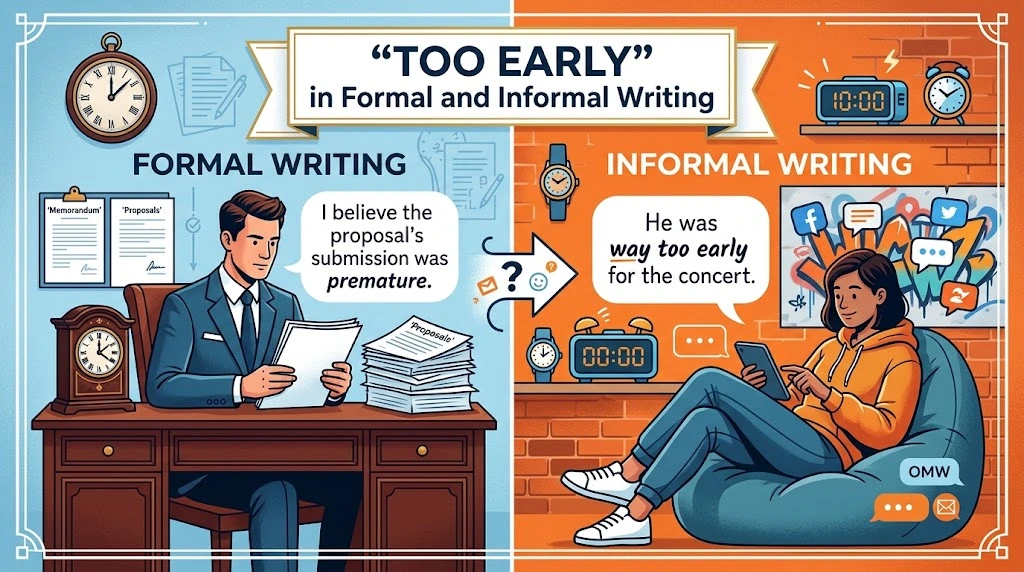
The phrase too early works naturally in virtually every variety of standard English.
You can use it in:
Casual conversation
It’s too early. Go back to bed!
Business writing
It may be too early to assess the full impact of the change.
Academic writing
At this stage, it is too early to draw a definitive conclusion.
Journalistic writing
Officials said it was too early to determine the cause.
Personal writing
I woke up too early and couldn’t fall back asleep.
The phrase itself isn’t informal. The surrounding vocabulary determines the overall tone.
Grammar and Style Guide Perspective
Major English dictionaries distinguish to and too as separate words with different meanings and grammatical roles.
Useful references include:
- Merriam-Webster — “too”
- Merriam-Webster — “to”
- Cambridge Dictionary — “too”
- Cambridge Dictionary — “to”
- Oxford Learner’s Dictionaries — “too”
- Oxford Learner’s Dictionaries — “to”
The grammatical distinction is consistent: too can express excessive degree, while to serves functions such as marking an infinitive or expressing relationships such as direction.
That distinction explains why too early is the standard form when the intended meaning is “earlier than appropriate.”
A Practical Case Study: Choosing the Right Word
Imagine a job interview starts at 2:00 p.m.
You arrive at 1:15 p.m.
You might say:
I arrived too early for the interview.
Why?
Because your arrival occurred before the useful or expected time.
Now imagine you are describing your plan:
I decided to arrive early for the interview.
Why is to correct here?
Because to introduces the verb arrive.
Notice how changing just one word changes the grammatical structure:
| Sentence | Key structure | Meaning |
| I arrived too early. | too + early | Earlier than appropriate |
| I decided to arrive early. | to + verb + early | Planned an early arrival |
| I arrived too early to enter. | too + early + to + verb | Arrived before entry was possible |
This is the distinction worth remembering.
Read More : Agreed vs. Agree: What’s the Real Difference?
Another Case Study: “Too Early to Tell”
Imagine a company launches a new product today.
Someone asks:
“Will it be successful?”
A reasonable response might be:
It’s too early to tell.
The sentence contains both words:
too = excessively / beyond the appropriate point
to = infinitive marker before tell
If someone writes:
It’s to early to tell.
the first word is wrong.
The corrected sentence is:
It’s too early to tell.
This expression is extremely common because many situations require time before a reliable conclusion becomes possible.
Common Questions About “Too Early” vs. “To Early”
What is the correct phrase: “to early” or “too early”?
Too early is correct when you mean that something happens before the appropriate, expected, or useful time.
Example:
We arrived too early for the meeting.
To early is not the standard form for this meaning.
Why is “too early” correct in English grammar?
Too works as an adverb of degree and modifies early.
It tells the reader that the timing is excessive or inappropriate.
In:
She arrived too early.
too modifies early, while early describes when she arrived.
Can “to” ever be used before “early”?
Yes, but not as a replacement for too.
For example:
I want to arrive early.
Here, to introduces the verb arrive.
Another example is:
The store operates from early to late.
In this sentence, to forms part of the range from early to late.
So the issue isn’t that to and early can never occur together. The issue is using to early when you mean too early.
Are “to” and “too” homophones?
Yes. In standard American English, to and too are normally pronounced alike.
They differ in spelling, meaning, and grammatical function.
The number two is also commonly pronounced the same way, making to, too, and two a familiar set of homophones.
Is it “too early to tell” or “to early to tell”?
The correct expression is:
too early to tell
The first word, too, means that the timing is premature or insufficient.
The second to introduces the verb tell.
The structure is:
too + early + to + tell
What’s the difference between “too early” and “very early”?
Very early emphasizes how early something happens.
Too early says that the timing is earlier than appropriate or useful.
For example:
She arrived very early for work.
This doesn’t necessarily suggest a problem.
She arrived too early for work.
This suggests that she arrived before it made sense to do so.
What’s the difference between “too early” and “too soon”?
Both expressions can describe premature timing.
Too early often emphasizes being at an early stage or before a suitable point.
Too soon often emphasizes that insufficient time has passed.
For example:
It’s too early to know the final result.
It’s too soon to return to the subject.
Context determines which phrase sounds most natural.
Can “too early” describe a person?
Usually, too early describes the timing of a person’s action rather than the person themselves.
For example:
John arrived too early.
The phrase tells us about John’s arrival time.
It doesn’t mean John himself is somehow “early” as a permanent personal quality.
Final Takeaway: Choose “Too Early” for Excessive Earliness
The difference between too early and to early comes down to one small letter with a big grammatical job.
Use too early when you mean:
- earlier than appropriate
- earlier than expected
- earlier than useful
- earlier than desired
- prematurely
For example:
I arrived too early for the appointment.
Use to when it performs another grammatical function, such as introducing an infinitive:
I decided to arrive early.
And when both words appear together, don’t let their identical pronunciation throw you off:
It’s too early to tell.
The easiest memory trick is this:
Too early = excessive earliness.
To arrive early = to + verb.
Once you stop relying solely on pronunciation and start checking the word’s grammatical role, the choice becomes straightforward. That extra o in too is your little warning sign: something has gone beyond the appropriate point.