
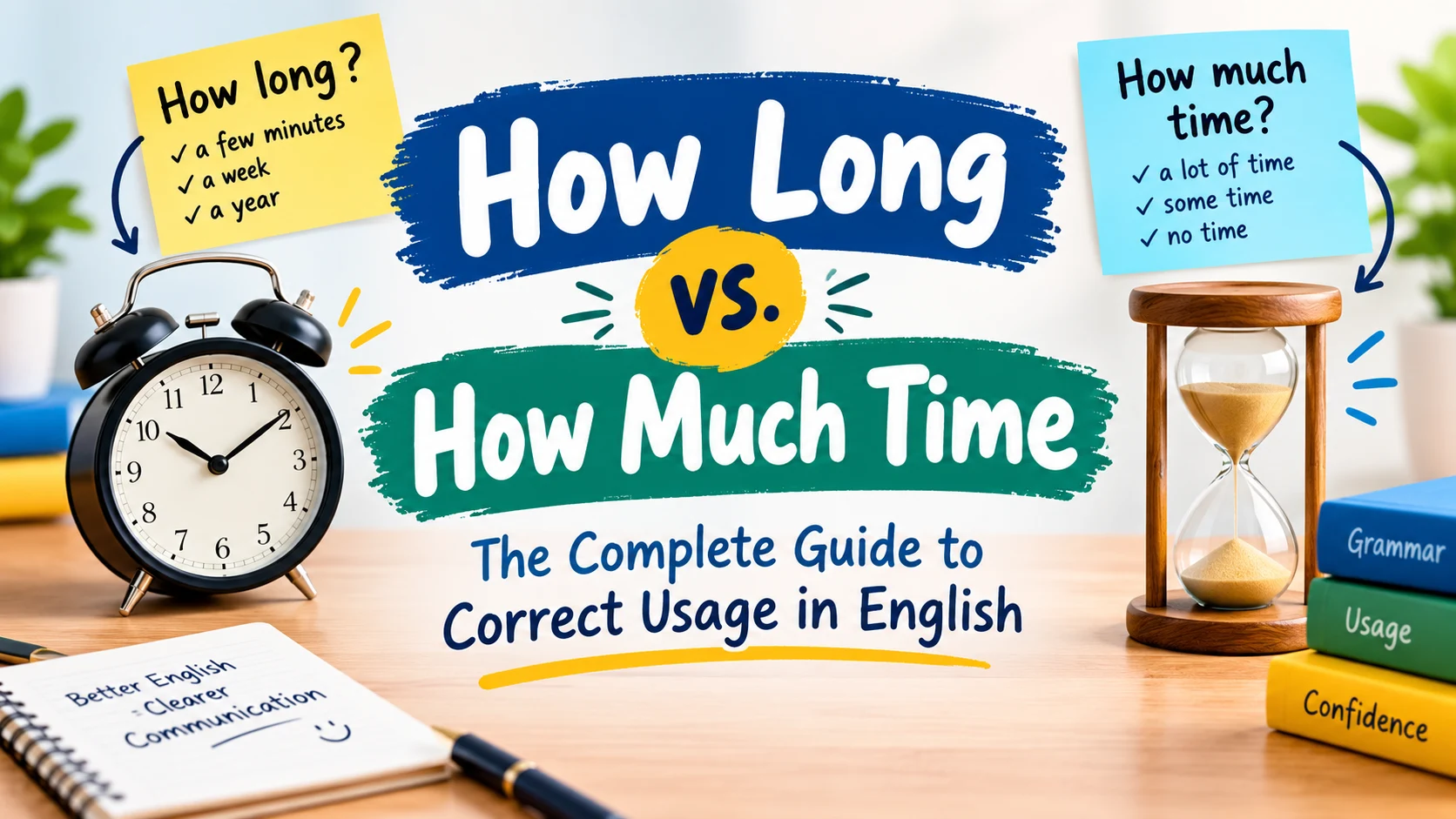
When talking about duration, time, or the length of an activity, English speakers often use “how long” and “how much time.” Although both expressions ask about the amount of time something takes, they are not always used in exactly the same way. Understanding the difference can make your everyday English, professional communication, and formal writing sound much more natural.
“How long” is the more common and natural choice when asking about duration. For example, you might ask, “How long will the meeting last?” or “How long does the journey take?” It works smoothly in both spoken English and written English.
“How much time” focuses more directly on the quantity of time available, required, or remaining. For example, “How much time do we have before the deadline?” emphasizes the time available, while “How long will the meeting take?” focuses on the duration of the meeting.
This small difference matters in business English, workplace communication, academic writing, and everyday conversations. Choosing the right expression can help you communicate clearly, avoid common grammar mistakes, and sound more like a natural English speaker.
In this guide, we’ll explore how long vs. how much time, their grammatical differences, common examples, useful sentence patterns, and situations where one expression sounds more appropriate than the other.
Understanding “How Long” vs. “How Much Time”
The simplest way to understand how long vs. how much time is to look at the role of time in the sentence.
How long generally asks about the duration of something:
- How long is the movie?
- How long did you wait?
- How long will the trip take?
- How long have you lived here?
How much time uses time as an uncountable noun and asks about an amount:
- How much time do we have?
- How much time do you need?
- How much time did you spend studying?
- How much time is left?
The two expressions overlap considerably. In fact, “How long will it take?” and “How much time will it take?” can ask essentially the same question. Still, the first often sounds more direct in ordinary conversation.
The Basic Distinction
Think about the difference this way:
How long? → duration
How much time? → amount, availability, requirement, or allocation
Imagine a movie.
If you ask:
How long is the movie?
You’re asking about its running time.
If you ask:
How much time do we have before the movie starts?
You’re asking about the amount of time available to you.
The subject may involve the same general concept of time. The perspective changes.
Why Both Can Sometimes Work
Consider these two sentences:
- How long does the repair take?
- How much time does the repair take?
Both can be understood as asking for the duration required to complete the repair.
However, how long is often the more natural everyday choice. How much time can place slightly more emphasis on the quantity of time required.
This distinction isn’t an absolute grammatical rule. Context matters.
When to Use “How Long”
Asking About Duration
The most common use of how long is asking how long something lasts or continues.
For example:
- How long is the class?
- How long did the meeting last?
- How long will the flight take?
- How long have you been waiting?
- How long did you stay there?
The answer normally gives a duration:
- Twenty minutes.
- Two hours.
- Three days.
- Six months.
- Ten years.
This makes how long the natural choice for many ordinary duration questions.
Example
How long did you stay in Chicago?
I stayed there for five days.
The question asks about the length of the stay.
You aren’t really treating those five days as a resource that was available to you. You’re asking about the duration of an experience.
Asking About the Length of an Activity or Event
English speakers frequently use how long for events and activities.
Consider these examples:
- How long is the concert?
- How long is the lecture?
- How long is the exam?
- How long does the class last?
- How long will the presentation be?
These questions focus on the expected or actual duration.
For example:
How long is the meeting?
A natural answer would be:
It’s about 45 minutes.
The question doesn’t ask how much time you personally have. It asks about the meeting’s duration.
Asking About an Ongoing Situation
One especially common pattern is:
How long + have/has + subject + past participle?
Examples include:
- How long have you lived here?
- How long have you worked there?
- How long has she known him?
- How long have they been married?
- How long have you studied English?
This construction is particularly useful when an action or state began in the past and continues into the present.
Example
How long have you worked at this company?
Possible answer:
I’ve worked there for eight years.
Or:
Since 2018.
The question asks about the duration of the employment relationship.
Learner-English resources consistently highlight this as a common use of how long, especially with the present perfect.
Asking About Future Duration
You can also use how long for something that hasn’t happened yet.
Examples:
- How long will the trip take?
- How long will you stay?
- How long will the interview last?
- How long are you going to be away?
- How long will the repair take?
The tense changes, but the basic idea remains the same: you’re asking about duration.
Compare
Past:
How long did the flight take?
Present:
How long does the flight take?
Future:
How long will the flight take?
The grammatical structure changes with tense. The underlying question remains about duration.
Common Grammatical Structures With “How Long”
Here are some of the most useful patterns:
| Structure | Example | Main Meaning |
| How long + do/does + subject + verb? | How long does it take? | Duration |
| How long + did + subject + verb? | How long did you stay? | Past duration |
| How long + will + subject + verb? | How long will it last? | Future duration |
| How long + have/has + subject + past participle? | How long have you lived here? | Duration continuing to now |
| How long + be + subject? | How long is the movie? | Length/duration |
The important point is that how long doesn’t require the word time afterward.
Common Mistakes With “How Long”
One of the biggest mistakes is combining how long and how much time.
Incorrect
❌ How long time will it take?
Correct
✅ How long will it take?
Or:
✅ How much time will it take?
Standard English doesn’t normally use “how long time” as a duration question.
The mistake happens because learners see these two correct structures:
- How long will it take?
- How much time will it take?
Then they combine them.
The result sounds like:
- ❌ How long time will it take?
English doesn’t build the question that way.
When to Use “How Much Time”
Asking About an Amount of Time
How much time treats time as an amount.
For example:
How much time do we have?
This question doesn’t necessarily ask how long an activity lasts. It asks how much time is available.
You might answer:
We have 30 minutes.
The same idea appears in:
- How much time do you need?
- How much time is left?
- How much time did you spend?
- How much time should we allow?
- How much time is available?
These questions make the quantity of time more prominent.
Asking About Available Time
This is one of the clearest situations for how much time.
Imagine you’re taking an exam.
Someone asks:
How much time do we have left?
You’re probably expecting an answer such as:
Twenty minutes.
The focus isn’t the duration of the exam itself. The focus is the remaining amount.
You could also say:
How long do we have left?
That works too. However, how much time do we have left? explicitly frames the remaining time as an available quantity.
Asking About Time Required
How much time works naturally when you’re thinking about how much time a task requires.
For example:
- How much time do you need?
- How much time should we allow?
- How much time is required?
- How much time should I set aside?
- How much time will the process require?
Consider a job interview.
How much time should I allow for the interview?
This sounds natural because you’re planning around a quantity of time.
The question isn’t simply about the interview’s duration. You’re deciding how much time to reserve.
Asking About Time Spent
The verb spend works particularly well with how much time.
Examples:
- How much time did you spend studying?
- How much time do you spend commuting?
- How much time did she spend on the project?
- How much time have they spent preparing?
Compare this with:
How long did you study?
Both questions can be correct.
However, the focus differs slightly.
How long did you study? focuses on duration.
How much time did you spend studying? emphasizes the amount of time invested in studying.
That’s why how much time can sound especially natural with verbs such as spend, need, require, allow, have, and save.
Asking About Remaining Time
Another natural use is asking how much time remains.
Examples:
- How much time is left?
- How much time do we have left?
- How much time remains?
- How much time is left before the deadline?
These questions are especially useful in situations involving limits.
Common situations
You might ask about:
- an exam
- a deadline
- a train departure
- a meeting
- a work shift
- a reservation
- a cooking timer
- a competition
The phrase works because you’re viewing time as something that can be used up, saved, allocated, or left over.
How Long vs. How Much Time: Comparing the Two
The difference becomes much clearer when you put the expressions side by side.
| Situation | How Long | How Much Time |
| Movie duration | How long is the movie? | Less natural for this exact meaning |
| Available time | How long do we have? | How much time do we have? |
| Time required | How long will it take? | How much time will it take? |
| Time needed | How long do you need? | How much time do you need? |
| Time spent | How long did you study? | How much time did you spend studying? |
| Remaining time | How long do we have left? | How much time do we have left? |
| Ongoing situation | How long have you lived here? | Less natural in many such contexts |
| Physical length | How long is the bridge? | Not applicable |
The table reveals something important: there isn’t a rigid rule that makes one phrase grammatically correct and the other grammatically incorrect in every situation.
Instead, natural usage depends heavily on the verb and intended focus.
Questions That Are Nearly Equivalent
Some pairs can communicate almost the same information.
Pair One
How long will it take?
How much time will it take?
Both ask about the time required to complete something.
Pair Two
How long do you need?
How much time do you need?
Again, both can ask about the required amount.
Pair Three
How long do we have?
How much time do we have?
Both can ask about available time.
Yet the second version makes the quantity of time more explicit.
The Verb Often Determines the Most Natural Choice

Here’s a useful shortcut: look at the verb before choosing the question form.
Certain verbs naturally connect with duration.
Verbs commonly associated with “How Long”
- last
- stay
- live
- wait
- remain
- continue
- take
Examples:
How long did the movie last?
How long did you stay?
How long have you lived there?
How long did you wait?
With these verbs, how long often sounds especially natural.
Verbs and Expressions That Work Well With “How Much Time”
- spend
- need
- require
- allow
- have
- save
- waste
- use
Examples:
How much time did you spend on this?
How much time do you need?
How much time should we allow?
How much time do we have?
How much time can you save?
The pattern isn’t absolute. However, it gives you a reliable starting point.
“How Long” Does Not Always Mean Time
There’s another important detail that English learners sometimes overlook.
How long can refer to physical length as well as duration.
For example:
How long is the bridge?
The answer might be:
It’s 500 feet long.
No time is involved.
Similarly:
- How long is the table?
- How long is the road?
- How long is the rope?
- How long is the tunnel?
Context determines whether long refers to physical measurement or duration.
Compare:
How long is the movie?
Duration.
How long is the movie screen?
Physical length.
This flexibility makes how long broader than how much time.
How Long vs. How Much Time in Everyday Situations
At Work
Imagine your team is preparing a presentation.
You could ask:
How long will the presentation last?
You’re asking about the presentation’s duration.
But you might ask:
How much time should we give each speaker?
Now you’re talking about allocating time.
That distinction matters in professional communication because planning often involves distributing limited time.
At School
Suppose an exam lasts two hours.
A student might ask:
How long is the exam?
The teacher might answer:
It’s two hours long.
But during the exam, a student might ask:
How much time do we have left?
The first question concerns the exam’s scheduled duration.
The second concerns the amount remaining.
Same exam. Different focus.
While Traveling
At an airport, you might ask:
How long is the flight?
That’s a duration question.
If you’re worried about catching your connection, you might ask:
How much time do we have before boarding?
Now you’re thinking about available time.
This is one of the easiest ways to remember the distinction.
At Home
Suppose you’re cooking dinner.
You could ask:
How long does the chicken need to cook?
Or:
How much time do we need to prepare everything?
The first question focuses on cooking duration.
The second considers the overall time required for preparation.
How Long vs. How Much Time With “Take”
The verb take causes a lot of confusion because both constructions are possible.
Natural everyday question
How long does it take to drive there?
This is extremely common.
You could also say:
How much time does it take to drive there?
That is grammatically acceptable. However, many speakers prefer how long in ordinary conversation.
More examples
How long does it take to cook rice?
How much time does it take to cook rice?
Both ask about the cooking duration.
Similarly:
How long did it take to finish?
How much time did it take to finish?
Both can work.
The shorter how long version often feels more conversational.
How Long vs. How Much Time With “Spend”
The verb spend creates a slightly different pattern.
Compare:
How long did you study?
with:
How much time did you spend studying?
Both can ask about duration. However, spend naturally pairs with an amount of time.
That’s because spend presents time almost like a resource.
You can:
- spend time studying
- spend time working
- spend time traveling
- spend time waiting
- spend time talking
- spend time practicing
Therefore:
How much time did you spend practicing?
sounds completely natural.
You can also ask:
How long did you practice?
The difference is subtle but useful.
Common Mistakes With “How Long” and “How Much Time”
Mistake: “How Long Time”
Incorrect:
❌ How long time will it take?
Correct:
✅ How long will it take?
Also correct:
✅ How much time will it take?
Don’t combine the two structures.
Mistake: “How Many Time”
When time means an amount or duration, it is normally uncountable.
Therefore:
❌ How many time do you need?
Use:
✅ How much time do you need?
However, times is countable when it means occasions.
For example:
How many times did you call?
That asks about the number of calls.
Compare
How much time? → amount of time
How many times? → number of occasions
These expressions are completely different.
Mistake: “How Much Times”
Another common error is mixing much with plural times.
Incorrect:
❌ How much times did you visit?
Correct:
✅ How many times did you visit?
Here, times means separate occasions. Therefore, many is required.
Mistake: Using “How Much Time” Everywhere
Although how much time is correct in many situations, it doesn’t automatically make every duration question sound natural.
For example:
How long did the movie last?
is very natural.
Compare:
How much time did the movie last?
The second version sounds awkward because last already expresses duration.
A better alternative would be:
How much time did you spend watching the movie?
Now the structure works naturally because spend takes an amount of time.
How Long vs. How Much Time in Professional English
Neither expression is inherently unprofessional.
Both appear in professional communication.
The best choice depends on what you’re asking.
Asking about duration
How long will the presentation last?
Asking about allocation
How much time should we allocate to the presentation?
Asking about availability
How much time do we have before the deadline?
Asking about requirements
How much time will the team need to complete the task?
Professional English often makes distinctions like these because time can represent both duration and a limited resource.
The important thing isn’t choosing the phrase that sounds more formal. It’s choosing the phrase that accurately communicates your intended meaning.
Real-Life Case Studies: Duration vs. Time Allocation
Case Study: A Business Meeting
Imagine a manager is organizing a one-hour team meeting.
The manager asks:
How long should the meeting be?
The focus is duration.
A different question might be:
How much time should we give each department?
Now the manager is allocating the available hour.
The total meeting length and the amount assigned to each speaker are related. They aren’t the same question.
Case Study: A School Exam
A teacher tells students:
The exam is two hours long.
A student asks:
How long is the exam?
The student wants to know the exam’s duration.
Later, with 35 minutes remaining, another student asks:
How much time do we have left?
Now the focus has shifted to available time.
What changed?
Not the clock.
The perspective changed.
That’s the central idea behind how long vs. how much time.
Case Study: A Work Project
Suppose a designer completes a website project.
A manager asks:
How long did the project take?
The answer might be:
Three weeks.
The manager could instead ask:
How much time did you spend on the project?
The answer might be:
About 65 hours.
These questions aren’t necessarily asking for exactly the same measurement.
The first describes the project’s elapsed duration.
The second describes the amount of work time invested.
That’s a valuable distinction in project planning.
Case Study: Travel
Imagine you’re driving to another city.
You ask:
How long will the drive take?
The answer:
About four hours.
Now imagine you’re planning your schedule:
How much time should I allow for the drive?
The second question has a planning focus.
You might allow five hours even if the normal drive takes four because traffic, fuel stops, weather, or delays could affect the schedule.
So duration and time allowance aren’t always identical.
Read More : Concurrent vs Simultaneous: What’s the Real Difference?
A Practical Decision Guide
When you’re unsure which expression to use, ask yourself what information you actually want.
Use “How Long” When You Mean:
- How long something lasts
- The duration of an event
- The length of an activity
- The length of a stay
- The duration of an ongoing situation
- The expected duration of a journey
- The physical length of something
Examples:
How long is the movie?
How long did you wait?
How long have you lived here?
How long will the trip take?
Use “How Much Time” When You Mean:
- How much time is available
- How much time remains
- How much time someone needs
- How much time someone spent
- How much time a task requires
- How much time should be allocated
- How much time can be saved or used
Examples:
How much time do we have?
How much time is left?
How much time do you need?
How much time did you spend?
How much time should we allow?
A Simple Mental Picture
Think of how long as a line:
Start ─────────────── End
You’re asking about the distance between the beginning and ending points in time.
Now think of how much time as a container:
Available time: [██████████]
You’re asking how much of that time exists, remains, is required, or has been used.
This isn’t a formal grammatical rule. It’s simply a useful mental model.
The easiest rule
Duration → “How long?”
Amount, availability, requirement, or allocation → “How much time?”
There’s plenty of overlap. Don’t treat this as an unbreakable wall between the two expressions.
Quick-Reference Table: How Long vs. How Much Time
| Meaning | Best Natural Example |
| Duration of a movie | How long is the movie? |
| Duration of a meeting | How long is the meeting? |
| Duration of a trip | How long will the trip take? |
| Ongoing situation | How long have you lived here? |
| Available time | How much time do we have? |
| Remaining time | How much time is left? |
| Required time | How much time do you need? |
| Time spent | How much time did you spend studying? |
| Allocated time | How much time should we give each speaker? |
| Number of occasions | How many times did you call? |
| Physical length | How long is the bridge? |
Why Accurate Usage Matters
The difference between these phrases rarely causes serious misunderstanding. Most listeners can infer your meaning from context.
However, accurate usage makes your English sound more natural and precise.
Consider:
How long did you stay?
This is clean and conversational.
Compare:
How much time did you stay?
The second sentence may be understood, but stay doesn’t naturally pair with an amount in the same way that spend does.
A more natural alternative would be:
How much time did you spend there?
That small adjustment makes the sentence sound much smoother.
Good grammar isn’t only about avoiding errors. It’s also about choosing combinations that English speakers naturally use together.
Frequently Asked Questions About “How Long” vs. “How Much Time”
What is the difference between “how long” and “how much time”?
How long usually asks about the duration or length of something. How much time asks about an amount of time that is available, required, remaining, spent, or allocated.
For example:
How long is the class?
asks about the class’s duration.
How much time do we have before class?
asks about available time.
Can “how long” and “how much time” be used interchangeably?
Sometimes.
For example:
How long will it take?
and:
How much time will it take?
can both ask about the duration required to complete something.
However, they aren’t interchangeable in every context.
How long works naturally with questions such as:
How long have you lived here?
While how much time often sounds more natural when talking about an amount:
How much time do we have left?
Usage sources note that the expressions overlap while differing in naturalness and emphasis depending on context.
Is “how long” used only for time?
No.
How long can also ask about physical length.
For example:
How long is the bridge?
This asks about physical measurement.
But:
How long is the flight?
asks about duration.
Context tells you which meaning applies.
Why is “how long time” incorrect?
In standard modern English, how long already functions as the duration question.
Therefore, you don’t normally add time after it.
Incorrect:
❌ How long time will the journey take?
Correct:
✅ How long will the journey take?
Or:
✅ How much time will the journey take?
The two correct forms shouldn’t be fused into one.
Should I say “how long will it take” or “how much time will it take”?
Both are grammatical.
How long will it take? is often the more natural everyday expression.
How much time will it take? places slightly more emphasis on the amount of time required.
For ordinary conversation, how long will it take? is usually the simpler choice.
Is “how much time do we have?” different from “how long do we have?”
They can mean essentially the same thing when asking about available time.
However, how much time do we have? clearly treats time as an available quantity.
For example:
We have 20 minutes before the train leaves.
You could also ask:
How long do we have before the train leaves?
Both are natural.
What is the difference between “how long” and “how many hours”?
How long asks for duration without specifying a unit.
How long is the meeting?
How many hours specifically asks for the number of hours.
How many hours is the meeting?
The first question could receive “90 minutes” or “an hour and a half.” The second specifically directs attention to hours.
What is the difference between “how much time” and “how many times”?
They ask completely different questions.
How much time asks about an amount of time:
How much time do you need?
How many times asks about the number of occasions:
How many times did you visit?
Don’t confuse time with times.
Which phrase sounds more natural in everyday American English?
For straightforward duration questions, how long is often the more natural and concise choice.
For example:
How long does it take?
is extremely natural.
However, how much time is also normal when discussing available, required, remaining, or spent time:
How much time do we have?
How much time do you need?
How much time did you spend?
Voice of America Learning English similarly notes that speakers commonly use how long and that how much time has particular uses involving the amount of time required or available.
Final Summary: How Long vs. How Much Time
The difference between how long vs. how much time becomes much easier once you stop treating them as competing grammar formulas.
Instead, look at the focus of the question.
Use how long when you primarily want to know the duration or length of something:
How long is the movie?
How long did you wait?
How long have you lived here?
How long will the journey take?
Use how much time when you want to emphasize an amount of time:
How much time do we have?
How much time do you need?
How much time is left?
How much time did you spend studying?
Both expressions can overlap. For instance, “How long will it take?” and “How much time will it take?” can communicate essentially the same idea. Yet how long often sounds more concise and natural for ordinary duration questions.
The biggest mistake to avoid is simple:
❌ How long time will it take?
Instead, choose one complete structure:
✅ How long will it take?
or:
✅ How much time will it take?
Finally, remember the practical rule:
How long? → duration or length.
How much time? → amount, availability, requirement, or allocation.
Once you pay attention to the verb and the situation, the correct choice becomes almost automatic. The clock hasn’t changed. You’re simply asking about it from a different angle.