
Have you ever wondered whether you should say “listen to music” or “listen to the music”? Both phrases are grammatically correct, but they do not always communicate exactly the same idea. The difference comes down to whether you are talking about music in general or referring to specific music that your listener can identify.
When you say “I like to listen to music,” you are talking about the activity of enjoying music, songs, or musical sounds generally. This expression often appears when discussing musical preferences, daily habits, relaxation, or entertainment. On the other hand, “I like to listen to the music” usually points to particular music, such as a song playing in the room, a concert performance, or a piece that has already been mentioned.
Understanding this small distinction can improve your English grammar, sentence structure, and everyday English usage. It also helps you understand how the definite article “the” changes meaning. In this guide, we’ll compare listen to music vs. listen to the music, explain when to use each expression, provide clear grammar rules, and give practical examples so you can choose the right phrase confidently.
Listen to Music vs. Listen to the Music: The Core Difference
The simplest distinction is this:
- Listen to music = listen to music in general.
- Listen to the music = listen to particular or identifiable music.
Consider these two sentences:
I listen to music while I work.
This describes a regular habit. The speaker isn’t referring to one particular song, album, or playlist.
Now compare it with:
Listen to the music coming from the next room.
Here, the listener can identify which music the speaker means. It’s the music coming from the next room.
The difference is therefore mainly about reference.
English often leaves an uncountable noun without an article when discussing it generally. When the speaker identifies a particular instance or context, the can make that noun definite.
| Expression | Meaning | Example |
| listen to music | Music generally | I listen to music every morning. |
| listen to the music | Particular music | Listen to the music in this scene. |
| listen to a song | One specific song | Listen to a song I wrote. |
| listen to songs | Songs generally or multiple songs | We listened to songs all night. |
So, neither phrase is automatically “more correct.”
Context decides.
What Does “Listen to Music” Mean?
“Listen to Music” Refers to Music Generally
When you say “listen to music,” you normally mean the general activity of listening to musical sounds.
You aren’t asking the listener to identify one particular recording. You’re describing something people do as a hobby, habit, form of entertainment, or part of everyday life.
For example:
- I listen to music while studying.
- She listens to music before bed.
- We listen to music on long drives.
- He loves listening to music.
- Do you listen to music while exercising?
- My parents listen to music every evening.
In each sentence, the exact song doesn’t matter.
You could listen to jazz today, classical music tomorrow, and pop music the next day. The statement remains true because you’re talking about the activity itself.
General Habits Usually Take No Article
This is why sentences such as these sound natural:
I listen to music every day.
She listens to music while cooking.
They enjoy listening to music together.
Adding the would change the reference.
Compare:
- I listen to music every day.
- I listen to the music every day.
The first sentence describes a general habit.
The second sounds as if there is some particular music that the speaker listens to every day. Perhaps it’s a specific playlist, soundtrack, recording, or collection already understood from context.
What Does “Listen to the Music” Mean?
“Listen to the Music” Refers to Specific Music
When you use “the music,” you’re normally identifying particular music.
The listener doesn’t necessarily need to know the song’s title. They simply need enough information to understand what music you’re referring to.
For example:
Listen to the music playing outside.
The phrase “the music” refers to the identifiable music playing outside.
You could also say:
Did you listen to the music I sent you?
Now the relative clause “I sent you” identifies the music.
Another example:
I love the music in this movie.
The phrase “this movie” creates a specific context. You’re not talking about music in general. You’re discussing the music associated with one particular movie.
“The” Does Not Mean “More Formal”
A common misconception is that adding the makes the sentence sound more polished or formal.
That’s not how the article works.
The doesn’t make music more formal. It makes the reference definite.
Compare:
I love music.
This expresses a broad preference.
I love the music in this restaurant.
This identifies particular music associated with the restaurant.
Both sentences can sound completely natural in casual conversation.
Why “Music” Usually Has No Article
To understand listen to music vs. listen to the music, you need to understand the noun music.
Music Is Usually an Uncountable Noun
In its ordinary general sense, music is an uncountable noun.
That means English doesn’t normally treat it as individual units when we’re talking about music as a substance, art form, or general category.
That’s why we say:
- I love music.
- She listens to music.
- Music can affect your mood.
- He studies music.
- They play music at home.
We don’t normally say:
- ❌ I love a music.
- ❌ She listens to a music.
- ❌ We played three musics.
If you want to identify an individual musical work, English gives you countable alternatives.
Use “Song,” “Track,” or “Piece of Music” for Individual Items
Instead of saying:
❌ I listened to a music.
Say:
I listened to a song.
Or:
I listened to a track.
You can also say:
I listened to a piece of music.
These expressions let you count individual musical works.
| Incorrect or unnatural | Natural alternative |
| a music | a song |
| two musics | two songs |
| three musics | three pieces of music |
| a beautiful music | beautiful music / a beautiful piece of music |
The distinction becomes especially useful for English learners because “the music” and “a song” don’t serve the same grammatical purpose.
Why “The Music” Is Possible Even Though Music Is Uncountable
Being uncountable doesn’t mean a noun can never take the.
That’s an important point.
English can use the with an uncountable noun when the noun refers to something specific.
For example:
- water
- the water
- coffee
- the coffee
- music
- the music
Consider:
I drink coffee every morning.
This refers to coffee generally.
Now:
The coffee on the table is cold.
This refers to particular coffee.
The same principle applies to music:
I listen to music while driving.
General.
Listen to the music in this video.
Specific.
The definite article narrows the reference.
Listen to Music vs. Listen to the Music: Why Context Matters
English doesn’t always make something specific by naming it directly.
Sometimes context alone makes the reference clear.
Imagine you’re sitting in a restaurant and a band begins playing.
Someone says:
Listen to the music.
You immediately understand what they mean. The current situation identifies the music.
Now imagine you’re talking about hobbies:
I like to listen to music.
There is no particular performance or recording under discussion. The meaning stays broad.
This is why rigid rules such as “never use the before music” are incorrect.
The correct rule is more useful:
Use “music” without an article when you mean music generally. Use “the music” when the context identifies particular music.
The Grammar Behind “Listen To”
The article isn’t the only important part of these phrases.
The preposition to matters too.
Why We Say “Listen to Music”
In standard English, the verb listen normally uses to when you identify what someone is deliberately paying attention to.
The basic pattern is:
listen + to + something
For example:
- listen to music
- listen to a song
- listen to the radio
- listen to a podcast
- listen to the speaker
- listen to advice
- listen to the sound
- listen to your teacher
So:
I listen to music every night.
is correct.
But:
❌ I listen music every night.
is not standard English.
The same applies when the appears:
Listen to the music.
Not:
❌ Listen the music.
The preposition remains necessary.
Listen vs. Hear: A Useful Distinction
English learners sometimes confuse listen and hear because both involve sound.
They don’t mean exactly the same thing.
Hear generally describes the perception of sound.
Listen to usually describes intentional attention to sound.
Compare:
I heard a strange noise outside.
You perceived the sound.
Now:
I listened to the strange noise carefully.
You deliberately paid attention to it.
That distinction becomes useful when choosing between sentences such as:
- I heard music downstairs.
- I listened to music downstairs.
- I heard the music from my bedroom.
- I listened to the music carefully.
Each sentence focuses on a slightly different relationship with the sound.
When to Use “Listen to Music”
Use listen to music when the type or identity of the music isn’t important.
General Habits
I listen to music while I work.
The sentence describes a repeated activity.
Personal Preferences
She loves listening to music.
The sentence says something about her general interest.
Hobbies
Listening to music is one of my favorite ways to relax.
Again, no particular music needs identification.
Daily Routines
He listens to music during his morning workout.
The sentence focuses on the routine rather than a particular recording.
Broad Recommendations
You should listen to music when you need a break.
The statement doesn’t identify one song or artist.
General Categories
You can also discuss types of music without using the when you’re referring to them generally:
- I listen to jazz.
- She listens to classical music.
- He listens to rock music.
- They listen to traditional music.
- We listen to instrumental music.
Here, the genre or category itself is the focus.
Common Collocations With “Listen to Music”
Some natural combinations appear frequently in everyday English:
- listen to music while studying
- listen to music while driving
- listen to music at work
- listen to music before bed
- listen to music for relaxation
- listen to music online
- listen to music through headphones
- listen to music every day
- listen to music with friends
- listen to live music
For example:
I usually listen to music through headphones when I’m working.
The phrase remains general even though the sentence gives plenty of contextual detail.
When to Use “Listen to the Music”
Use listen to the music when the listener can identify which music you mean.
Music Playing Right Now
Listen to the music coming from upstairs.
The music is identifiable because of its source.
Music at an Event
Everyone stopped talking to listen to the music.
The event supplies the context.
Music in a Movie
Listen to the music during this scene.
The movie establishes which music you’re discussing.
Previously Mentioned Music
Did you listen to the music I sent you yesterday?
The phrase “I sent you yesterday” identifies the music.
Music From a Specific Place
I love the music at that café.
The café provides the boundary of the reference.
Music From a Specific Performance
The music from last night’s concert was unforgettable.
The reference is specific because the sentence identifies the concert.
When “The Music” Refers to More Than One Song

Here’s where the grammar gets interesting.
The music doesn’t necessarily mean one song.
It can refer to an entire collection or musical sound associated with a particular context.
For example:
I love the music in this film.
That could include dozens of musical pieces.
Likewise:
The music at the wedding was beautiful.
This doesn’t have to mean one song. It can refer collectively to the music played throughout the event.
So don’t assume:
the music = one song
A better rule is:
the music = identifiable music as a whole or in a particular context
That distinction prevents a common misunderstanding.
Listen to Music vs. Listen to the Music in Real-Life Situations
At Home
Imagine someone asks:
What do you do when you’re relaxing?
You might say:
I listen to music.
You’re describing a general habit.
Now imagine music is currently playing:
Turn off the TV and listen to the music for a minute.
Here, the music is specific.
While Driving
I always listen to music when I drive.
General routine.
But:
Listen to the music on this playlist.
Specific playlist.
At a Concert
If someone asks:
Why do you go to concerts?
You could answer:
I love listening to music live.
General activity.
During the concert, however:
Listen to the music they’re playing now.
Now the reference is specific.
In a Movie
I listen to music while watching movies.
General habit.
But:
I really like the music in this movie.
Specific soundtrack or musical content.
At a Restaurant
I enjoy listening to music when I eat out.
General preference.
If a band is performing:
Listen to the music they’re playing.
The context identifies the music.
Side-by-Side Examples
| General | Specific |
| I listen to music every morning. | I listen to the music you recommended. |
| She listens to music while studying. | She listens to the music from that movie. |
| We listen to music on road trips. | We listened to the music at the concert. |
| He loves listening to music. | He loves the music in this restaurant. |
| They listen to music to relax. | They listened to the music playing outside. |
| Do you listen to music often? | Did you listen to the music I sent? |
Notice the pattern.
The left column focuses on music as an activity or general category.
The right column identifies particular music.
Mini Case Study: How One Article Changes the Meaning
Consider this short conversation.
Maya: What do you usually do after work?
Daniel: I listen to music and cook dinner.
Here, Daniel describes his routine. He isn’t talking about one specific recording.
Later, they hear music from another room.
Maya: What’s that sound?
Daniel: I’m not sure. Listen to the music.
Now the phrase changes because the context has changed.
The first statement is broad.
The second statement points to identifiable music.
Another Case Study: A Shared Playlist
Suppose a friend sends you a playlist.
Before receiving it:
I like listening to music when I exercise.
After receiving it:
I listened to the music you sent me.
The second sentence becomes specific because “you sent me” identifies the music.
This demonstrates an important principle:
Specificity can come from the surrounding sentence, not just from the noun itself.
Common Misconceptions About “Listen to Music” vs. “Listen to the Music”
Misconception: Only One Phrase Is Correct
Both are correct.
The choice depends on meaning and context.
I listen to music. ✅
Listen to the music. ✅
Neither phrase is inherently grammatically superior.
Misconception: “The” Makes the Sentence More Formal
It doesn’t.
The marks definiteness. It doesn’t automatically signal formal language.
Listen to the music!
That’s perfectly natural in casual conversation.
Misconception: “Music” Always Needs “The”
Not at all.
In general statements, music commonly appears without an article.
Music is important to many people.
I listen to music every day.
She enjoys music.
Misconception: “Music” Can Never Take “The”
It can.
When the context identifies particular music, the music is completely natural.
The music in that scene was beautiful.
Misconception: “Listen Music” Is Acceptable
In standard English, it isn’t.
Use:
listen to music
not:
❌ listen music
The preposition to belongs with this use of listen.
Misconception: “Listen to a Music” Means One Song
Usually, no.
If you mean one song, say:
listen to a song
You can also say:
listen to a track
or:
listen to a piece of music
Can “The Music” Be General?
Sometimes the boundary between general and specific isn’t as sharp as a simple grammar chart suggests.
Consider:
I love the music of Beethoven.
This doesn’t necessarily point to one specific recording playing in the room.
Instead, the music of Beethoven identifies a particular body of musical work associated with one composer.
Similarly:
She studies the music of the Renaissance.
The reference is specific because the phrase defines a particular historical musical tradition or body of work.
So the real concept isn’t simply “the = something physically present.”
The better concept is:
“The” identifies a definite reference that the context allows the listener to understand.
That reference can be a song, soundtrack, collection, style, body of work, or music associated with a particular event.
“Listen to Music” vs. “Listen to the Music” vs. “Listen to a Song”
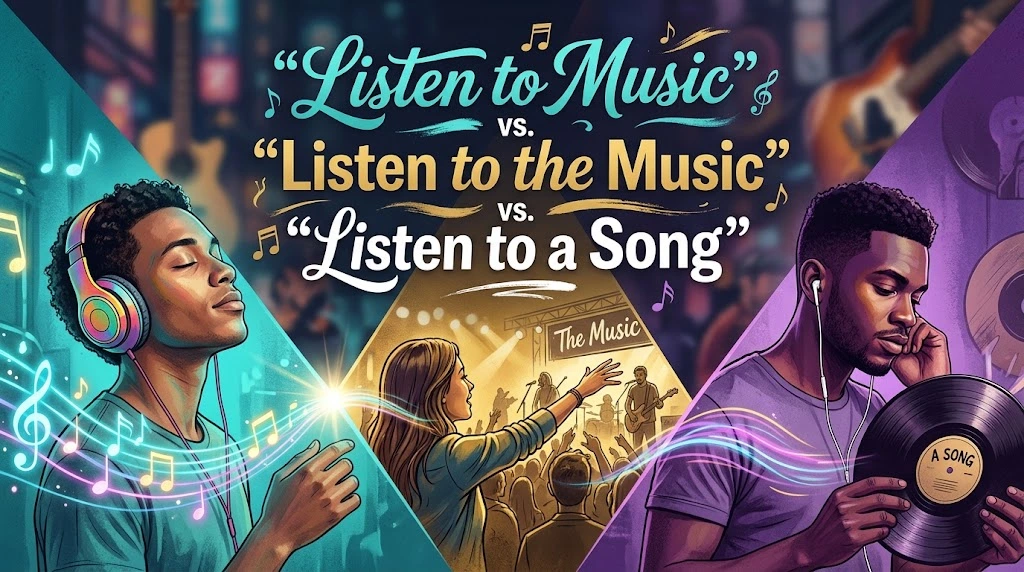
These three expressions are worth separating.
Listen to Music
General activity:
I listen to music every evening.
Listen to the Music
Specific identifiable music:
Listen to the music in this video.
Listen to a Song
One individual song:
Listen to a song I recorded yesterday.
Here’s the distinction in a compact form:
| Phrase | Reference |
| listen to music | Music generally |
| listen to the music | Identifiable music |
| listen to a song | One song |
| listen to the song | A particular known song |
| listen to songs | Songs generally or multiple songs |
| listen to the songs | A specific known group of songs |
This comparison is especially helpful when you’re unsure which article or noun to choose.
A Practical Decision Guide
When you’re writing or speaking, don’t memorize dozens of isolated sentences.
Use this quick process.
Ask: Am I Talking About Music Generally?
If yes, use:
listen to music
Example:
I listen to music while I study.
Ask: Can the Listener Identify the Music?
If yes, use:
listen to the music
Example:
Listen to the music playing outside.
Ask: Do I Mean One Individual Song?
Use:
listen to a song
Example:
Listen to a song from my new playlist.
Ask: Has the Music Already Been Identified?
If yes, the often works naturally.
Example:
I sent you three tracks. Did you listen to the music?
The earlier context establishes what music the speaker means.
Read More : Anyone Has or Anyone Have? The Complete Grammar Guide
A Simple Memory Trick for “Listen to Music” vs. “Listen to the Music”
Think of the as a spotlight.
Without the spotlight:
music
The subject remains broad.
With the spotlight:
the music
Your attention moves toward identifiable music.
Another useful test is to ask whether you could naturally replace the music with that music.
For example:
Listen to the music coming from upstairs.
You could imagine saying:
Listen to that music coming from upstairs.
That tells you the reference is specific.
However, don’t treat this as an absolute replacement rule. That and the have different grammatical functions. The test simply helps you recognize specificity.
Quick Grammar Cheat Sheet
| If you mean… | Use… | Example |
| Music generally | listen to music | I listen to music daily. |
| A specific musical selection | listen to the music | Listen to the music in this scene. |
| One song | listen to a song | Listen to a song I wrote. |
| A known song | listen to the song | Listen to the song again. |
| Several unspecified songs | listen to songs | We listened to songs all night. |
| Several known songs | listen to the songs | Listen to the songs on this album. |
Common Sentence Corrections
Incorrect: “I Listen Music Every Day”
Correct:
I listen to music every day.
Why? The verb listen normally takes to before the thing being heard.
Incorrect: “She Listens to a Music”
Correct:
She listens to music.
Or, if you mean one particular musical work:
She listens to a song.
Incorrect: “Listen the Music”
Correct:
Listen to the music.
The preposition remains necessary.
Awkward for a General Habit: “I Listen to the Music Every Day”
This isn’t automatically ungrammatical. However, it suggests particular music.
If you simply mean the general activity, say:
I listen to music every day.
If you’re referring to a specific playlist, soundtrack, or collection, the original sentence can work:
I listen to the music from that album every day.
The surrounding context makes the reference clear.
Why Native Speakers Choose Between Them Naturally
Native speakers generally don’t stop to calculate the grammar rule every time they use an article.
They respond to the meaning they want to communicate.
If the topic is a hobby:
I listen to music.
If someone wants you to pay attention to a song currently playing:
Listen to the music.
If you’re discussing one song:
Listen to this song.
The choice happens because the speaker knows what they want the listener to identify.
For English learners, the trick is to stop thinking of the as an optional decoration.
It isn’t.
It carries information.
A Final Comparison: General vs. Specific
Imagine walking into a room where nobody is playing anything.
You say:
I like listening to music.
You’re talking about music generally.
Now imagine someone starts playing a beautiful recording.
You say:
Listen to the music.
You’re directing attention toward that identifiable sound.
Later, someone asks which recording you heard.
You answer:
I listened to a song by an artist I like.
Now you’ve narrowed the reference to one countable item.
The progression looks like this:
music → the music → a song
The noun stays related to music, but the reference becomes increasingly specific.
Frequently Asked Questions About Listen to Music vs. Listen to the Music
What Is the Difference Between “Listen to Music” and “Listen to the Music”?
“Listen to music” normally refers to music generally. “Listen to the music” usually refers to particular music that the listener can identify from the context.
For example:
I listen to music while working.
This describes a general habit.
Listen to the music in this video.
This identifies particular music.
Is “Listen Music” Grammatically Correct?
No. In standard English, when listen identifies what someone is paying attention to, it normally takes the preposition to.
Use:
listen to music
not:
❌ listen music
Is “Listen to the Music” Grammatically Correct?
Yes.
The phrase is completely grammatical when the music refers to identifiable music.
For example:
Listen to the music coming from the garden.
Is “Listen to Music” Grammatically Correct?
Yes.
It’s the natural choice when you’re talking about music generally.
I listen to music when I exercise.
Can I Say “Listen to a Music”?
Usually, no.
Music is normally uncountable when referring to the art form or musical sound generally. If you mean one individual work, use a song, a track, or a piece of music.
Does “The” Always Mean One Song?
No.
The music can refer to multiple songs or an entire body of music within a defined context.
For example:
I love the music in this movie.
That could include many separate musical pieces.
Is “Listen to the Music” More Formal?
No.
The article the doesn’t make the expression formal. It normally indicates that the music is definite or identifiable.
Which Phrase Should I Use for a Daily Habit?
Use listen to music when you’re describing a general habit.
I listen to music every morning.
If you’re talking about one specific playlist or collection, the music may be appropriate.
Can “Listen to the Music” Refer to Music in a Movie?
Yes.
For example:
Listen to the music during this scene.
Here, the movie or scene provides the context needed to identify the music.
Why Do We Say “Listen to Music” Instead of “Listen Music”?
Because listen normally takes to before its complement when you identify what you’re listening to.
The standard pattern is:
listen + to + noun
For example:
- listen to music
- listen to a podcast
- listen to the radio
- listen to a song
- listen to your teacher
Should I Say “Listen to Songs” or “Listen to Music”?
Both can be correct.
Listen to music is broader because music refers to music generally.
Listen to songs emphasizes individual songs, usually without identifying exactly which songs.
Compare:
I listen to music while driving.
I listen to songs from the 1990s while driving.
The second sentence narrows the reference to songs from a particular category or period.
Conclusion: Listen to Music vs. Listen to the Music
The difference between “listen to music” and “listen to the music” comes down to one central idea: specificity.
Use listen to music when you’re talking about music generally. It works naturally for habits, hobbies, preferences, routines, and broad statements.
Use listen to the music when you mean particular music that the listener can identify from the situation, previous conversation, or additional information.
Remember these three patterns:
Listen to music → music generally.
Listen to the music → identifiable music.
Listen to a song → one individual song.
Also remember the preposition. Standard English uses listen to, not listen directly before the thing being heard.
Once you focus on meaning rather than simply memorizing an article rule, the choice becomes much easier. When the subject is broad, leave the out. When the context points to identifiable music, bring the in.
That’s the whole distinction — small on the page, but surprisingly useful in everyday English.