
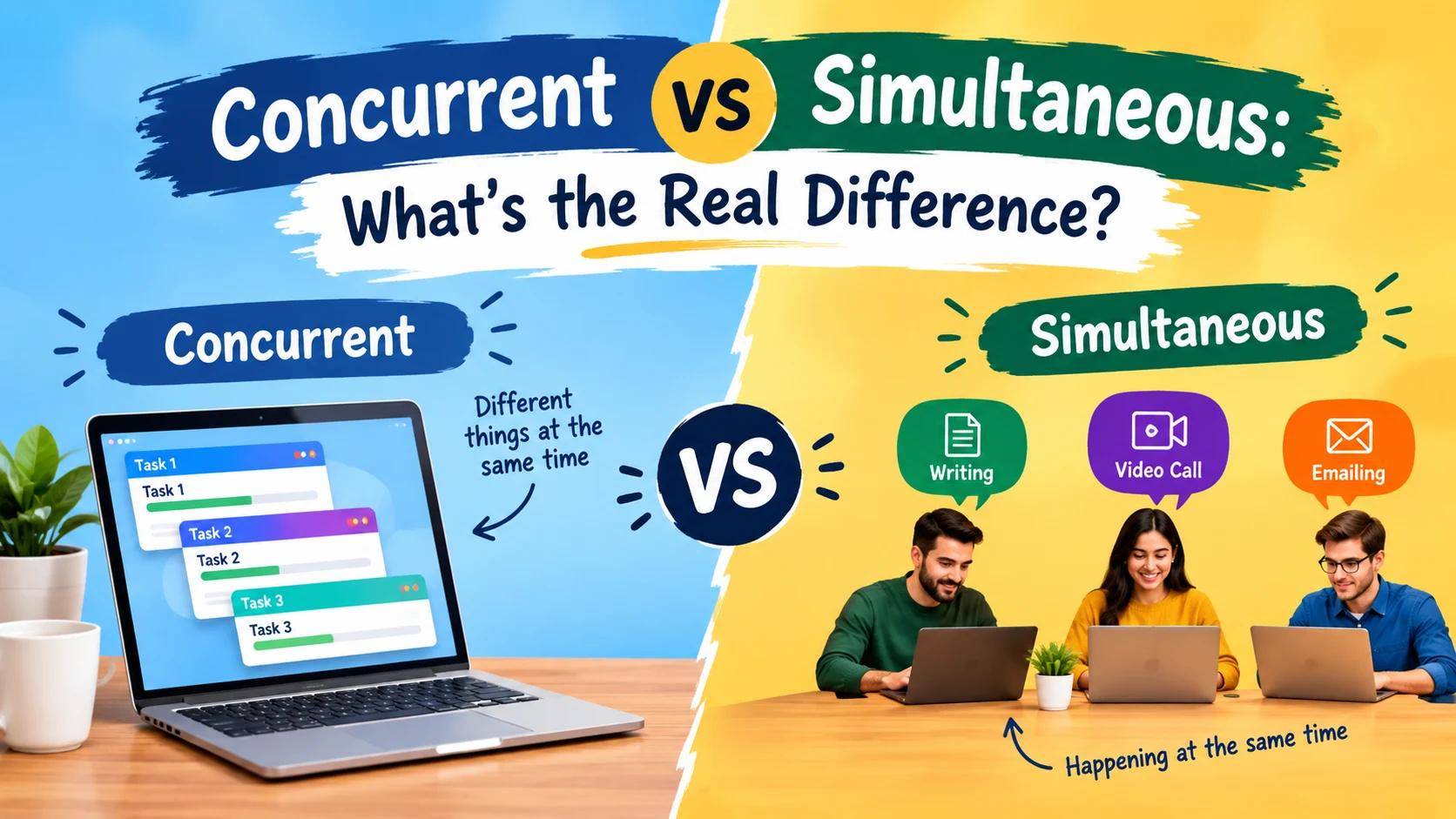
Concurrent vs. simultaneous can be confusing because both words describe events or actions that happen at the same time. In everyday English, they are often interchangeable, but they can carry slightly different shades of meaning depending on the context. Understanding this distinction can help you choose the right word in formal writing, professional communication, academic work, and everyday conversation.
The adjective concurrent commonly describes two or more events, activities, conditions, or processes that overlap in time. For example, “The company is running concurrent projects” means the projects are taking place during the same general period. Simultaneous, on the other hand, usually emphasizes that things happen at exactly the same time or occur together at one specific moment.
These related words frequently appear in discussions about timing, overlapping events, parallel activities, and multiple actions. However, choosing between them depends on whether you want to emphasize a shared time period or an exact moment of occurrence.
In this guide, you’ll learn the meaning of concurrent, the meaning of simultaneous, their differences, common examples, and practical rules that make the choice much easier.
Concurrent vs Simultaneous: The Core Difference
The easiest way to understand concurrent vs simultaneous is to think about the shape of time involved.
Concurrency can cover a period. Simultaneity tends to highlight a point or matching moment.
Suppose Maria starts cooking dinner at 6:00 PM. She puts pasta on the stove at 6:10 PM while the sauce continues cooking. At 6:20 PM she prepares a salad while both the pasta and sauce remain active parts of dinner preparation.
Several activities overlap.
You could describe these activities as concurrent.
Now picture three lights turning on at exactly 7:00 PM. Their shared timing matters more than their duration. You could call their activation simultaneous.
The simplest distinction
| Word | Main idea | Timing emphasis |
| Concurrent | Events overlap or occur during the same period | Broad overlap |
| Simultaneous | Events occur at the same time | Stronger emphasis on matching timing |
There is an important nuance here. Dictionaries don’t treat the words as completely unrelated. Cambridge lists simultaneous as a synonym of concurrent in its dictionary entry for concurrent.
That doesn’t make every sentence equally natural with either word.
Context still matters.
Why the two words are easy to confuse
Both words answer a similar question:
“When did these things happen?”
The difference lies in how precisely you care about the timing.
If two projects run during the same month, they can be concurrent even if one starts several days after the other.
If two alarms sound at the same instant, they are simultaneous.
Think of concurrency as two roads that overlap for a while. Simultaneity is more like two runners reaching the same starting signal together.
The key question to ask
When you’re unsure which word to use, ask:
Do these events overlap in time or do they occur at the same moment?
If the answer is overlap, concurrent will often fit.
If the answer is same moment, simultaneous will usually communicate the idea more precisely.
What Does “Concurrent” Mean?
Concurrent is an adjective that describes things happening or existing at the same time. In practical usage, the word often highlights activities that coexist during a shared period. Cambridge also uses concurrent in contexts involving multiple issues being handled at the same time and multiple users being active in an information system.
The important idea is temporal overlap.
Key characteristics of concurrency
Concurrent activities can have:
- Different starting times
- Different ending times
- Different durations
- Different purposes
- Different participants
- A shared period of activity
They don’t need to begin at the exact same second.
Consider this timeline:
9:00 AM 9:15 AM 10:00 AM
Task A ──────────────────────────
Task B ───────────────────
↑
Time overlap
Task A begins first.
Task B starts later.
Once Task B begins, both tasks are active. From that point forward, they are concurrent.
A simple definition of concurrent
Concurrent means happening or existing during the same period, with some overlap in time.
The word appears naturally in many fields.
You might see:
- concurrent projects
- concurrent sessions
- concurrent users
- concurrent processes
- concurrent investigations
- concurrent conditions
- concurrent events
In business English, for example, concurrent can describe conditions that must occur together. In information technology, it can describe a system supporting many active users.
Concurrent does not always mean “at the exact same instant”
This is one of the most important points.
Suppose a company runs two projects:
- Project A: January 1–March 31
- Project B: February 1–April 30
The projects are concurrent during February and March.
They aren’t identical in duration. They don’t start together. They don’t finish together.
Their schedules simply overlap.
That is concurrency.
What Does “Simultaneous” Mean?
Simultaneous describes things that happen or are done at the same time. In its American English definition, Cambridge specifically describes it as happening or existing at exactly the same time.
The word therefore puts greater weight on timing precision.
Key characteristics of simultaneity
Simultaneous events generally:
- Occur at the same moment
- Share a particular point in time
- May result from one common signal or trigger
- Can involve different actions
- Can have different durations after they begin
For example, imagine a theater production where several stage lights turn on when a director gives one cue.
The lights may illuminate different areas. Their functions may differ. Yet their activation can be simultaneous.
A simple definition of simultaneous
Simultaneous means happening or being done at the same time, with particular emphasis on matching timing.
The word commonly appears in phrases such as:
- simultaneous events
- simultaneous reactions
- simultaneous explosions
- simultaneous translation
- simultaneous movements
- simultaneous attacks
- simultaneous changes
Cambridge provides examples involving simultaneous explosions, simultaneous cheers, and simultaneous translation.
Simultaneous does not mean identical
This misconception causes unnecessary confusion.
Two events can be simultaneous without being the same kind of event.
For example:
- One person laughs.
- Another person claps.
- Both happen at the same moment.
The actions are different. Their timing is shared.
Therefore, they can be simultaneous actions.
Concurrent vs Simultaneous at a Glance
The difference becomes clearer when you compare the words directly.
| Feature | Concurrent | Simultaneous |
| Basic meaning | Happening during an overlapping period | Happening at the same time |
| Main emphasis | Overlap | Matching timing |
| Exact same instant required? | Not necessarily | Usually emphasized |
| Can events start at different times? | Yes | Generally not when exact simultaneity is intended |
| Can durations differ? | Yes | Yes |
| Common everyday use | Activities, schedules, projects | Reactions, signals, events |
| Common technical use | Users, processes, tasks | Synchronized operations |
| Related idea | Coexistence | Coincidence in time |
One subtle point deserves attention: concurrent and simultaneous can describe the same event from different angles.
If two alarms activate at precisely 8:00 AM then they are simultaneous. They are also concurrent in the broad sense that they occur during the same time period.
The more useful question is therefore not “Which word is always correct?”
Instead ask:
“What aspect of timing does this sentence need to emphasize?”
Can Concurrent and Simultaneous Mean the Same Thing?
Yes. In some sentences, the two words can communicate nearly the same basic idea.
For example:
The two events occurred concurrently.
and
The two events occurred simultaneously.
Both tell the reader that the events happened at the same time.
The second sentence sounds more focused on exact temporal coincidence.
The first can feel slightly broader depending on context.
Where their meanings overlap
You can often find both words in discussions involving:
- Events
- Meetings
- Activities
- Processes
- Operations
- Reactions
- Conditions
That’s why dictionary definitions can list one as a synonym of the other.
Where the distinction becomes important
Precision matters more when you’re discussing:
- Software systems
- Performance testing
- Scheduling
- Scientific experiments
- Synchronized actions
- Legal conditions
- Timelines
- Data processing
In those contexts, a small difference in timing can change the meaning.
Why context determines the better word
Concurrent often answers:
“Were these things active during the same period?”
Simultaneous often answers:
“Did these things happen at the same moment?”
That distinction is simple. It is also surprisingly powerful.
Real-World Examples of Concurrent Actions
Concurrency appears everywhere because many human activities naturally overlap.
A student studying while listening to music
A student starts studying at 4:00 PM. Music begins at 4:05 PM and continues until 5:00 PM.
The two activities overlap.
They are concurrent activities.
The student didn’t need to start the music at exactly 4:00 PM. The important fact is that studying and listening occur during an overlapping period.
Employees working on different projects
Imagine a marketing employee writing a campaign brief while a designer prepares graphics for that campaign.
The two tasks may begin at different times.
They may also finish at different times.
Still, their work can be concurrent because the activities overlap within the broader project schedule.
Cars traveling on the same road
Picture a busy highway at 8:00 AM.
Hundreds of vehicles may be moving along the road during the same period. Their speeds differ. Their positions differ. Some enter the highway later while others leave earlier.
Their journeys can occur concurrently.
They aren’t necessarily simultaneous.
Multiple meetings with overlapping schedules
Suppose:
- Meeting A runs from 10:00 to 11:00.
- Meeting B runs from 10:30 to 11:30.
The meetings are concurrent from 10:30 to 11:00.
This is a particularly useful example because it shows that concurrent does not require identical schedules.
Why these qualify as concurrent
The common factor is overlap.
The events don’t need to start together. They don’t need to end together. They don’t need to perform the same function.
They simply occupy some of the same time.
Real-Life Examples of Simultaneous Actions
Simultaneity is easier to recognize when a shared instant matters.
Two runners starting when the signal sounds
Imagine a race official fires the starting signal.
Two runners push forward at the same starting cue.
Their movements can be described as simultaneous if they begin at the same moment.
The important detail isn’t that they both run. It’s that their starts coincide.
A choir singing a note together
A choir may produce the same note at the same time.
The singers occupy different positions. Their voices aren’t physically identical. Yet the performance can be simultaneous.
The timing creates the connection.
Multiple fireworks exploding at once
Several fireworks can be programmed to explode at a shared moment.
Their colors may differ. Their shapes may differ. Their locations may differ.
Their explosions are simultaneous because they occur together in time.
Several alarms sounding together
Imagine a building’s emergency system triggering several alarms at once.
One alarm may sound in a hallway. Another may sound in an office. Another may activate outdoors.
Different locations don’t prevent simultaneity.
The shared trigger creates the same moment of activation.
Why these examples are simultaneous
In each case, the timing itself is the defining feature.
That’s the crucial distinction.
Concurrent vs Simultaneous in Grammar and Everyday Writing
The words are both adjectives. Their grammatical behavior is straightforward. The challenge usually lies in choosing the meaning that matches the situation.
How “concurrent” works in a sentence
Common constructions include:
- concurrent projects
- concurrent sessions
- concurrent operations
- concurrent processes
- concurrent events
- concurrent activities
Examples:
The company is managing several concurrent projects.
The server supports thousands of concurrent users.
Two investigations proceeded concurrently.
The adverb concurrently means that actions happen during the same time period. Cambridge gives examples of issues being handled concurrently and activities running concurrently.
How “simultaneous” works in a sentence
Common combinations include:
- simultaneous events
- simultaneous reactions
- simultaneous movements
- simultaneous changes
- simultaneous translation
Examples:
The system detected simultaneous failures in two components.
The audience erupted in simultaneous cheers.
The translator provided simultaneous interpretation.
A common writing mistake
Don’t automatically choose simultaneous whenever several things happen during the same period.
Consider:
The company ran three simultaneous projects.
This sentence can work if the writer means the projects operated at the same time. Yet concurrent projects often communicates the broader idea of overlapping project work more naturally.
Now compare:
The three alarms sounded simultaneously.
Here the emphasis falls directly on the shared moment.
Concurrent vs Simultaneous in Technology
Technology makes this distinction especially interesting.
A computer system can handle multiple tasks during overlapping periods without literally executing every instruction at the exact same instant.
That’s where concurrency becomes an important technical concept.
What concurrency means in computing
In computing, concurrency generally concerns multiple tasks making progress within overlapping periods.
For example, an application might:
- Receive a network request.
- Wait for data from a database.
- Handle another request.
- Update a user interface.
- Process a background task.
These activities can be concurrent even when a single processor doesn’t execute every instruction at exactly the same instant.
The system organizes work so multiple tasks can make progress.
Concurrency vs parallelism
These concepts often get mixed together.
Concurrency is about dealing with multiple tasks during overlapping periods.
Parallelism is about performing multiple computations at the same time using multiple execution resources.
A simple analogy helps.
Imagine one chef preparing several dishes. The chef may switch between tasks:
- Chop vegetables.
- Start cooking.
- Stir a sauce.
- Return to the vegetables.
The tasks are managed concurrently.
Now imagine three chefs working on three dishes at once.
That introduces literal parallel activity.
Concurrency and parallelism can occur together. They aren’t identical concepts.
Examples of concurrent operations
A web application may handle:
- Multiple user sessions
- Database requests
- Background jobs
- File uploads
- API calls
- Message processing
These activities can overlap.
A system’s ability to manage concurrent work doesn’t automatically mean every operation occurs simultaneously.
What simultaneous means in technology
In technology, simultaneous is useful when several events genuinely share a timing point.
For example, suppose thousands of devices send a request at nearly the same scheduled instant.
A system might experience a simultaneous request burst.
The word highlights the concentration of events around one moment.
Why technical writing needs precision
Technical language often depends on timing details.
Consider these two statements:
The server handled 10,000 concurrent users.
This describes users who were active during an overlapping period.
Now consider:
10,000 users sent requests simultaneously.
This describes a concentrated event where timing is much tighter.
Those scenarios can produce very different workloads.
Concurrent Users vs Simultaneous Users
The distinction becomes particularly useful in performance discussions.
What “concurrent users” means
A concurrent user is generally a user who is active within the same period as other users.
Imagine an online store with 10,000 active sessions during a 10-minute period.
Those users are concurrent.
They don’t need to click the same button at the same second.
Cambridge’s Business English definition specifically uses IT examples involving systems that can support thousands of concurrent users.
What “simultaneous users” can imply
Simultaneous users emphasizes users performing an action at the same time.
Suppose 10,000 users press “Sign Up” within the same second.
That’s a much more synchronized event.
The number of users is identical in both scenarios. The timing is different.
Why the distinction matters in performance testing
Consider two load patterns.
| Scenario | Timing | What it represents |
| 10,000 users active over 10 minutes | Spread across a period | Concurrent activity |
| 10,000 requests arriving at one instant | Highly concentrated | Simultaneous activity |
| 10,000 users active for different durations | Overlapping sessions | Concurrency |
| 10,000 users clicking at one scheduled moment | Shared event | Simultaneity |
A system may tolerate a large number of concurrent sessions while struggling with a sharply synchronized request spike.
That difference can affect CPU usage, database connections, network traffic, queues, and response times.
Concurrent vs Simultaneous: A Practical Decision Guide
Choosing between these words doesn’t have to feel like a grammar puzzle.
Use “concurrent” when…
Choose concurrent when:
- Activities overlap.
- Projects operate during the same period.
- Users remain active during an overlapping window.
- Processes make progress during overlapping periods.
- Exact synchronization isn’t the main point.
- Different events have different start or end times.
Examples:
We are managing three concurrent projects.
The application supports thousands of concurrent users.
Several investigations were conducted concurrently.
Use “simultaneous” when…
Choose simultaneous when:
- Events happen at the same moment.
- Synchronization matters.
- Several actions share a common trigger.
- You want to emphasize exact timing.
- A synchronized burst or reaction matters.
Examples:
The alarms produced simultaneous signals.
The players made simultaneous moves.
The devices performed simultaneous measurements.
Use both when the context requires both ideas
Sometimes an event can be concurrent and simultaneous at different levels.
Imagine 1,000 customers use an online store throughout an hour.
Their sessions are concurrent.
During that hour, 500 customers may click a promotion at exactly noon.
Those clicks can be simultaneous.
One situation can therefore contain both concepts.
Case Study: Ten Thousand Users and One Sign-Up Button
Here’s a practical example that makes concurrent vs simultaneous much easier to remember.
Scenario: Users arrive over ten minutes
Imagine an application receives 10,000 users between 9:00 AM and 9:10 AM.
Some arrive at 9:00.
Others arrive at 9:03.
More arrive at 9:07.
Some users leave quickly. Others remain active until 9:10.
The sessions overlap.
This is primarily a concurrent-user scenario.
The users are active within a shared period. They don’t perform every action at exactly the same moment.
Scenario: Everyone clicks at 9:00:00 AM
Now change the scenario.
All 10,000 users click the “Sign Up” button at precisely 9:00:00 AM.
The workload is much more synchronized.
The action is simultaneous in the intended sense.
The system now faces a concentrated event rather than merely a broad period of overlapping activity.
What engineers learn from this
The example demonstrates why timing matters.
Concurrency asks how much activity overlaps.
Simultaneity asks how tightly that activity aligns in time.
That’s why the two words can describe related situations without being perfect substitutes.
Read More : Next Friday vs. This Friday: The Clear Guide to Understanding the Difference
Common Mistakes With Concurrent and Simultaneous
Even experienced writers can blur these terms because their dictionary meanings overlap.
Mistake: Treating the words as perfect synonyms
The words can be synonymous in some contexts. They don’t carry identical emphasis in every technical or practical context.
When timing precision matters, choosing the more specific word improves clarity.
Mistake: Assuming concurrent means exactly at once
That’s too narrow.
Concurrent activities can have different start times.
For example:
The two projects ran concurrently for three months.
That doesn’t necessarily mean both projects started at 9:00 AM on the same day.
It means their schedules overlapped.
Mistake: Assuming simultaneous means identical activities
Also incorrect.
Two different actions can happen simultaneously.
One person can clap while another person speaks.
If both actions occur at the same moment, their timing is simultaneous even though their activities differ.
Mistake: Confusing concurrency with parallelism
In computing, these terms have specific technical meanings.
Concurrent tasks can be managed during overlapping periods. Parallel tasks can execute at the same time using separate execution resources.
The concepts can overlap. They shouldn’t be treated as automatic synonyms.
Mistake: Using “simultaneous” for any overlapping schedule
If two meetings overlap for 30 minutes but start at different times, concurrent meetings is often the clearer expression.
If two meetings begin at precisely 2:00 PM, simultaneous meetings emphasizes their shared start time.
Concurrent vs Simultaneous: Related Words
Several other words sit near these terms. Each one has its own shade of meaning.
Words related to concurrent
Overlapping focuses directly on shared time.
Concurrent focuses on things existing or happening during the same period.
Parallel can describe activities progressing alongside each other. In technical contexts, it has a more specific meaning.
Contemporaneous means existing or occurring during the same period. It often appears in formal or historical writing.
Coincident can describe events that occur together in time or happen to align.
These words aren’t interchangeable in every sentence.
Words related to simultaneous
At the same time is the simplest everyday expression.
Together can describe shared action without necessarily emphasizing exact timing.
Synchronized suggests coordination or alignment according to a timing relationship.
At once can mean immediately or simultaneously depending on context.
Simultaneously is the adverbial form of simultaneous.
Choosing among them depends on what you actually want the reader to understand.
Historical and Etymological Background
The origins of these words help explain their modern meanings.
Concurrent comes from Latin roots associated with things running or coming together. The modern word developed around the idea of things occurring together or existing alongside each other.
Simultaneous ultimately comes from Latin simul, meaning “at the same time” or “together.”
That historical connection explains why the words sit so close together semantically.
Yet modern usage gives them different practical emphasis.
Concurrent naturally works well for overlapping processes and periods.
Simultaneous strongly highlights temporal coincidence.
The distinction isn’t a rigid mathematical law. It’s a useful semantic guide.
Concurrent vs Simultaneous: Quick Examples
Here are some fast examples to make the difference stick.
| Situation | Better word | Why |
| Two projects overlap for three months | Concurrent | Their schedules overlap |
| Two alarms activate at exactly 8:00 | Simultaneous | Their activation shares a moment |
| Several users remain active during an hour | Concurrent | Their sessions overlap |
| Several users click a button at once | Simultaneous | Their actions align closely in time |
| Two meetings run from 2:00–3:00 and 2:30–3:30 | Concurrent | They overlap for 30 minutes |
| Two signals trigger at exactly the same time | Simultaneous | They share the same instant |
| Several background tasks remain active together | Concurrent | Their execution periods overlap |
| Multiple devices take measurements at the same instant | Simultaneous | Timing is synchronized |
This table captures the central idea without turning the distinction into a rigid rule.
Frequently Asked Questions About Concurrent vs Simultaneous
What is the difference between concurrent and simultaneous?
Concurrent generally emphasizes activities or events that happen during an overlapping period. Simultaneous emphasizes events happening at the same time or exact moment.
The words overlap in meaning. Cambridge lists each as a synonym for the other in relevant dictionary entries.
Can concurrent events happen at different times?
Yes.
Two concurrent events can begin at different times as long as their periods overlap.
For example, one meeting can start at 1:00 PM while another starts at 1:30 PM. If both remain active between 1:30 and 2:00 PM, they are concurrent during that period.
Does concurrent mean exactly at the same time?
Not necessarily.
In everyday English, concurrent can mean happening at the same time. In practical contexts, however, it often describes overlapping activity rather than perfectly synchronized activity.
That distinction becomes especially useful in computing and scheduling.
Does simultaneous mean exactly at the same instant?
Usually, yes when the context calls for precision.
Simultaneous strongly emphasizes events occurring at the same time. Cambridge’s American English definition uses “exactly the same time” as the central idea.
Can something be both concurrent and simultaneous?
Yes.
If two events happen at exactly the same moment, they are also occurring within the same period.
For example, two alarms that activate at 10:00:00 can be described as simultaneous. They also occur concurrently in the broad dictionary sense.
What is an example of concurrent activity?
Two employees working on different projects during overlapping work hours provide a clear example.
They don’t need to perform their tasks at the same second.
Their work simply overlaps.
What is an example of a simultaneous event?
Several fireworks exploding at exactly the same moment provide a clear example.
The explosions may occur in different locations. Their shared timing makes them simultaneous.
Are concurrent and simultaneous synonyms?
They can function as synonyms in some contexts. Their emphasis can differ.
Concurrent often works well when the focus is on overlapping activity or periods.
Simultaneous works especially well when the focus is on the same moment.
What is the difference between concurrent and parallel in computing?
Concurrency concerns multiple tasks being managed or making progress during overlapping periods.
Parallelism involves multiple computations actually executing at the same time using separate execution resources.
A system can support concurrency without executing every task literally simultaneously.
What does concurrent users mean?
Concurrent users are users active within an overlapping period.
For example, 5,000 people may have active sessions on a website during the same 10-minute window. They don’t need to click the same button simultaneously.
What does simultaneous users mean?
The phrase simultaneous users emphasizes users performing an action at the same time.
For example, thousands of people might submit requests at one scheduled moment.
In performance discussions, that timing distinction can matter greatly.
Conclusion: Concurrent vs Simultaneous
The difference between concurrent vs simultaneous becomes straightforward once you stop treating time as a single point.
Concurrent is about overlap.
Simultaneous is about shared timing.
Two projects can run concurrently even when they start on different days. Two alarms can sound simultaneously when they activate at exactly the same moment. Multiple users can be concurrent throughout a busy period while their individual actions occur at different times.
The easiest memory trick is this:
Concurrent activities share a stretch of time. Simultaneous events share a moment.
When writing an ordinary sentence, either word may sometimes work because English allows their meanings to overlap. When precision matters, though, look at the timing.
If you mean “these things were happening during the same period,” choose concurrent.
If you mean “these things happened at the same moment,” choose simultaneous.
That small distinction can make your writing much clearer, especially when you’re describing schedules, software systems, user activity, experiments, or synchronized events.