
Have you ever agreed to meet someone “this Friday,” only to discover that you both meant different dates? The confusion surrounding Next Friday vs. This Friday is surprisingly common. These phrases look simple, but their meaning can shift depending on the current day, conversation context, and even the speaker’s regional language habits.
Generally, “this Friday” refers to the Friday within the current week. For example, if today is Tuesday, “this Friday” usually means the Friday coming up in a few days. “Next Friday,” however, often means the Friday of the following week. Yet casual conversations don’t always follow that neat calendar rule.
That’s where the trouble begins. A phrase such as “Let’s meet next Friday” can create uncertainty, especially when people communicate across different English-speaking regions, workplaces, or time zones. What sounds perfectly clear to one person may leave another reaching for a calendar.
Understanding relative time expressions, calendar dates, and weekly scheduling language can help you avoid these mix-ups. In this guide, you’ll learn the practical difference between this Friday and next Friday, see real-world examples, and discover simple ways to make your meaning crystal clear.
Why “Next Friday” and “This Friday” Cause So Much Confusion
At first glance, the difference seems obvious.
If today is Tuesday, for example, you might think:
- This Friday = the Friday coming up in the current week.
- Next Friday = the Friday after that.
That distinction is common and perfectly natural. The trouble begins because English speakers don’t always use “next Friday” according to one universal rule.
Some speakers use next Friday to mean the Friday of the following week. Others use it to mean the next occurrence of Friday. Language discussions among English speakers regularly identify this ambiguity.
Think of it like two people looking at the same road sign from slightly different angles. The words haven’t changed. Their mental reference point has.
The phrase “this Friday” tends to anchor the day to the current week. By contrast, “next Friday” requires the listener to decide what next is being measured from.
That difference becomes especially noticeable:
- on Friday itself
- during Saturday and Sunday
- when people from different English-speaking backgrounds communicate
- in workplace scheduling
- when deadlines are involved
- when someone uses “next” to mean simply “the next occurrence”
The ambiguity isn’t necessarily a grammar error. It’s a problem of interpretation.
The Core Difference Between “This Friday” and “Next Friday”
The most practical distinction looks like this:
| Expression | Common interpretation | Example if today is Tuesday |
| This Friday | Friday in the current week | The upcoming Friday |
| Next Friday | Often Friday in the following week | The Friday after the upcoming one |
| This coming Friday | The upcoming Friday | The nearest Friday |
| Friday next week | Friday belonging to next week | The following week’s Friday |
| Friday, September 25 | Exact calendar date | Completely specific |
The word “usually” matters here.
It would be misleading to say that every English speaker must interpret next Friday in exactly the same way. Real usage is more flexible. In some contexts, next Friday means the Friday immediately ahead. In others, it clearly means the Friday after the upcoming one.
That’s why context matters so much.
A Simple Example
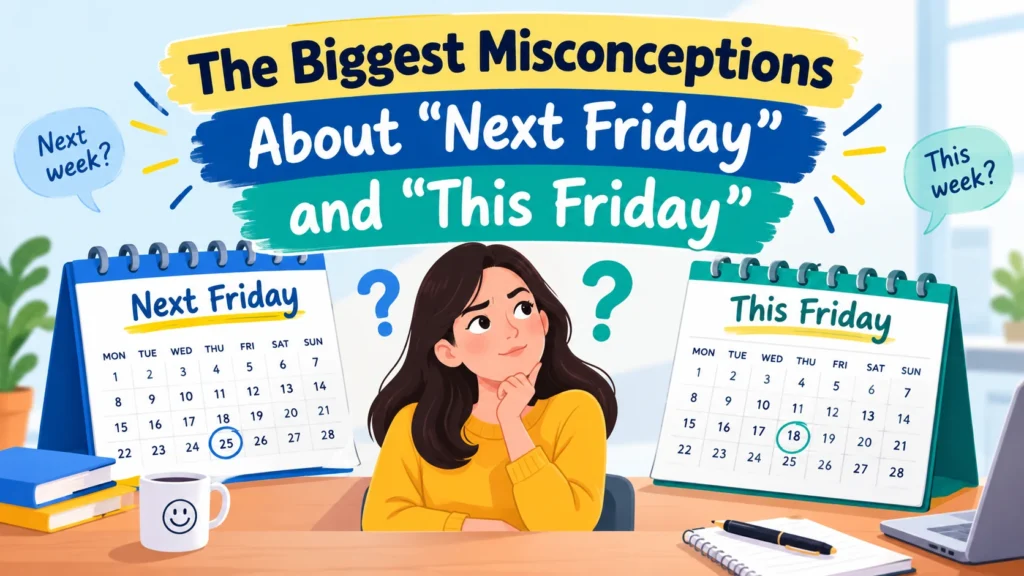
Suppose today is Tuesday, September 15.
The upcoming Friday is September 18. The Friday in the following week is September 25.
Someone might say:
“Let’s meet this Friday.”
Most listeners will understand September 18.
If the same person says:
“Let’s meet next Friday.”
Many listeners will understand September 25.
But another speaker could use “next Friday” for September 18 because that is the next Friday on the calendar.
There’s the rub.
How the Structure of the Week Shapes Meaning
Relative date expressions become easier to understand when you consider where you are in the week.
From Monday through Thursday, “this Friday” is generally straightforward because the upcoming Friday belongs to the week currently underway.
Friday itself creates more room for interpretation. The weekend creates even more.
Here’s a practical overview:
| Day of conversation | “This Friday” | “Next Friday” |
| Monday | Usually upcoming Friday | Often following Friday |
| Tuesday | Usually upcoming Friday | Often following Friday |
| Wednesday | Usually upcoming Friday | Often following Friday |
| Thursday | Usually upcoming Friday | Often following Friday |
| Friday | Often today | Usually following Friday, but context matters |
| Saturday | Potentially ambiguous | Potentially ambiguous |
| Sunday | Potentially ambiguous | Potentially ambiguous |
This isn’t a rigid grammar chart. It’s a usage guide.
The farther you move toward the weekend, the more important context becomes. English speakers can mentally organize the week in slightly different ways, particularly when discussing a Friday that has just passed versus one that is approaching.
What “This Friday” Actually Means
In common usage, “this Friday” usually identifies the Friday connected to the current week.
If today is Monday, Tuesday, Wednesday, or Thursday, the meaning is normally easy to understand.
For example:
- “The report is due this Friday.”
- “Are you free this Friday?”
- “We have a team meeting this Friday.”
- “The students have a test this Friday.”
- “I’m flying home this Friday.”
In each sentence, this Friday normally points toward the Friday that is approaching within the current week.
Using “This Friday” Earlier in the Week
Monday through Thursday are usually the easiest days for using “this Friday.”
Imagine today is Wednesday.
You say:
“I’m meeting Sarah this Friday.”
The listener will normally understand that you mean the Friday two days away.
There’s little reason to search for another Friday because the phrase “this” connects Friday to the week currently in progress.
This is also why “this Friday” often sounds more immediate than “next Friday.”
Compare:
“The presentation is this Friday.”
with:
“The presentation is next Friday.”
The first sentence normally feels closer. The second creates more distance.
That difference can matter when people are organizing work, travel, school assignments, or social plans.
Using “This Friday” on Friday Itself
Friday is where things become more interesting.
Suppose today is Friday morning and someone says:
“Let’s meet this Friday.”
What does that mean?
Most listeners will probably consider today a natural interpretation, especially if the meeting could still happen later that day.
For example:
“Are you available this Friday at 4 p.m.?”
If the speaker says this on Friday morning, the meaning is likely clear: today at 4 p.m.
But context can change the interpretation.
Consider:
“We’ll discuss the project this Friday.”
If the conversation happens late Friday evening, the listener may wonder whether the speaker means the Friday that has just ended or the Friday coming next week.
That’s where relative time expressions start to wobble.
When the stakes are high, an exact date works much better.
Instead of:
“Let’s discuss it this Friday.”
write:
“Let’s discuss it Friday, September 18.”
There’s nothing mysterious about the second sentence. Everyone gets the same date.
What “Next Friday” Really Means
The phrase “next Friday” has two common interpretive patterns, which explains much of the confusion.
The first treats next as the Friday belonging to the following week.
The second treats next as the next occurrence of Friday.
Both interpretations have an understandable logic.
The Calendar-Based Interpretation
Under one interpretation, next Friday means the Friday that comes next chronologically.
Imagine today is Monday.
Friday is four days away.
Under this interpretation:
“I’ll see you next Friday.”
means the Friday that arrives in four days.
This interpretation treats next almost like “the next occurrence.”
A similar logic appears in ordinary phrases such as:
- next bus
- next train
- next meeting
- next available appointment
If the next bus arrives in five minutes, you don’t normally skip it because another bus will arrive later.
The same mental pattern can influence “next Friday.”
The Conversational Interpretation
Another common interpretation treats “this Friday” as belonging to this week and “next Friday” as belonging to next week.
Suppose today is Tuesday.
You might think of the calendar like this:
Current week
Monday → Tuesday → Wednesday → Thursday → Friday
Following week
Monday → Tuesday → Wednesday → Thursday → Friday
Under this interpretation:
- This Friday = Friday in the current week
- Next Friday = Friday in the following week
This contrast is especially common when speakers deliberately use this and next together.
For example:
“I can’t meet this Friday, but I’m free next Friday.”
Here, the contrast strongly suggests two different Fridays.
Context does a lot of heavy lifting.
“Next Friday” vs. “This Friday” Side by Side
The easiest way to understand the distinction is to see both phrases in realistic sentences.
| Sentence | Common intended meaning |
| “The exam is this Friday.” | Upcoming Friday |
| “The exam is next Friday.” | Often the following Friday |
| “Are you free this Friday?” | Upcoming Friday |
| “Are you free next Friday instead?” | Often the Friday after the upcoming one |
| “The office closes this Friday.” | Current-week Friday |
| “The office reopens next Friday.” | Usually Friday of the following week |
| “Let’s meet Friday next week.” | Clearly the following week’s Friday |
| “Let’s meet Friday, September 25.” | Exact date |
The final two examples are especially useful when clarity matters.
The Biggest Misconceptions About “Next Friday” and “This Friday”
Assuming Everyone Uses the Same Rule
One of the biggest mistakes is assuming that every English speaker has exactly the same mental rule for next Friday.
They don’t.
Some speakers distinguish:
this Friday → upcoming Friday
next Friday → Friday after the upcoming one
Others interpret:
next Friday → next Friday that occurs
English-language discussions document both interpretations.
That means arguing that one interpretation is always the only possible meaning misses the real issue.
Believing Grammar Alone Decides Meaning
Grammar tells you that “next Friday” and “this Friday” are grammatically well-formed expressions.
Grammar doesn’t always tell you which calendar date the speaker has in mind.
These are examples of deictic expressions. Their interpretation depends on context, especially the time at which someone says them.
Consider:
“I’ll call you tomorrow.”
The word tomorrow has no fixed date.
If someone says it on September 15, it means September 16.
If someone says the same sentence on September 20, it means September 21.
This Friday and next Friday work in a similar relative way.
Ignoring Timing in the Conversation
The date and time of the conversation can change how a phrase sounds.
Compare:
“Are you free this Friday?”
asked on Tuesday.
There’s little ambiguity.
Now compare:
“Are you free this Friday?”
asked on Friday evening.
Suddenly, the listener needs more information.
That doesn’t mean the grammar changed. The reference point changed.
Real-Life Scenarios: “This Friday” in Context
Work Deadlines
Imagine a manager writes:
“Please submit the revised report this Friday.”
If the message arrives on Wednesday, employees will normally understand that the report is due in two days.
However, a professional deadline should ideally include the exact date.
A stronger version would be:
“Please submit the revised report by Friday, September 18.”
This becomes especially important when multiple teams work across countries or time zones.
Social Plans
Friends often rely on context:
“Want to grab dinner this Friday?”
In casual conversation, that’s usually enough.
If someone responds:
“Sure. What time?”
the date is probably settled.
But if the conversation happens on Sunday, a clearer phrase could be:
“Want to grab dinner this coming Friday?”
Or:
“Want to grab dinner Friday, September 18?”
The more important the arrangement, the more useful the extra precision becomes.
School or Training Schedules
Students might hear:
“Your presentation is next Friday.”
If several assignments are approaching, that phrase can create confusion.
A teacher could instead say:
“Your presentation is Friday next week, September 25.”
That wording identifies both the week and the date.
Real-Life Scenarios: “Next Friday” in Context
Project Timelines
Suppose a project manager says:
“We’ll review the final version next Friday.”
If the team has a deadline coming up this Friday, people may naturally interpret next Friday as the following week.
But a remote team with different language habits might interpret it differently.
A clearer version is:
“We’ll review the final version on Friday, September 25.”
That tiny change can prevent a much larger problem.
Appointments and Bookings
Appointments are another area where relative dates can become risky.
Consider:
“Your appointment is next Friday.”
A patient might reasonably ask:
“Do you mean September 18 or September 25?”
That isn’t being difficult. It’s being precise.
For appointments, reservations, interviews, flights, examinations, and deadlines, the calendar date should carry the burden of precision rather than a potentially ambiguous relative expression.
Conversations Late in the Week
Late-week conversations deserve extra attention.
If someone says “next Friday” on Thursday, the listener may interpret it as the following week. Another person may hear it as the Friday arriving tomorrow.
That difference can produce a one-week scheduling error.
The safest response is simple:
“Just to confirm, do you mean Friday the 18th or Friday the 25th?”
One question can save an entire chain of messages.
What Happens When the Weekend Starts?
Friday Night Usage
Friday evening creates a strange transition.
The current Friday is almost over, while another Friday is exactly one week away.
Someone saying:
“I’ll finish it this Friday.”
could mean today if the task is still possible.
But if the conversation happens after midnight, the calendar has already moved to Saturday.
The phrase can suddenly feel outdated or unclear.
Saturday and Sunday Usage
Weekend conversations can be particularly ambiguous because speakers may organize weeks differently in casual speech.
For example, on Saturday someone might say:
“Let’s meet this Friday.”
One listener could understand the upcoming Friday.
Another might wonder whether the speaker means the Friday that just passed.
If clarity matters, use:
“this coming Friday”
or:
“Friday next week”
or, better yet:
“Friday, September 25.”
Regional and Cultural Differences in Usage

It’s tempting to blame this confusion entirely on regional English differences. That would oversimplify the issue.
Different English speakers can use next Friday differently even when they share the same variety of English.
Language forums and usage discussions provide examples of American, British, Canadian, and other English speakers describing different interpretations.
The important lesson is not to memorize a regional stereotype.
Instead, recognize that relative date expressions depend heavily on conversational context.
Workplace vs. Casual Speech
Casual conversations can tolerate ambiguity because people can quickly repair misunderstandings.
For example:
“Next Friday?”
“You mean this Friday?”
“Oh, yeah. This Friday.”
Problem solved.
Workplace communication can be less forgiving.
A vague date in a team email can create:
- missed deadlines
- scheduling conflicts
- duplicated work
- unnecessary follow-ups
- incorrect calendar entries
That’s why professional writing should favor precision.
Global Teams
International teams have another layer of complexity.
Imagine employees in New York, London, Lahore, Singapore, and Sydney discussing a deadline. Even if everyone speaks excellent English, relative expressions can still create confusion.
A message such as:
“The report is due next Friday.”
is less precise than:
“The report is due Friday, September 25, at 5 p.m. Eastern Time.”
The second version leaves much less room for interpretation.
How to Avoid Confusion Completely
The easiest solution is surprisingly simple: say exactly which Friday you mean.
Use Specific Dates
Instead of:
“The meeting is next Friday.”
write:
“The meeting is Friday, September 25.”
This is the clearest option because the date doesn’t depend on when someone reads the message.
Use Clarifying Phrases
If you don’t want to give the full date, use wording that identifies the week.
For the upcoming Friday:
“this coming Friday”
For the Friday in the following week:
“Friday next week”
These phrases can be clearer than an isolated “next Friday.”
Confirm When Stakes Are High
If someone says:
“The interview is next Friday.”
and you aren’t certain which Friday they mean, don’t guess.
Ask:
“Do you mean Friday the 18th or Friday the 25th?”
That question is short, polite, and precise.
Professional Communication: Why Clarity Matters
Relative dates work beautifully in casual conversation because context fills the gaps.
Professional communication has a different goal. It needs to create a record that another person can understand later.
Imagine an email sent on September 15:
“Please send the invoice next Friday.”
Now imagine someone reading that email on September 20.
The phrase “next Friday” is no longer interpreted from exactly the same conversational moment. The email has become a permanent record while the expression remains relative.
That’s one reason exact dates are so valuable in written communication.
Less Clear
“The contract needs to be signed next Friday.”
Clearer
“The contract needs to be signed by Friday, September 25.”
Even More Precise for High-Stakes Work
“Please sign and return the contract by 5 p.m. Eastern Time on Friday, September 25.”
The last version gives the reader:
- the action
- the deadline
- the date
- the time
- the time zone
That’s what useful business writing looks like.
A Quick Decision Guide: “Next Friday” vs. “This Friday”
If you’re unsure which expression to use, start with your intended date.
| What you mean | Recommended wording |
| Friday coming up in the current week | This Friday |
| Friday immediately approaching | This coming Friday |
| Friday belonging to the following week | Friday next week |
| A date that absolutely cannot be misunderstood | Friday, [Month] [Date] |
| A deadline involving different time zones | [Day], [Month] [Date], at [time] [time zone] |
The key point is that “next Friday” can be ambiguous.
If your meaning could reasonably be interpreted in two ways, choose a clearer expression.
Common Grammar Questions About “Next Friday” and “This Friday”
Is “Next Friday” Grammatically Correct?
Yes.
“Next Friday” is grammatically correct. The issue is not grammar. The issue is interpretation.
You can naturally say:
“I’ll see you next Friday.”
The potential problem is deciding which Friday the speaker means.
Do You Say “On Friday” or “This Friday”?
Both can be correct.
Use:
“I’ll see you on Friday.”
You can also say:
“I’ll see you this Friday.”
However, English normally does not require on before this Friday or next Friday.
Natural:
“I’ll see you next Friday.”
Natural:
“I’ll see you this Friday.”
Less natural in ordinary usage:
“I’ll see you on next Friday.”
Is “On This Friday” Correct?
It can appear in English, especially in unusual or highly specific constructions, but ordinary conversational English usually doesn’t need it.
Most speakers simply say:
“I’ll see you this Friday.”
rather than:
“I’ll see you on this Friday.”
The same principle applies to next Friday.
Is “At Friday” Correct?
No.
Use “on Friday”, not “at Friday.”
For example:
“We have a meeting on Friday.”
Or:
“We have a meeting this Friday.”
Or:
“We have a meeting next Friday.”
English generally uses on with days of the week.
Does “This Friday” Mean Today When Today Is Friday?
It can.
If today is Friday, “this Friday” can naturally refer to today, particularly when the event occurs later that day.
For example:
“The store closes early this Friday.”
If the speaker says this Friday morning, today is a natural interpretation.
However, context still matters.
Is “Next Friday” Always Seven Days Away?
No.
That assumption is one of the most common traps.
If today is Tuesday and someone uses next Friday to mean the Friday of the following week, that date is 10 days away, not seven.
If they use next Friday to mean the immediate upcoming Friday, it is only three days away.
So “next Friday” does not automatically represent a fixed seven-day interval.
The phrase describes a relative date rather than performing a simple mathematical calculation.
Read More : Serpent vs. Snake: Meaning, Differences, Usage, and Examples
Case Study: A One-Week Scheduling Mix-Up
Consider a project team discussing a presentation on Tuesday.
The manager writes:
“Let’s have the final review next Friday.”
The manager means September 25.
One employee interprets next Friday as September 18 because that is the next Friday that occurs.
Another employee assumes the manager means September 25 because the team normally uses this Friday for the current week’s Friday.
Now the calendar contains two possible dates.
Nothing is wrong with the grammar.
The problem is that the phrase didn’t identify the date clearly enough.
A better message would be:
“Let’s have the final review Friday, September 25.”
Even better, if the meeting is important:
“Let’s have the final review Friday, September 25, at 2 p.m. Eastern Time.”
The lesson is simple: when a date matters, precision beats cleverness.
A Useful Timeline for “This Friday” and “Next Friday”
Imagine today is Tuesday:
CURRENT WEEK
Monday Tuesday Wednesday Thursday THIS FRIDAY
| | | | |
| TODAY | | Sept. 18
|
—————————————————-
FOLLOWING WEEK
Monday Tuesday Wednesday Thursday NEXT FRIDAY
| | | | |
| | | | Sept. 25
Under the common current-week vs. following-week interpretation:
This Friday → September 18
Next Friday → September 25
But remember that some speakers use “next Friday” for the next Friday that occurs. That’s why the exact date remains the safest option when precision matters.
The Difference Between “This Friday,” “Next Friday,” and “Friday Next Week”
These expressions are close, but they don’t carry the same level of clarity.
This Friday
Usually connects Friday with the current week.
“The report is due this Friday.”
Next Friday
Often points to the Friday of the following week, but can be ambiguous.
“The report is due next Friday.”
Friday Next Week
Explicitly places Friday in the following week.
“The report is due Friday next week.”
Exact Date
Removes the ambiguity.
“The report is due Friday, September 25.”
When you’re writing an important email, the final option is hard to beat.
Final Takeaway: Next Friday vs. This Friday
The difference between “next Friday” and “this Friday” looks tiny, but the meaning can depend on context.
In common usage:
- This Friday usually refers to Friday in the current week.
- Next Friday often refers to Friday in the following week.
- Next Friday can also mean the next Friday that occurs.
- This Friday becomes less clear around Friday itself and over the weekend.
- Friday next week can make the following-week meaning clearer.
- This coming Friday can emphasize the approaching Friday.
- An exact calendar date is the safest choice when misunderstanding would matter.
The most important lesson is this: don’t treat “next Friday” as a mathematical formula.
English speakers can use the phrase differently. Context, timing, and conversational habits all influence interpretation.
So if someone tells you:
“Let’s meet next Friday.”
and you’re not completely sure which Friday they mean, don’t gamble on your calendar.
Ask:
“Do you mean this Friday or Friday next week?”
Better still, confirm the actual date.
One small clarification can prevent a surprisingly large scheduling headache.