
Choosing between “here is” and “here are” seems easy until a sentence contains a plural noun, an uncountable noun, a list, or a contraction. Suddenly, a tiny verb can become a surprisingly large grammar question.
Should you write “Here is the documents” or “Here are the documents”? What about “Here’s the keys”? Is “Here is some information” correct? And why does spoken English sometimes seem to ignore the rule?
The good news is that the basic distinction is straightforward. In standard English, “here is” generally introduces a singular noun or an uncountable noun, while “here are” introduces a plural noun. The tricky part comes from sentence structure and a handful of special constructions.
This guide explains the difference between here is vs. here are in detail. You’ll learn how subject–verb agreement works, how to handle uncountable nouns, what happens with lists and measurements, why “here’s” causes trouble, and how to choose the right form in professional writing.
Here Is vs. Here Are: The Basic Rule
The simplest way to understand here is and here are is to look at the noun that follows the verb.
- Here is + singular noun
- Here is + uncountable noun
- Here are + plural noun
For example:
- Here is the report.
- Here is your ticket.
- Here is some information.
- Here are the reports.
- Here are your tickets.
The word “here” does not determine whether you need is or are. Instead, the grammatical number of the noun or noun phrase being introduced determines the choice.
Cambridge Dictionary describes here as an adverb and notes that it can appear at the beginning of statements such as “here is X”, where the subject and verb appear in an inverted order.
When to Use “Here Is”
Use “here is” when you introduce one person, one thing, or an uncountable noun.
Examples include:
- Here is your book.
- Here is the answer.
- Here is my brother.
- Here is the problem.
- Here is some advice.
- Here is the information you requested.
The noun can also be part of a longer noun phrase:
Here is the final version of the report.
The head noun is version, which is singular. The longer phrase “the final version of the report” doesn’t change that.
When to Use “Here Are”
Use “here are” when the noun or noun phrase is plural.
Examples:
- Here are your books.
- Here are the documents.
- Here are three reasons to reconsider the plan.
- Here are the students who registered today.
- Here are the results of the survey.
The noun documents is plural, so are is required in standard English.
The Rule at a Glance
| Structure | Noun type | Example |
| Here is | Singular countable noun | Here is the document. |
| Here is | Uncountable noun | Here is some information. |
| Here are | Plural countable noun | Here are the documents. |
| Here it is | Singular pronoun | Here it is. |
| Here they are | Plural pronoun | Here they are. |
If you remember only one principle, remember this:
Look past “here” and identify the noun or noun phrase being presented.
That small habit prevents most mistakes.
Why “Here Is” and “Here Are” Confuse So Many People
The problem isn’t that the rule itself is unusually complicated. The sentence structure makes it easier to lose sight of the subject.
Compare these sentences:
The documents are here.
and:
Here are the documents.
The meaning is closely related, but the word order changes.
In the first sentence, the subject appears first:
The documents → are → here
In the second sentence, the introductory adverb comes first and the verb appears before the subject:
Here → are → the documents
That inversion can make writers focus on here instead of documents.
The Word “Here” Is Not the Subject
In this construction, here typically functions as an adverb. It can identify a location or draw attention to something being presented.
For example:
Here is your coffee.
The thing being introduced is your coffee. The word here doesn’t become the grammatical subject simply because it appears first.
This is why the following pair works:
Here is the package.
Here are the packages.
The difference comes from package versus packages.
Spoken English Makes It Worse
Conversation adds another layer of confusion.
When people speak quickly, they often use contractions and familiar conversational patterns. Cambridge specifically lists “here’s” as a short form of “here is” and gives examples such as “Here’s your key.”
You may also hear speakers use “here’s” before a plural expression in casual conversation.
That doesn’t mean every spoken construction automatically becomes appropriate in formal writing.
A useful distinction is:
- Common in casual speech doesn’t necessarily mean preferred in edited writing.
- Formal grammar and everyday speech can sometimes diverge.
- When writing professionally, standard agreement is usually the safest choice.
Subject–Verb Agreement: The Real Foundation
The choice between is and are comes down to subject–verb agreement.
Singular subjects normally take is:
The document is ready.
Plural subjects normally take are:
The documents are ready.
The same relationship appears when the sentence begins with here:
Here is the document.
Here are the documents.
A helpful test is to mentally reverse the construction.
The Reversal Test
Suppose you’re unsure about:
Here are the files.
Rearrange it mentally:
The files are here.
That clearly works.
Now consider:
Here is the file.
Reverse it:
The file is here.
Again, the agreement becomes obvious.
This test works especially well when you’re proofreading quickly.
Quick Breakdown
| Sentence | Subject | Number | Correct verb |
| Here is the file. | file | Singular | is |
| Here are the files. | files | Plural | are |
| Here is some advice. | advice | Uncountable | is |
| Here are several suggestions. | suggestions | Plural | are |
The key is not to count every word. Identify the head noun that controls the phrase.
Countable and Uncountable Nouns: The Hidden Trap
One of the most important details in here is vs. here are involves countability.
English nouns can behave differently depending on whether you can normally count them as individual units.
Countable Nouns
Countable nouns can have singular and plural forms.
Examples include:
- book → books
- document → documents
- idea → ideas
- student → students
- suggestion → suggestions
- problem → problems
Use here is with the singular form:
Here is an idea.
Use here are with the plural form:
Here are several ideas.
Another example:
Here is the document.
Here are the documents.
The noun’s number directly affects the verb.
Uncountable Nouns
Uncountable nouns generally don’t take a regular plural form when you’re referring to the substance, concept, or material as a whole.
Common examples include:
- information
- advice
- equipment
- furniture
- research
- knowledge
- traffic
- evidence
These normally take a singular verb:
Here is some information.
Here is the advice you requested.
Here is the equipment we ordered.
Not:
❌ Here are some information.
The problem isn’t simply the verb. Information is normally uncountable in standard English, so some information takes a singular verb.
Quick Reference Table
| Noun | Type | Correct example |
| information | Uncountable | Here is some information. |
| advice | Uncountable | Here is some advice. |
| equipment | Uncountable | Here is the equipment. |
| document | Singular countable | Here is the document. |
| documents | Plural countable | Here are the documents. |
| suggestion | Singular countable | Here is a suggestion. |
| suggestions | Plural countable | Here are some suggestions. |
Don’t Fix the Wrong Noun With the Wrong Verb
Consider:
❌ Here are the information you requested.
Changing is to are doesn’t solve the problem.
The natural standard-English version is:
Here is the information you requested.
If you need a plural expression, change the noun:
Here are the details you requested.
This is an important editing lesson: sometimes the problem isn’t the verb. It’s the noun.
The “Here’s” Problem: Why It Causes So Many Errors
“Here’s” is a contraction of “here is.” Cambridge’s grammar materials explicitly identify here’s as the short form of here is.
Examples:
- Here’s your ticket.
- Here’s the answer.
- Here’s the report.
- Here’s some information.
Because the contraction is so common, writers sometimes extend it to plural nouns:
Here’s the keys.
In standard edited English, the expected form is:
Here are the keys.
Likewise:
❌ Here’s the documents.
✅ Here are the documents.
The reason is simple. Keys and documents are plural.
Why Do People Say “Here’s the Keys”?
Natural conversation doesn’t always follow the same patterns as formal edited prose. Contractions are fast and highly familiar, and speakers sometimes use here’s as a fixed conversational opener rather than consciously constructing here + is.
That usage is worth recognizing because you’ll encounter it in real speech.
However, when you’re writing:
- a business email,
- an academic paper,
- a report,
- formal website copy,
- professional instructions,
standard agreement is the clearer choice.
What About “Here’re”?
English technically has the possible contraction “here’re”, but it is extremely uncommon and awkward in normal modern writing.
Instead of forcing a contraction, write:
Here are the documents.
There’s no advantage to making the sentence harder to read.
Here Is and Here Are With Lists
Lists create some of the most interesting cases.
Consider:
Here are the pen, notebook, and folders.
The list contains several items, so are feels natural.
But what happens here?
Here is a pen and a notebook.
This construction is common because the speaker may be presenting the two objects as one package or offering them together.
List constructions can therefore become less straightforward than simple singular-versus-plural examples.
The Safest Approach
When a list follows here, don’t rely on a rigid one-size-fits-all rule. Consider what the sentence is actually presenting.
If you’re introducing several clearly separate items, here are is usually the straightforward choice:
Here are the files, receipts, and invoices.
If the phrase is functioning as a single package or follows a singular framing expression, here is may appear naturally:
Here is what you need: a pen, a notebook, and a calculator.
Notice the important difference.
In the second example, the grammatical structure is:
Here is + what you need
The list comes after the clause “what you need.”
Restructure Awkward Lists
When a list creates an uncomfortable agreement question, rewriting often produces the cleanest sentence.
Instead of:
Here is a pen, two notebooks, and three folders.
You could write:
You’ll find a pen, two notebooks, and three folders here.
Or:
Included are a pen, two notebooks, and three folders.
Good writing isn’t about winning an argument with a grammar rule. Sometimes the smartest solution is to reshape the sentence.
Pronouns After Here Is and Here Are
Pronouns make the pattern especially easy to see.
Here It Is
Use “here it is” with a singular thing:
Where’s my phone?
Here it is.
The pronoun it is singular, so is fits.
Here They Are
Use “here they are” with plural things:
Where are the keys?
Here they are.
The pronoun they is plural, so are fits.
Here You Are
“Here you are” has a slightly different function.
People commonly use it when handing something to someone:
“Could I have the receipt?”
“Sure. Here you are.”
Cambridge explains that here you are and there you are can be used when giving something to someone.
In this structure, you is the subject pronoun. It doesn’t mean that the object being handed over determines is or are.
Here We Are
“Here we are” can mean that people have arrived:
Here we are! We finally made it.
It can also introduce a stage or point in a discussion:
Here we are at the final stage of the process.
These expressions demonstrate why you shouldn’t treat every sentence beginning with here as a simple here is + noun construction.
Here Is vs. There Is: What’s the Difference?
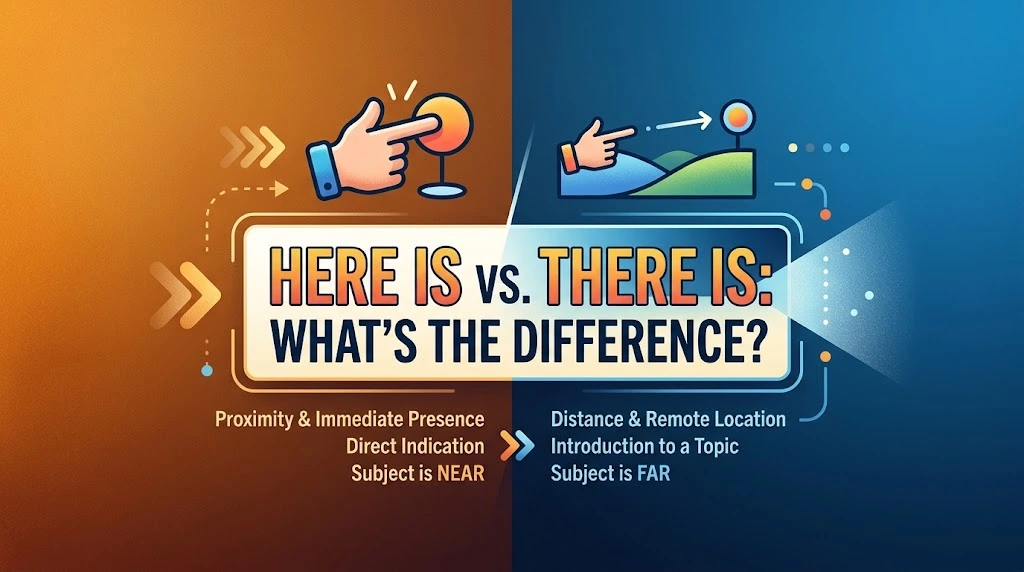
Here and there often appear in similar structures, but they serve different purposes.
Generally, here refers to the speaker’s location or something being presented from the speaker’s perspective. There commonly points to another location or introduces an existential statement.
Cambridge notes that here and there are adverbs and explains that they can occur in front-position constructions with inversion, including here is and there is.
Meaning Difference
Compare:
Here is your coffee.
The speaker is presenting or pointing out the coffee.
Now compare:
There is a coffee shop near the station.
This sentence introduces the existence or location of a coffee shop.
The difference isn’t merely grammatical. The constructions often perform different jobs.
Comparison Table
| Expression | Typical function | Example |
| Here is | Presents one thing | Here is your ticket. |
| Here are | Presents several things | Here are your tickets. |
| There is | States that one thing exists or is located somewhere | There is a problem. |
| There are | States that several things exist or are located somewhere | There are several problems. |
A useful shortcut is:
Here often draws attention to something being presented.
There often introduces existence or location.
Formal vs. Informal Usage
The grammar itself doesn’t suddenly change because you’re writing an email instead of talking to a friend. However, register affects which constructions sound appropriate.
In Informal Speech
You may hear:
Here’s the keys.
You may also hear shortened or conversational forms that speakers use automatically.
The important point is that frequent conversational usage doesn’t necessarily make a construction the preferred form for formal writing.
In Formal Writing
Choose the standard agreement pattern:
Here are the keys.
Here are the documents you requested.
Here is the information from the survey.
This approach is especially useful when clarity and grammatical precision matter.
Measurements, Amounts, and Quantities
Measurements can create another layer of uncertainty because a quantity can represent either a collection of individual units or one total amount.
Compare:
Here is five dollars.
and:
Here are five dollar bills.
In the first sentence, five dollars can function as a single amount of money.
In the second sentence, five dollar bills refers to five separate countable objects.
The same distinction can appear with measurements:
Here is ten miles of road.
Here are ten miles of roads.
The first treats ten miles as a single distance. The second uses roads as a plural noun.
A Practical Question to Ask
When dealing with a quantity, ask:
Am I presenting one amount or several individual things?
That question often reveals the appropriate structure.
Collective Nouns and Group Expressions
Collective nouns can refer to groups of people or things while appearing grammatically singular.
Examples include:
- team
- family
- committee
- audience
- staff
- group
In American English, collective nouns are commonly treated as singular when the group acts as one unit.
For example:
Here is the team.
The noun team is singular.
If you specifically identify individual members, the construction may change:
Here are the team members.
The difference isn’t the concept of a group itself. It is the grammatical form of the noun phrase.
This distinction matters in professional writing:
Here is the committee.
versus:
Here are the committee members.
Both can be correct because they introduce different noun phrases.
“Here Is” With a Clause
Not every sentence after here is contains a simple noun.
Consider:
Here is what happened.
Here is why the system failed.
Here is how you can solve the problem.
In these constructions, what happened, why the system failed, and how you can solve the problem are clauses.
That’s why blindly applying the rule “plural-looking idea = here are” can lead you astray.
For example:
Here is what you need.
This is standard because the complement after is is a clause beginning with what.
You shouldn’t change it simply because what you need might contain several individual things.
Common Mistakes With Here Is and Here Are
“Here Is the Documents”
This is one of the most common errors.
❌ Here is the documents.
The noun documents is plural.
✅ Here are the documents.
“Here Are Some Information”
The issue here is the noun information.
❌ Here are some information.
✅ Here is some information.
You could also replace the uncountable noun with a countable plural:
✅ Here are some details.
“Here’s the Keys”
The contraction here’s means here is.
❌ Here’s the keys.
✅ Here are the keys.
The first sentence may occur in informal speech, but standard edited writing favors the second.
“Here Are the Information”
This sentence tries to solve the problem by changing is to are, but the noun remains uncountable.
❌ Here are the information.
Better:
✅ Here is the information.
Or:
✅ Here are the details.
“Here Is the Reasons”
The noun reasons is plural.
❌ Here is the reasons.
✅ Here are the reasons.
The same pattern applies to countless other plural nouns:
- Here are the answers.
- Here are the problems.
- Here are the examples.
- Here are the results.
Here Is and Here Are in Professional Writing
Small agreement errors can become more noticeable when they appear in workplace communication.
Business Emails
Suppose you’re sending several attachments.
Weak:
❌ Here is the files you requested.
Standard:
Here are the files you requested.
If you’re sending one file:
Here is the file you requested.
If you’re sending information:
Here is the information you requested.
The noun determines the form.
Reports and Academic Writing
Consider:
Here are the results of the experiment.
That’s appropriate because results is plural.
For an uncountable noun:
Here is the evidence supporting the conclusion.
The noun evidence is normally uncountable in this meaning, so is is appropriate.
Website Copy
Website content often uses these constructions to introduce lists:
Here are three ways to improve your writing.
Here is what you need to know before you begin.
These forms are concise and direct, which makes them useful in guides, tutorials, and instructional content.
Read More : Disloyal vs. Unloyal: The Real Difference, Meaning, and Correct Usage
Case Study: Three Real-World Writing Situations
Case Study: A Business Email
Imagine a manager sending several documents to a client.
Original:
Here is the contracts and invoices you requested.
The noun phrase is plural: contracts and invoices.
Improved:
Here are the contracts and invoices you requested.
The correction is simple because the noun phrase clearly refers to multiple documents.
Case Study: A Website Guide
Original:
Here are the information you need to register.
The writer has used a plural verb with the uncountable noun information.
Better:
Here is the information you need to register.
An alternative is:
Here are the details you need to register.
Both are standard. The second version changes the noun to a plural countable form.
Case Study: A Presentation
Suppose a presenter introduces three key points:
Here are the three reasons this approach works.
That’s straightforward because reasons is plural.
Now compare:
Here is why this approach works.
The second construction introduces a clause beginning with why. The structure is different even though both sentences introduce an explanation.
A Quick Decision Guide for “Here Is or Here Are”
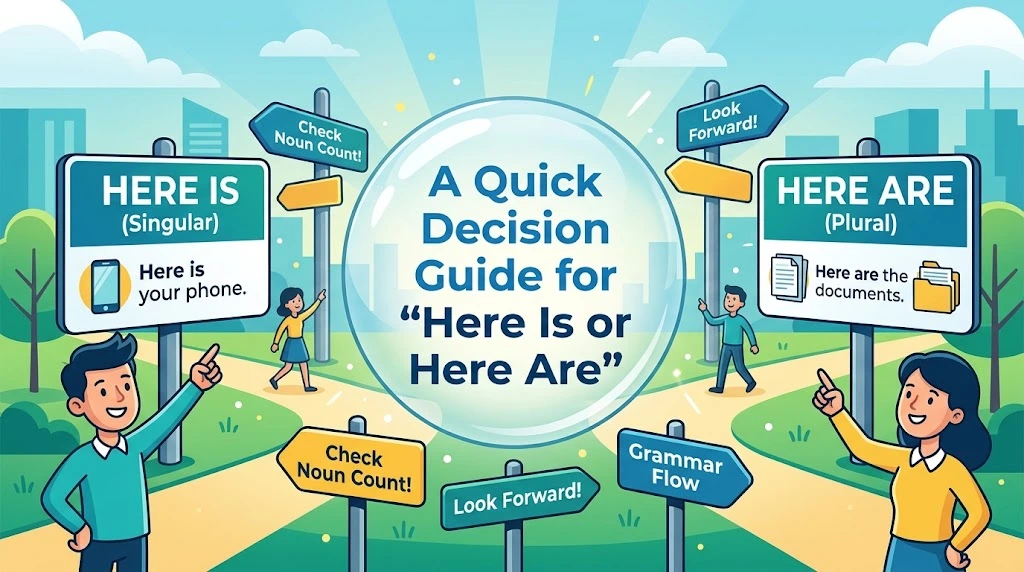
When you’re unsure, use this sequence.
Identify the noun
Find the noun or noun phrase being introduced.
Check its number
Ask whether it is:
- singular,
- plural,
- or uncountable.
Choose the verb
Use:
- here is for singular and uncountable nouns.
- here are for plural nouns.
Check the construction
If you’re dealing with:
- a pronoun,
- a clause,
- a measurement,
- a list,
- or an idiomatic expression,
look at the whole sentence rather than applying the basic rule mechanically.
Use the reversal test
Try changing:
Here are the books.
into:
The books are here.
If the reversed sentence makes the agreement obvious, you’ve probably found the correct form.
Quick Reference Table for Here Is vs. Here Are
| Situation | Correct form | Example |
| Singular noun | Here is | Here is the answer. |
| Plural noun | Here are | Here are the answers. |
| Uncountable noun | Here is | Here is some advice. |
| Singular pronoun | Here it is | Here it is. |
| Plural pronoun | Here they are | Here they are. |
| Clause beginning with what | Here is | Here is what happened. |
| Clause beginning with why | Here is | Here is why it matters. |
| Several separate objects | Here are | Here are the books and pens. |
| One collective noun | Here is | Here is the team. |
| Group members | Here are | Here are the team members. |
Common Questions About Here Is and Here Are
What Is the Difference Between “Here Is” and “Here Are”?
Here is generally introduces a singular or uncountable noun, while here are introduces a plural noun.
- Here is the document.
- Here are the documents.
- Here is some information.
The noun or noun phrase determines the agreement.
Is “Here’s” Correct With Plural Nouns?
In standard edited English, avoid “here’s” before a straightforward plural noun.
Use:
Here are the keys.
rather than:
Here’s the keys.
Here’s is the contraction of here is, and standard agreement requires are with a plural noun.
Why Do People Say “Here’s the Keys”?
It’s common to encounter this pattern in informal speech because conversational English often uses fixed, reduced expressions. However, frequency in speech isn’t the same thing as the preferred form in formal writing.
For professional writing, use:
Here are the keys.
Is “Here Is the Information” Correct?
Yes.
Information is normally an uncountable noun, so:
Here is the information you requested.
is correct.
You can also use a plural countable noun:
Here are the details you requested.
Is “Here Are the Information” Correct?
No, not in standard English when information has its normal uncountable meaning.
Use:
Here is the information.
Or change the noun:
Here are the details.
Should I Say “Here Is” or “Here Are” Before a List?
It depends on the grammatical structure of the sentence and what the list represents.
For a straightforward plural noun phrase:
Here are the books, notebooks, and folders.
For a construction introducing a clause:
Here is what you need: books, notebooks, and folders.
If a list produces an awkward sentence, restructuring it is often the clearest solution.
What Is Correct: “Here It Is” or “Here They Are”?
Use here it is for one thing and here they are for multiple things.
Where’s my phone? Here it is.
Where are my keys? Here they are.
Do American and British English Use “Here Is” and “Here Are” Differently?
The core agreement principle is shared across standard American and British English.
Regional differences become more noticeable in some broader areas of collective-noun agreement and conversational usage. They don’t overturn the basic distinction between singular is and plural are.
Can “Here Is” Be Used With an Uncountable Noun?
Yes.
Examples include:
- Here is some advice.
- Here is the equipment.
- Here is the information.
- Here is the evidence.
The uncountable noun normally takes singular agreement.
How Do Measurements and Amounts Affect the Choice?
Look at whether the expression represents one amount or several individual items.
For example:
Here is five dollars.
can present one monetary amount.
But:
Here are five dollar bills.
presents five individual objects.
The noun phrase determines the grammatical structure.
The Rule in 10 Seconds
If you’re in a hurry, use this:
One thing or an uncountable noun → “Here is.”
More than one countable thing → “Here are.”
Examples:
- Here is the book.
- Here is some information.
- Here are the books.
- Here are the answers.
Then check for special constructions such as pronouns, clauses, lists, and measurements.
Quick Diagnostic Checklist Before You Publish
Before sending an email, publishing an article, or submitting an assignment, run through this checklist:
- Find the noun. What exactly are you introducing?
- Check number. Is the noun singular or plural?
- Check countability. Is it an uncountable noun such as information or advice?
- Check the verb. Use is for singular and uncountable nouns and are for plural nouns.
- Check contractions. Remember that here’s means here is.
- Check pronouns. Use here it is for one thing and here they are for multiple things.
- Check lists. Make sure the entire construction is clear.
- Check quantities. Decide whether you’re presenting one amount or separate items.
- Read the sentence aloud. If the structure sounds awkward, consider rewriting it.
- Choose clarity over cleverness. A clean sentence usually beats a complicated grammatical workaround.
Conclusion
The difference between “here is” and “here are” rests on a simple grammatical principle: subject–verb agreement.
Use “here is” with a singular noun or an uncountable noun:
Here is the report.
Here is some information.
Use “here are” with a plural noun:
Here are the reports.
Here are the details.
The real challenge comes from the sentence structure. Because here appears before the verb and the noun often follows it, the construction can feel backward. Spoken English adds another wrinkle through contractions such as “here’s” and other conversational patterns.
The best habit is to look past here and identify what the sentence is actually presenting. If you’re still uncertain, use the reversal test: “The documents are here” makes it obvious that “Here are the documents” needs are.
For formal writing, standard agreement keeps your prose clear and polished. Once you understand how singular nouns, plural nouns, uncountable nouns, pronouns, clauses, lists, and quantities behave, here is vs. here are becomes much less of a guessing game.
The rule may be small, but mastering it can make your everyday writing noticeably sharper.