
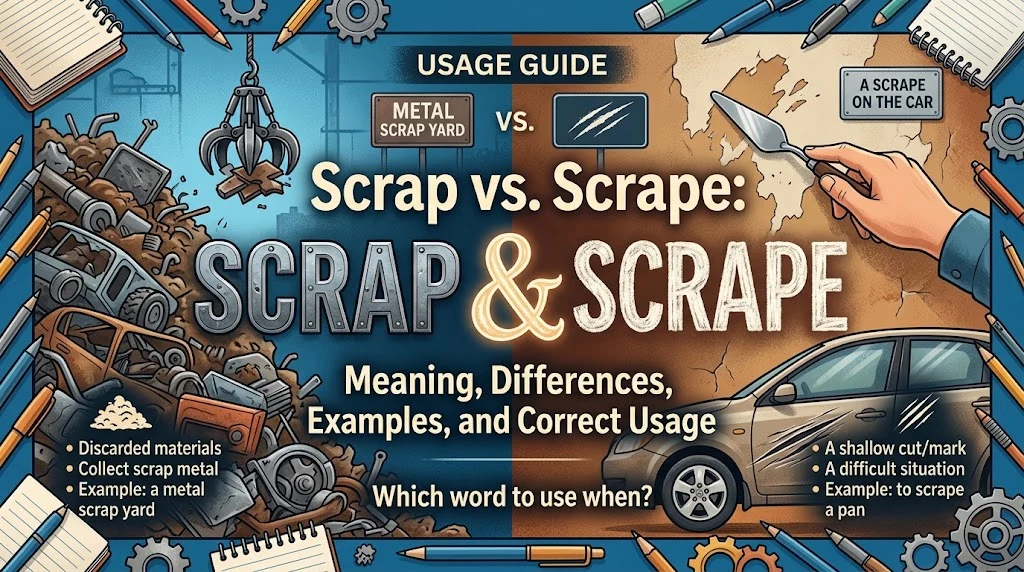
If you’ve ever hesitated between scrap and scrape, you’re not alone. These words look and sound remarkably similar, yet they describe very different actions.
You scrap a project when you cancel or abandon it. You scrape paint when you remove it from a surface. You keep scrap metal as discarded material, while you might scrape your knee after falling.
That small letter e changes the meaning completely.
The confusion becomes even more interesting because both words work as nouns and verbs. Scrap can mean a leftover piece of material, an abandoned plan, or an informal fight. Scrape can describe rubbing against a surface, removing something, a minor injury, or barely managing to accomplish something.
This guide breaks down scrap vs. scrape from every useful angle, including definitions, grammar, spelling, collocations, idioms, real-world examples, and common mistakes.
Quick rule: Scrap usually relates to discarding, abandoning, or leftover material. Scrape usually relates to rubbing, scratching, or removing something from a surface.
Scrap vs. Scrape: The Quick Difference
The easiest way to distinguish these words is to focus on the action involved.
| Word | Main idea | Example |
| Scrap | Discard, abandon, or use leftover material | They scrapped the old plan. |
| Scrape | Rub, scratch, or remove something from a surface | She scraped the paint off the wall. |
Consider these two sentences:
- The company scrapped the proposal.
- The worker scraped the paint from the door.
In the first sentence, the company abandoned something.
In the second, the worker removed material from a surface.
The words aren’t interchangeable.
Scrap at a Glance
Scrap can function as both a noun and a verb.
As a noun, it can refer to:
- A small leftover piece of something
- Discarded material
- Food leftovers
- A small amount or fragment
- An informal fight
As a verb, it can mean:
- To discard something
- To abandon a plan
- To cancel a project
- To dismantle something
- To fight informally
For example:
The factory sold its scrap metal.
The committee scrapped the proposal.
The two players got into a scrap.
Scrape at a Glance
Scrape also works as both a noun and a verb.
As a verb, it can mean:
- To rub against something
- To remove material from a surface
- To scratch or injure the skin
- To make a harsh rubbing sound
- To gather something with difficulty
- To barely succeed
As a noun, it can mean:
- A shallow skin injury
- A mark caused by rubbing
- A scraping sound or action
- A difficult situation
For example:
He scraped his knee on the pavement.
She scraped the mud off her shoes.
We scraped together enough money for the repair.
What Does “Scrap” Mean?
The word scrap has several related meanings. Its central ideas involve something small, leftover, discarded, or abandoned.
Scrap as a Verb
When scrap functions as a verb, it often means to get rid of something because it is no longer wanted, useful, or necessary.
For example:
The company scrapped its outdated software.
Here, the company didn’t physically scratch the software. It abandoned or discontinued it.
You can scrap:
- A plan
- A project
- A proposal
- An idea
- A policy
- A system
- A machine
- A vehicle
- An agreement
For example:
The city scrapped the original construction plan.
They scrapped the old computer system.
The director scrapped the scene from the movie.
In each case, scrap means something like discard, cancel, abandon, or remove from use.
Scrap Can Also Mean “Fight”
In informal English, scrap can describe a fight or physical confrontation.
For example:
The two men got into a scrap outside the bar.
As a verb:
The teenagers started scrapping in the parking lot.
This use is informal. In formal writing, words such as fight, altercation, or confrontation may be more appropriate depending on the context.
Scrap as a Noun
As a noun, scrap often means a small piece left over from a larger amount of material.
For example:
She used a scrap of fabric to repair the shirt.
You might also encounter:
- Scrap paper
- Scrap metal
- Food scraps
- Scrap wood
- Scrap material
The idea is simple: something remains after a larger piece has been used, cut, processed, or discarded.
“A Scrap of” for a Small Amount
The phrase a scrap of can describe a very small amount of something.
For example:
He didn’t have a scrap of evidence to support the claim.
She wrote the address on a scrap of paper.
Here, scrap doesn’t necessarily mean literal garbage. It can simply mean a small piece or tiny amount.
What Does “Scrape” Mean?
Scrape revolves around contact, friction, scratching, and removal.
Imagine dragging a metal chair across a concrete floor. The chair might scrape against the floor.
Imagine using a tool to remove dried paint. You might scrape the paint off.
Imagine falling on rough pavement. You might scrape your knee.
The physical idea connects all three uses.
Scrape as a Verb
One major meaning of scrape is to remove something from a surface by rubbing or dragging a hard edge against it.
For example:
Scrape the mud off your boots.
He scraped the ice from the windshield.
She scraped the burnt food from the pan.
Common objects that you might scrape include:
- Paint
- Ice
- Mud
- Dirt
- Food
- Wax
- Glue
- Residue
- Rust
- Dried material
Scrape as Physical Contact
Scrape can also describe something rubbing against another surface.
For example:
The bottom of the chair scraped against the floor.
The car scraped against the garage wall.
Here, the important idea isn’t necessarily removal. The word emphasizes rough contact or friction.
Scrape as a Minor Injury
A scrape is also a shallow injury caused when the skin rubs against a rough surface.
For example:
I got a scrape on my elbow.
She has a small scrape on her knee.
The corresponding verb is:
He scraped his knee when he fell.
This is one of the most common places where people mistakenly use scrap.
You scrape your knee, not scrap your knee.
Scrape as “Barely Manage”
English also uses scrape figuratively to describe accomplishing something with difficulty or only just succeeding.
For example:
We scraped together enough money to buy the equipment.
He scraped by on a very small income.
The team scraped through to the next round.
These expressions preserve the underlying idea of struggling to obtain or achieve something.
Scrap vs. Scrape: The Key Differences
The distinction becomes much easier when you compare their most common meanings side by side.
Discarding vs. Rubbing
Scrap often means discard.
Scrape often means rub or remove from a surface.
Compare:
The manager scrapped the old policy.
The worker scraped the old paint from the wall.
The manager abandoned something. The worker physically removed something.
Leftover Material vs. Surface Removal
Compare these:
I found a scrap of paper.
I scraped the paper residue off the desk.
The first sentence describes a piece of material.
The second describes an action involving removal.
Abandoning Something vs. Gathering Something With Difficulty
This contrast is particularly useful:
They scrapped the project.
They scraped together the money to finish it.
The first means they canceled or abandoned the project.
The second means they managed to gather the necessary money despite difficulty.
Minor Injury vs. Discarded Material
Compare:
She has a scrape on her arm.
She found a scrap of cloth.
A scrape is an injury or mark.
A scrap is a small leftover piece.
Scrap vs. Scrape Grammar and Word Forms
Spelling becomes especially important when these words change form.
Forms of “Scrap”
The common forms are:
| Form | Example |
| Base form | scrap |
| Third-person singular | scraps |
| Past tense | scrapped |
| Present participle | scrapping |
Notice the doubled p:
- scrap → scrapped
- scrap → scrapping
For example:
The company scrapped the proposal.
They are scrapping the old equipment.
Forms of “Scrape”
The common forms are:
| Form | Example |
| Base form | scrape |
| Third-person singular | scrapes |
| Past tense | scraped |
| Present participle | scraping |
Notice what happens when scrape takes these endings:
- scrape → scraped
- scrape → scraping
The final e disappears before -ing:
scrape → scraping
That spelling difference can help you identify the word you need.
Common Collocations With “Scrap”
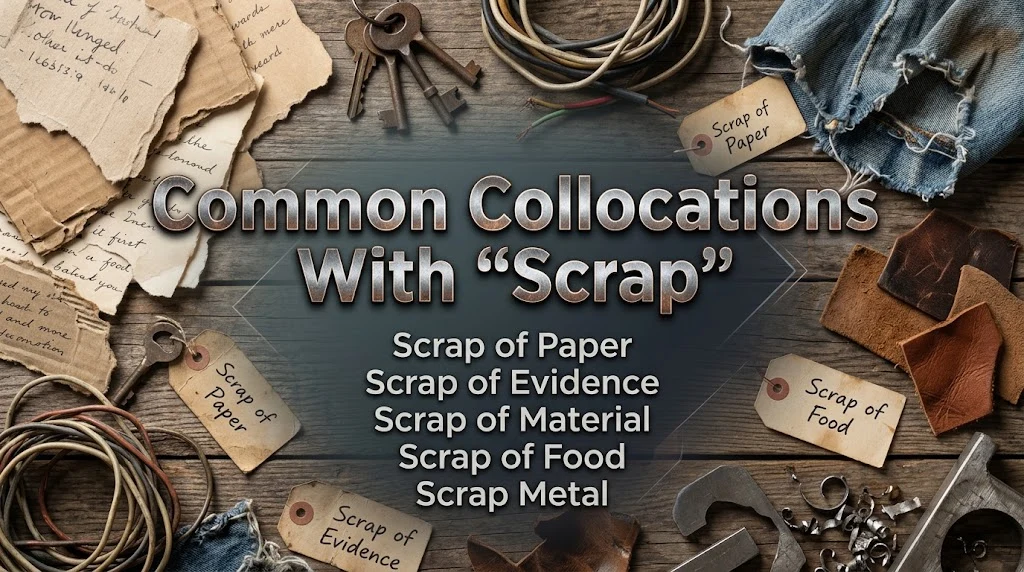
A collocation is a word combination that commonly occurs in natural English.
Learning these combinations can make the distinction much easier.
Common Scrap Collocations
- scrap metal
- scrap paper
- food scraps
- scrap material
- scrap wood
- scrap yard
- scrap value
- scrap a plan
- scrap a project
- scrap a proposal
- scrap an idea
- scrap a policy
For example:
The mechanic sold the damaged parts for scrap value.
The board decided to scrap the proposal.
“Scrap Yard”
A scrap yard is a place where discarded materials, particularly metal, are collected, sorted, processed, or sold.
You might hear:
The old cars were taken to the scrap yard.
This meaning has nothing to do with scraping a surface.
Common Collocations With “Scrape”
Scrape has a different set of natural word combinations.
Common examples include:
- scrape paint
- scrape ice
- scrape dirt
- scrape residue
- scrape your knee
- scrape your elbow
- scrape against something
- scrape something off
- scrape something away
- scrape something out
- scrape together money
- scrape by
- scrape through
For example:
He scraped the ice off the windshield.
The box scraped against the wall.
They scraped together enough money for rent.
These phrases reinforce the central meaning of scrape: contact, removal, friction, or difficult acquisition.
Common Mistakes With Scrap and Scrape
Because the words look so similar, mistakes usually happen when writers remember the sound but not the meaning.
“Scrap the Paint” vs. “Scrape the Paint”
When you mean remove paint from a surface, use scrape.
Correct:
We need to scrape the paint off the door.
Incorrect in the intended physical sense:
We need to scrap the paint off the door.
However, scrap the paint could theoretically be understood in a different context if someone means discard the paint. Context matters, but scrape is the natural choice for physical removal.
“Scrape the Project” vs. “Scrap the Project”
When you mean cancel or abandon a project, use scrap.
Correct:
The company scrapped the project after funding disappeared.
Not:
The company scraped the project.
The project isn’t being rubbed against a surface. It’s being abandoned.
“Scrap My Knee” vs. “Scrape My Knee”
The standard expression is:
I scraped my knee.
Not:
I scrapped my knee.
A scrape is a minor skin injury caused by friction or contact with a rough surface.
“Scrap Together Money” vs. “Scrape Together Money”
The correct phrase is:
We scraped together enough money.
Scrape together means to gather something with difficulty.
For example:
She scraped together enough savings to replace the broken appliance.
“Scraps” vs. “Scrapes”
These plural nouns have different meanings.
Scraps can mean:
- Leftover pieces
- Small fragments
- Food leftovers
- Small amounts
- Fights
Scrapes can mean:
- Minor injuries
- Marks caused by rubbing
- Difficult situations
- Instances of scraping
Compare:
The dog ate the scraps from dinner.
The child came home with several scrapes on his knees.
Scrap vs. Scrape in Construction and Home Improvement
Construction provides an excellent setting for seeing both words together.
Suppose you’re renovating an old house.
You might scrape old paint from the walls.
Afterward, you may have pieces of scrap material lying around.
You could then decide to scrap an outdated renovation plan.
Three uses appear in one setting:
The contractor scraped the old paint from the wall, collected the scrap material, and eventually scrapped the original design.
Each word performs a different job.
Construction Examples
Scrape:
Workers scraped cement residue from the floor.
Scrap:
The contractor removed the damaged metal as scrap.
Scrap as a verb:
The builder scrapped the original layout.
This distinction is useful in technical writing because construction documents often discuss both physical materials and project decisions.
Scrap vs. Scrape in Automotive and Mechanical Work
Cars and machines create another useful contrast.
A damaged vehicle might be sent for scrap if repairing it no longer makes economic sense.
At the same time, a mechanic might hear a scraping noise from a brake component.
For example:
The mechanic heard the brakes scraping against the rotor.
Later:
The owner decided to sell the damaged vehicle for scrap.
Again, the concepts are different.
Scraping describes physical contact.
Scrap describes discarded material or an item that is no longer being kept in service.
Scrap vs. Scrape in Business and Project Management
Business English uses scrap frequently when organizations cancel or abandon something.
For example:
The company scrapped its expansion plan.
Management scrapped the proposal after reviewing the costs.
The word often signals a deliberate decision to stop pursuing something.
Meanwhile, scrape together appears when someone gathers limited resources.
For example:
The startup scraped together enough funding to continue operating.
This gives you a useful contrast:
| Business meaning | Word | Example |
| Cancel a project | Scrap | They scrapped the project. |
| Abandon a proposal | Scrap | The board scrapped the proposal. |
| Gather limited resources | Scrape | They scraped together the funds. |
| Barely succeed | Scrape | The company scraped by during the downturn. |
Scrap vs. Scrape in Cooking and Household Tasks
You can also encounter both words in ordinary household situations.
Food scraps are leftovers or discarded pieces of food.
For example:
Put the vegetable scraps in the compost container.
But if food sticks to the bottom of a pan, you might scrape it off.
She scraped the burnt food from the pan.
The difference is straightforward:
- Scraps = leftover pieces
- Scrape = remove something by rubbing or dragging
Figurative and Idiomatic Uses of “Scrap”
The word scrap extends beyond physical materials.
Scrap a Plan
The team scrapped the plan after discovering a major problem.
This means they abandoned it.
Scrap an Idea
He scrapped the idea before presenting it to the committee.
Again, the idea was discarded.
A Scrap of Evidence
There wasn’t a scrap of evidence connecting the two events.
Here, scrap means a tiny amount.
Scrap Metal
The old machinery was sold as scrap metal.
Here, it refers to material that has been discarded or is being recovered for recycling.
Figurative and Idiomatic Uses of “Scrape”
Scrape has several common figurative expressions.
Scrape By
Scrape by means to survive or succeed with very little money, resources, or margin for error.
They managed to scrape by on a tight budget.
Scrape Together
Scrape together means to gather something with difficulty.
He scraped together enough money for the repair.
Scrape Through
Scrape through means to succeed narrowly or with difficulty.
She scraped through the final exam.
In a Scrape
In informal English, in a scrape means to be in a difficult or troublesome situation.
He found himself in a scrape after missing the last train.
Scrape the Bottom of the Barrel
This expression means to use the least desirable or remaining options.
We were scraping the bottom of the barrel for replacement parts.
The phrase uses the physical image of scraping material from the bottom of a container.
Scrap vs. Scrape: Real-World Case Studies
Case Study: Renovating an Old Kitchen
Imagine a homeowner replacing an old kitchen.
First, the contractor decides to scrap the original cabinet design because it doesn’t fit the new layout.
Next, workers scrape old adhesive from the floor.
Finally, the homeowner saves some scrap wood for a later project.
One paragraph can contain all three meanings:
The contractor scrapped the original design, workers scraped adhesive from the floor, and the homeowner saved the remaining scrap wood.
The words are similar in appearance, yet each points to a different concept.
Case Study: A Damaged Car
A driver takes an old car to a repair shop.
The mechanic notices a strange scraping sound.
After inspection, the mechanic discovers that a component is rubbing against another metal part.
Later, the owner decides the vehicle is too expensive to repair and sells it for scrap.
The sequence illustrates the distinction perfectly:
The car was scraping against a component, and eventually the owner sold the vehicle for scrap.
Case Study: A Business Project
A company has a new software project.
During development, costs rise sharply. Management decides to scrap the project.
Another department, meanwhile, has limited funds and must scrape together enough money to maintain an older system.
The two verbs describe completely different actions:
- Scrap = abandon
- Scrape together = gather with difficulty
When Can “Scrap” and “Scrape” Appear in the Same Sentence?
Interestingly, these words can work together naturally.
Consider:
The company scrapped the damaged machine after workers scraped the dirt from its surface.
The company discarded the machine.
The workers removed dirt from it.
Another example:
They scraped the old paint away before deciding to scrap the entire door.
First, they removed the paint.
Then, they decided to discard the door.
This is a useful way to remember the difference because it places both words in the same context.
A Simple Memory Trick for Scrap vs. Scrape
When you’re stuck, ask yourself one question:
Are you throwing something away or abandoning it?
Use scrap.
They scrapped the plan.
The factory sells scrap metal.
Are you rubbing, scratching, or removing something from a surface?
Use scrape.
He scraped his knee.
She scraped paint from the wall.
Are you barely managing or gathering something with difficulty?
Use scrape.
We scraped together enough money.
They scraped by for several months.
A compact memory trick is:
SCRAP = discard or leftover.
SCRAPE = rub, remove, or struggle to obtain.
Scrap vs. Scrape: Side-by-Side Examples
| Intended meaning | Correct word | Example |
| Cancel a project | Scrap | They scrapped the project. |
| Remove paint | Scrape | She scraped the paint off. |
| Leftover material | Scrap | The factory sells scrap metal. |
| Minor skin injury | Scrape | He has a scrape on his knee. |
| Gather money with difficulty | Scrape | We scraped together enough money. |
| Rub against a surface | Scrape | The door scraped the floor. |
| Informal fight | Scrap | They got into a scrap. |
| Small piece | Scrap | She used a scrap of paper. |
| Barely succeed | Scrape | The team scraped through. |
| Discard an old machine | Scrap | They scrapped the machine. |
Scrap vs. Scrape: Why the Confusion Happens
The confusion isn’t surprising.
Both words:
- Begin with scr-
- Have similar pronunciation
- Contain the letters scrap
- Can function as nouns and verbs
- Appear in everyday English
- Have physical and figurative meanings
However, their core concepts differ.
Scrap moves toward the idea of discarding or remaining material.
Scrape moves toward the idea of friction, contact, removal, or difficulty.
Once you understand those conceptual centers, the individual meanings become much easier to remember.
Read More : Entwined vs. Intertwined: Meaning, Differences, Correct Usage, and Examples
How to Choose the Correct Word
Use this quick decision guide.
You mean “cancel” or “abandon”?
→ Scrap
You mean “leftover material”?
→ Scrap
You mean “fight” in informal English?
→ Scrap
You mean “rub against a surface”?
→ Scrape
You mean “remove something from a surface”?
→ Scrape
You mean “injure the skin slightly”?
→ Scrape
You mean “barely succeed”?
→ Scrape
You mean “gather something with difficulty”?
→ Scrape
This simple test covers most everyday uses.
Frequently Asked Questions About Scrap vs. Scrape
What is the difference between scrap and scrape?
Scrap usually relates to discarding something, abandoning something, or referring to leftover material. Scrape usually relates to rubbing against a surface, removing something from a surface, causing a minor skin injury, or barely managing something.
For example:
They scrapped the proposal.
He scraped his knee.
Is it “scrap a project” or “scrape a project”?
The standard expression is scrap a project when you mean to cancel or abandon it.
The company scrapped the project after the costs increased.
Is it “scrape your knee” or “scrap your knee”?
The correct expression is scrape your knee.
I scraped my knee when I fell.
A scrape is a minor injury caused by rubbing the skin against a rough surface.
What does “scrap” mean as a verb?
As a verb, scrap commonly means to discard, cancel, abandon, or dismantle something.
The company scrapped the old system.
In informal English, it can also mean to fight:
The two men started scrapping.
What does “scrape” mean as a verb?
Scrape can mean to rub against a surface, remove something from a surface, or cause a minor skin injury.
It also appears in expressions such as scrape together, scrape by, and scrape through.
What does “scrap metal” mean?
Scrap metal refers to discarded or leftover metal that can often be collected, processed, reused, or recycled.
For example:
The damaged machinery was sold as scrap metal.
What does “scrape together” mean?
Scrape together means to gather something with difficulty, often because the available amount is limited.
We scraped together enough money to pay the bill.
Can scrap and scrape be used interchangeably?
No. Although they look and sound similar, their meanings are different.
You scrap a plan because you’re abandoning it.
You scrape paint because you’re removing it from a surface.
Is “scrapped” the correct past tense of scrap?
Yes.
The past tense and past participle of scrap are scrapped.
They scrapped the old proposal.
The present participle is scrapping.
They are scrapping the outdated system.
What is the difference between scraps and scrapes?
Scraps usually means leftover pieces, discarded material, small amounts, or informal fights.
Scrapes can mean minor injuries, marks caused by rubbing, difficult situations, or instances of scraping.
Compare:
The dog ate the food scraps.
The child had several scrapes on his knees.
Final Takeaway: Scrap vs. Scrape
The difference between scrap and scrape becomes much easier once you focus on the action behind each word.
Scrap is mainly connected with discarding, abandoning, leftover material, and informal fights.
Scrape is mainly connected with rubbing, scratching, removing material from a surface, minor injuries, and barely managing something.
Keep these examples in mind:
- Scrap a project = abandon it
- Scrap metal = discarded or leftover metal
- A scrap of paper = a small piece of paper
- Scrape paint = remove paint from a surface
- Scrape your knee = injure the skin slightly
- Scrape together money = gather money with difficulty
- Scrape by = manage with limited resources
- Scrape against a wall = rub against it
The simplest rule is worth remembering:
Scrap means discard or leftover. Scrape means rub, remove, or struggle to obtain.
Once that distinction clicks, choosing between scrap vs. scrape becomes much less of a guessing game.