
English has plenty of words that look simple until you need to make them plural. Passerby is one of them.
At first glance, you might think the plural should be passerbys. Someone unfamiliar with the word might even write passerbyers. Neither form is the standard plural, though.
The correct pattern is:
One passerby → two or more passersby
There’s also a hyphenated form:
One passer-by → two or more passers-by
Major dictionaries, including Cambridge, Collins, and Oxford, recognize passerby or passer-by and give passersby or passers-by as the plural forms.
That unusual plural makes sense once you understand how the compound is built. The word isn’t simply a noun that happens to end in by. It comes from the idea of a person who passes by.
This guide explains the difference between passerby, passersby, passer-bys, passers-by, passerbys, and passerbyers, along with examples, usage rules, related words, and practical memory tricks.
Understanding “Passerby”: Meaning, Structure, and Word Formation
A passerby is a person who happens to be passing a particular place.
Cambridge defines passerby as someone going past a particular place. Collins similarly defines it as a person who passes by.
For example:
- A passerby noticed smoke coming from the building.
- A passerby called the police.
- The injured man asked a passerby for help.
- A friendly passerby stopped to give directions.
The word usually describes someone who isn’t necessarily involved in an event. They’re simply nearby and happen to pass through the situation.
Imagine a cyclist falls on a busy sidewalk. Someone walking past notices the accident and stops to help. That person is a passerby.
What “passerby” means
The meaning is straightforward:
passerby = a person who passes by
The word can refer to someone walking past a location, although context can determine the exact situation.
For example:
A passerby saw the broken window and contacted the store owner.
The passerby wasn’t necessarily a witness in the legal sense. The sentence simply tells you that the person happened to be passing when they noticed the window.
How “passerby” is formed
The structure becomes more interesting when you break the word apart:
passer + by → passerby
The first element, passer, refers to someone who passes. The second element, by, comes from the expression pass by.
Collins traces the word to pass by plus the noun-forming element associated with passer, with the particle by positioned after it. Its recorded origin dates to the 1560s–1570s.
This structure explains why the plural looks unusual.
When you have several people, you pluralize passer, not by.
So:
passer + by → passerby
becomes:
passers + by → passersby
That’s the key.
Passerby: The Correct Singular Form
When you’re talking about one person, use passerby.
You can place it after articles such as a or the:
- A passerby helped the child.
- The passerby called emergency services.
- I asked a passerby for directions.
- The passerby noticed something unusual.
- A passerby found the lost wallet.
The singular form doesn’t take an additional plural ending.
When to use “passerby”
Use passerby when only one person is involved.
For example:
A passerby stopped to help.
The phrase a passerby clearly identifies one person.
You can also use the word with possessives:
The passerby’s quick thinking prevented further damage.
Here, passerby’s is not a plural. It’s the singular possessive form.
Compare these:
| Form | Meaning | Example |
| passerby | One person | A passerby helped. |
| passer’s | Possessive singular | The passerby’s phone rang. |
| passersby | More than one person | Several passersby stopped. |
| passersby’s | Possessive plural | The passersby’s reactions varied. |
The last form may look strange, but the grammatical principle is consistent. The apostrophe follows the plural form.
For example:
The passersby’s accounts differed slightly.
In careful writing, you may also restructure the sentence to avoid an awkward possessive construction:
The accounts given by the passersby differed slightly.
That version often reads more naturally.
Passersby: The Correct Plural Form
When you mean more than one person, use passersby.
This is the standard plural form listed by major dictionaries. Cambridge gives passersby as the US plural of passerby. Collins also lists passersby as the plural. Oxford’s American English dictionary gives both passersby and passers-by.
Examples include:
- Several passersby stopped to watch.
- The passersby called for help.
- Police interviewed several passersby.
- Curious passersby gathered outside the building.
- Two passersby helped move the fallen bicycle.
Notice what happens inside the word.
passerby → passersby
The s goes after passer, not after by.
Why “passersby” looks unusual
Most English plurals appear at the end of the word:
- car → cars
- book → books
- student → students
- visitor → visitors
That’s why passersby can feel strange.
Your brain may expect:
passerby + s = passerbys
But English compound nouns don’t always form plurals that way.
The important question is: Which part of the compound represents the person or thing being counted?
In passerby, the person is the passer.
Therefore:
one passer → several passers
The word by doesn’t need to change.
Passerby vs. Passersby: Side-by-Side Comparison
The simplest way to remember the difference is this:
| Word | Number | Meaning | Example |
| passerby | Singular | One person passing by | A passerby called 911. |
| passersby | Plural | Two or more people passing by | Several passersby stopped. |
| passer-by | Singular variant | One person passing by | A passer-by saw the accident. |
| passers-by | Plural variant | Two or more people passing by | Several passers-by watched. |
| passerbys | Nonstandard plural | Intended as plural | Avoid in standard writing. |
| passerbyers | Nonstandard form | Intended as plural | Avoid. |
Cambridge and Collins both document the closed and hyphenated patterns.
A quick sentence test
If you can replace the word with one person, use passerby:
A passerby helped me.
If you can replace it with several people, use passersby:
Several passersby helped me.
That simple substitution test eliminates most mistakes.
Why the Plural Is “Passersby,” Not “Passerbyers”
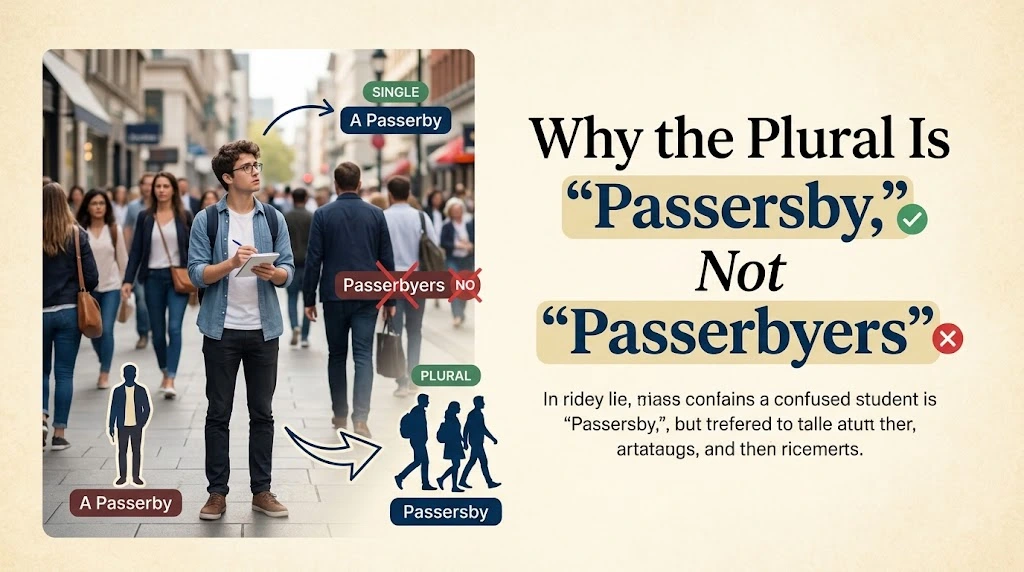
The biggest source of confusion is probably passerbyers.
It looks as though someone has taken passerby and added an ending to make it sound like a plural noun. However, standard English doesn’t form the plural this way.
The established plural is passersby.
Think about the underlying phrase:
a person who passes by
The person is the passer.
Now make that person plural:
people who pass by
The noun-like element becomes passers.
So the compound becomes:
passers + by = passersby
Why “passerbyers” doesn’t work
The form passerbyers essentially adds an unnecessary extra ending.
The word passer already contains the -er element that identifies the person who performs the action of passing.
Adding another -er doesn’t create the accepted plural.
Compare:
passerby → passersby
not:
passerby → passerbyers
For example:
❌ Several passerbyers stopped near the entrance.
✅ Several passersby stopped near the entrance.
The second sentence uses the established dictionary form.
Why people might write “passerbyers”
The error is understandable.
English usually teaches learners that plural nouns take -s or -es. When a word ends in an unusual position, people naturally try to regularize it.
That’s why forms such as passerbys and passerbyers can appear in informal writing.
However, familiarity doesn’t make a form standard.
When you’re writing an article, report, email, academic paper, news story, or professional document, stick with passersby.
Why “Passerbys” Is Usually Incorrect
Passerbys looks more plausible than passerbyers because English frequently creates plurals by adding -s.
Consider:
- passer → passers
- driver → drivers
- visitor → visitors
- traveler → travelers
You might therefore reason:
passerby → passerbys
The problem is that the established compound doesn’t pluralize at the very end.
Instead:
passerby → passersby
The plural marker attaches to passer.
Compare the two patterns
Incorrect:
passerby + s → passerbys
Standard:
passer + s + by → passersby
This isn’t simply a spelling preference. It’s part of how this compound’s plural form has become established in English.
Dictionary.com explicitly lists passersby as the plural of passerby.
Is “passerbys” ever useful?
You may encounter passerbys in unedited online content, informal posts, learner writing, or other contexts where standard editing hasn’t been applied.
That doesn’t make it the preferred standard form.
For polished English, use:
passersby
If you’re writing for an audience that expects standard American English, there’s little reason to choose passerbys.
How Compound Nouns Like “Passerby” Form Their Plurals
The unusual plural becomes easier when you understand compound nouns.
A compound noun combines two or more words into a unit with a particular meaning.
Examples include:
- toothpaste
- classroom
- mother-in-law
- editor-in-chief
- runner-up
- passerby
Pluralization depends on the structure of the compound.
Some compounds simply receive -s at the end:
classroom → classrooms
Others have a structure in which the meaningful noun takes the plural marker:
mother-in-law → mothers-in-law
runner-up → runners-up
The same basic idea helps explain:
passerby → passersby
The main element matters
With passerby, the person being counted is the passer.
That’s why the plural marker goes there.
A useful mental diagram looks like this:
SINGULAR
passer + by
↓
one person
↓
passerby
PLURAL
passer + s + by
↓
multiple people
↓
passersby
The word by functions as part of the compound. It isn’t the thing being counted.
Similar compound noun patterns
Here are a few useful comparisons:
| Singular | Plural |
| passerby | passersby |
| runner-up | runners-up |
| mother-in-law | mothers-in-law |
| attorney general | attorneys general |
| commander-in-chief | commanders-in-chief |
These words remind us that English doesn’t always attach the plural ending to the final word.
The exact plural rule depends on the structure and history of each compound. That’s why it’s better to learn established forms rather than assume every compound behaves identically.
Passerby vs. Passer-by: Which Spelling Should You Use?
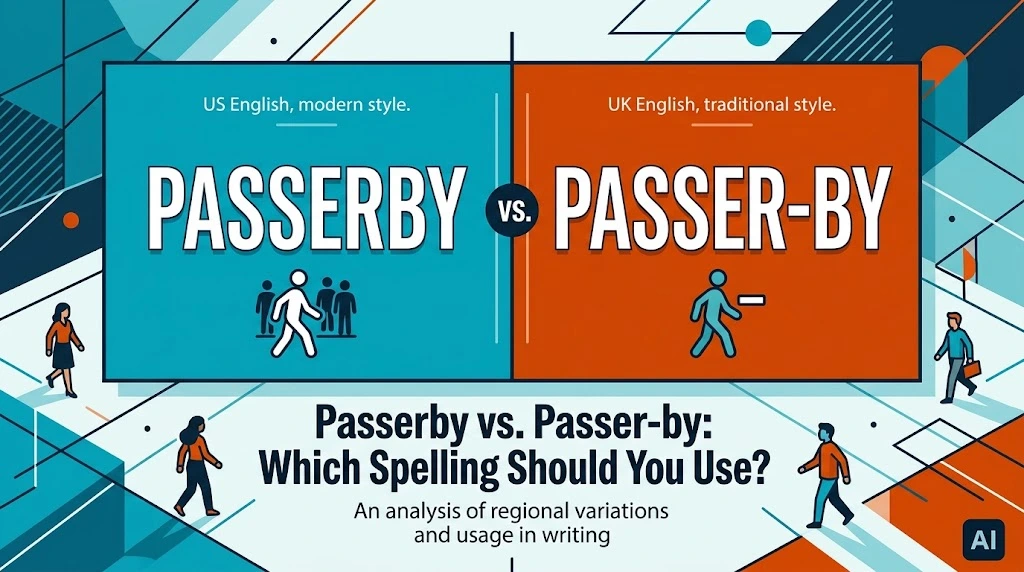
Both passerby and passer-by are established spellings.
Cambridge lists passer-by and gives passers-by as its plural. Cambridge’s US dictionary also lists passerby and passersby.
Oxford’s American English dictionary similarly lists:
passerby
also passer-by
plural passersby, passers-by
So you may encounter both forms in reputable writing.
Modern American English usage
For US English, passerby is a well-established closed form.
For example:
A passerby called the fire department.
You may also see:
A passer-by called the fire department.
The meaning remains the same.
The important point is consistency. If a publication’s style guide uses passerby, follow that spelling throughout the piece.
What about British English?
British dictionaries commonly feature the hyphenated form passer-by.
Cambridge’s English dictionary lists passer-by with the plural passers-by.
That doesn’t mean the closed spelling is somehow meaningless. English spelling conventions vary by variety, dictionary, publisher, and editorial style.
The practical distinction is:
- US English: passerby and passersby are well established.
- British English: passer-by and passers-by are commonly listed.
- Both patterns represent the same underlying word and meaning.
Passersby vs. Passers-by: How the Hyphenated Plural Works
If you choose the hyphenated singular, the plural remains structurally similar:
passer-by → passers-by
The plural marker still appears after passer.
That’s important.
The plural isn’t:
passer-bys
Instead, it’s:
passers-by
Cambridge explicitly gives passers-by as the plural of passer-by.
Examples of the hyphenated plural
- Several passers-by stopped to help.
- The police questioned passers-by.
- Curious passers-by watched the demonstration.
- A few passers-by photographed the scene.
If your publication uses the closed form, write:
Several passersby stopped to help.
If it uses the hyphenated form, write:
Several passers-by stopped to help.
Don’t mix styles randomly within the same article.
Real-World Usage: Passerby and Passersby in Context
A word becomes easier to understand when you see what it actually does in real sentences.
News and journalism
Journalists often use passerby and passersby when describing people who happened to be nearby during an incident.
For example:
A passerby noticed smoke and alerted emergency services.
Or:
Several passersby stopped after hearing the noise.
Dictionary examples show this kind of usage. Cambridge includes examples involving passersby noticing unusual events and contacting authorities.
The word works especially well when the person’s connection to an event comes from chance rather than planning.
Legal and official writing
The word can also appear in reports involving accidents, emergencies, public incidents, or witnesses.
For example:
Police asked passersby whether they had seen the collision.
However, there’s an important distinction between passerby and witness.
A passerby simply happens to be passing.
A witness is someone who sees an event and may be able to provide information about it.
One person can be both:
A passerby witnessed the accident.
But the terms aren’t automatically interchangeable.
Everyday writing
You might use passerby in ordinary conversation when describing an unexpected interaction:
A passerby gave us directions.
Or:
Several passersby stopped to admire the street performer.
The word often creates a useful sense of chance. The person wasn’t necessarily part of your original situation. They just happened to be there.
Passerby vs. Bystander vs. Pedestrian
These words overlap, but they aren’t identical.
Oxford distinguishes passer-by, bystander, onlooker, observer, witness, and eyewitness based on the relationship each person has to an event.
| Word | Main idea | Example |
| passerby | Someone passing a place | A passerby saw the accident. |
| bystander | Someone nearby who isn’t directly involved | A bystander called for help. |
| pedestrian | A person traveling on foot | The pedestrian crossed the street. |
| onlooker | Someone watching an event | Onlookers gathered around the performer. |
| witness | Someone who sees an event and can report it | The witness described the vehicle. |
| eyewitness | Someone who directly saw an event | An eyewitness gave police a statement. |
Passerby vs. pedestrian
A pedestrian specifically refers to someone traveling on foot.
A passerby emphasizes the fact that someone is passing a particular place.
Therefore, one person can be both:
A pedestrian passed the store.
and:
A passerby noticed the broken window.
The second sentence focuses on the person’s incidental presence.
Passerby vs. bystander
A bystander is someone who is present near an event but isn’t directly involved.
A passerby may become a bystander if they stop and remain at the scene.
For example:
A passerby stopped when she heard the crash and became a bystander.
The words describe slightly different aspects of the same person.
Common Mistakes With Passerby and Passersby
These mistakes are easy to avoid once you know what causes them.
Mistake: “passerbyers”
❌ Several passerbyers gathered outside.
✅ Several passersby gathered outside.
Why? Passerbyers isn’t the established plural.
Mistake: “passerbys”
❌ The passerbys watched the event.
✅ The passersby watched the event.
Why? The plural marker belongs with passer.
Mistake: “passer-bys”
❌ Several passer-bys stopped.
✅ Several passers-by stopped.
The hyphenated form still pluralizes passer, not the entire compound at the end.
Mistake: using the singular with a plural quantity
❌ Several passerby stopped to help.
✅ Several passersby stopped to help.
Words such as several, many, two, three, and numerous require the plural form.
Mistake: using a plural verb with singular passerby
❌ A passerby were standing outside.
✅ A passerby was standing outside.
The noun is singular, so the verb should normally be singular.
Spoken English vs. Written English: Where Confusion Starts
The difference between passerby and passersby is easier to hear than you might expect.
The plural form changes the pronunciation of passer slightly because the plural s becomes part of the spoken word.
However, listeners usually understand the meaning through context.
Consider:
A passerby stopped.
versus:
Several passersby stopped.
The words a and several immediately signal whether you’re talking about one person or multiple people.
Writing creates a different challenge because you can see the unusual spelling.
That’s where mistakes such as passerbys and passerbyers tend to appear.
Why “Passersby” Has Survived Language Change
The form passersby may look old-fashioned at first glance, but it remains firmly established in modern English.
Current dictionary entries continue to list it as the plural of passerby. Dictionary.com’s recent examples also show passersby in contemporary journalism and published material.
That persistence makes sense.
The construction is compact and meaningful:
passers + by
Readers can still understand the underlying relationship immediately.
The word also fills a useful semantic gap. English needs a concise way to describe people who happen to be passing a location.
Instead of saying:
people who happened to be walking past the location
you can simply say:
passersby
One word does the work of a much longer phrase.
Quick Memory Trick: Never Confuse Passerby and Passersby Again
Here’s the easiest rule:
One passerby. Two passersby.
Now focus on passer.
If one person passes, you have:
passer
If several people pass, you have:
passers
Add by to both:
passer + by = passerby
passers + by = passersby
The by doesn’t change.
The “one passer, many passers” trick
Think of the word this way:
ONE
passer + by
= passerby
MANY
passers + by
= passersby
This works better than memorizing a strange spelling because it explains why the spelling works.
Read More : Segway vs. Segue: Meaning, Pronunciation, Differences, and Correct Usage
Practice: Choose the Correct Form
Try these examples before looking at the answers.
Example A
A _______ found the lost child.
Answer: passerby
Only one person is mentioned.
Example B
Several _______ stopped to watch.
Answer: passersby
Several requires a plural noun.
Example C
Police questioned two _______.
Answer: passersby
The number two requires the plural.
Example D
A _______ called emergency services.
Answer: passerby
The article a signals the singular.
Example E
Curious _______ gathered outside the theater.
Answer: passersby
The sentence refers to multiple people.
Correct the mistakes
Incorrect: Several passerbyers called the police.
Correct: Several passersby called the police.
Incorrect: Two passerbys saw the accident.
Correct: Two passersby saw the accident.
Incorrect: A passersby helped the driver.
Correct: A passerby helped the driver.
Incorrect: Several passer-bys watched.
Correct: Several passers-by watched.
Common Synonyms for Passersby
Sometimes you don’t need to repeat passersby throughout a paragraph.
Depending on the context, several related words can work.
Bystanders
Use bystanders when the focus is on people who are nearby during an event.
Several bystanders called for help.
Pedestrians
Use pedestrians when the focus is on people traveling on foot.
Pedestrians waited for the traffic light.
Onlookers
Use onlookers when people are actively watching something.
Onlookers gathered around the street performer.
Witnesses
Use witnesses when people saw an event and can potentially provide information about it.
Police interviewed several witnesses.
Spectators
Use spectators when people intentionally watch an event or performance.
Spectators filled the stadium.
These aren’t perfect substitutes in every sentence. Each word carries a slightly different emphasis.
Frequently Asked Questions About Passerby, Passersby, and Passerbyers
What is the singular form of passersby?
The singular form is passerby.
For example:
A passerby helped the injured cyclist.
What is the plural of passerby?
The standard plural is passersby.
For example:
Several passersby stopped to help.
Cambridge and Collins both list passersby as the plural form.
Is passerbyers a real word?
Passerbyers is not the standard plural form of passerby. Standard dictionaries give passersby instead.
Use passersby in formal, professional, academic, and edited writing.
Is passerbys correct?
No. Passerbys isn’t the standard plural.
The preferred form is:
passerby → passersby
Why does passerby become passersby?
The plural marker attaches to passer, which represents the person doing the passing.
So:
passer + by → passerby
becomes:
passers + by → passersby
Is passer-by still correct?
Yes. Passer-by is an established spelling. Cambridge lists it as a noun and gives passers-by as the plural.
Is passers-by correct?
Yes.
Passers-by is the plural of the hyphenated form passer-by.
For example:
Several passers-by stopped to help.
Should American English use passerby or passer-by?
Both are recognized, but passerby is a well-established American English spelling. Oxford’s American English dictionary lists passerby and notes passer-by as an alternative.
The best choice can depend on the style guide you’re following.
Is passerby the same as pedestrian?
Not exactly.
A pedestrian is someone traveling on foot. A passerby is someone passing a particular place, often incidentally.
A pedestrian can be a passerby, but the two words emphasize different things.
Does passersby take a plural verb?
Yes.
For example:
The passersby were curious.
Not:
The passersby was curious.
The noun refers to multiple people.
Can I use passerbys informally?
You may encounter passerbys in informal or unedited writing, but it isn’t the standard plural form.
For polished writing, use passersby.
Final Takeaway: Passerby vs. Passersby vs. Passerbyers
The difference between passerby, passersby, and passerbyers is much simpler once you understand the structure of the word.
The core rule is:
One passerby → two or more passersby
The hyphenated version follows the same principle:
One passer-by → two or more passers-by
The forms passerbyers and passerbys aren’t the standard plurals.
Here’s the rule at a glance:
| Form | Correct? | Use |
| passerby | ✅ | Singular |
| passersby | ✅ | Plural |
| passer-by | ✅ | Hyphenated singular variant |
| passers-by | ✅ | Hyphenated plural variant |
| passerbyers | ❌ | Avoid |
| passerbys | ❌ | Avoid |
| passer-bys | ❌ | Avoid |
The best memory trick is almost too simple:
One passerby. Many passersby.
Don’t add -ers. Don’t simply attach -s to the end. Just make passer plural and leave by alone.
Once that pattern clicks, this unusual English plural stops being a stumbling block and becomes a word you can use confidently in everyday, professional, and formal writing.