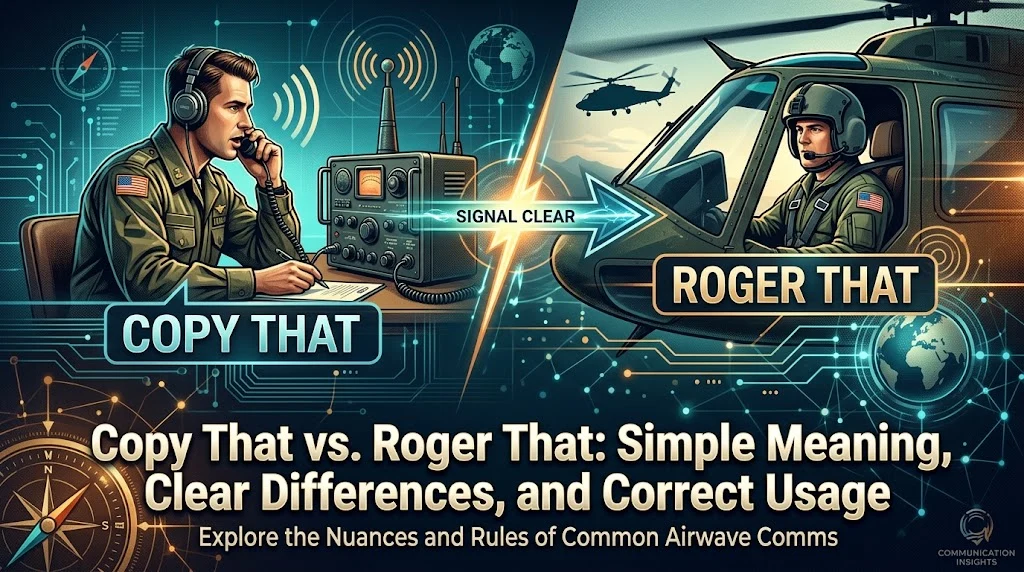
If you’ve watched enough military movies, police dramas, aviation scenes, or old action films, you’ve probably heard “Copy that” and “Roger that.” They sound almost interchangeable, and in casual conversation they often are.
But there’s a small yet important distinction hiding underneath.
Both expressions can acknowledge a message. However, “copy” focuses on receiving or understanding information, while “roger” traditionally signals that a message has been received. Neither phrase automatically means “I agree” or “I’ll do it.”
That last point matters more than you might expect.
If someone gives you an instruction and you answer “Copy that,” you’ve acknowledged the message. You haven’t necessarily promised to follow it. If you say “Wilco,” however, you’re using a term that traditionally combines receipt with an intention to comply.
This guide breaks down copy that vs. roger that, their origins, modern meanings, examples, radio terminology, common mistakes, and the practical difference between acknowledgment and action.
Why People Get Confused About “Copy That” vs. “Roger That”
The confusion makes sense because both phrases often appear in the same kinds of conversations.
Imagine a pilot receiving information from another crew member:
“The weather is clearing to the north.”
The response might be:
“Roger that.”
In another context, someone might say:
“The meeting has moved to 3 p.m.”
The reply:
“Copy that.”
Both responses tell the other person that the information reached the listener.
So where’s the difference?
The answer lies partly in radio terminology and historical usage. These phrases developed in communication environments where every word needed to carry useful information.
Radio operators couldn’t rely on facial expressions, gestures, or the easy back-and-forth of face-to-face conversation. They needed concise signals that communicated whether a transmission had been received.
Over time, popular culture simplified those distinctions.
Today, “roger that” and “copy that” overlap heavily in ordinary American English. Still, their traditional radio meanings aren’t identical.
The simplest distinction
| Phrase | Core idea |
| Copy that | I received/understood that message. |
| Roger that | I received your message. |
| Wilco | I received your instruction and will comply. |
Think of it this way:
Copy = receipt or understanding.
Roger = receipt.
Wilco = compliance.
That’s the basic framework to remember throughout the article.
What Does “Copy That” Mean?
Simple Meaning of “Copy That”
“Copy that” means “I received and understood your message.”
The word copy has a specialized meaning in radio communication. It doesn’t mean making a duplicate document or reproducing something.
Instead, it indicates that the listener successfully received the transmission.
For example:
“Flight team, proceed to the north entrance.”
“Copy that.”
The response acknowledges the information. Depending on the context, the speaker may also understand what was communicated.
However, “copy that” doesn’t inherently promise action.
That’s an important distinction.
If your manager says:
“Please send the revised report before noon.”
You could respond:
“Copy that.”
The manager knows you received the instruction. But the phrase itself doesn’t have the precise compliance meaning of “wilco.”
In ordinary workplace English, however, people often use “copy that” more loosely to mean:
“Got it. I’ll take care of it.”
That’s a modern conversational interpretation rather than the narrowest traditional radio meaning.
Where “Copy That” Comes From
The use of copy in communication grew from the practical language of radio and telecommunications.
When people communicate through a radio system, they need to know whether the other party can hear the transmission. A short acknowledgment such as “copy” provides that information efficiently.
The expression is especially associated with military, emergency, aviation, and other operational communication.
The exact conventions can vary between services and communication systems. That’s why it’s better to think of “copy” as operational radio language rather than a universal technical command with one identical definition everywhere.
The phrase became especially familiar to the public through movies, television, video games, and other entertainment.
Today, you might hear:
“We’re five minutes away.”
“Copy that.”
No radio is involved.
Here, the speaker is borrowing the style of radio communication and using it as casual shorthand for “Got it.”
How “Copy That” Is Used Today
Modern American English uses “copy that” in several ways.
Radio and operational communication
In a genuine radio-style environment, “copy” can acknowledge that a transmission has been received.
For example:
“Unit 4, the roadblock is now in place.”
“Copy that.”
Workplace communication
Coworkers sometimes use the phrase casually:
“The client wants the presentation moved to Friday.”
“Copy that.”
This sounds more informal and jargon-heavy than:
“Understood.”
Informal conversation
Someone might say:
“Pick up some milk on your way home.”
“Copy that.”
Here, the phrase is playful rather than technical.
Online communication
You may also see “copy that” in text messages, gaming chats, and online communities.
A gamer might write:
“Hold your position until the next round.”
“Copy that.”
The phrase retains its radio-inspired flavor even without spoken communication.
Examples of “Copy That”
Here are several examples showing how the phrase works in different situations:
Receiving information:
“The delivery truck arrived at the south entrance.”
“Copy that.”
Acknowledging a change:
“The presentation will start at 10 instead of 9.”
“Copy that.”
Acknowledging a direction:
“Take the second exit after the bridge.”
“Copy that.”
Casual use:
“Don’t forget your keys.”
“Copy that.”
Notice the pattern. The speaker acknowledges what they heard. The exact degree of commitment depends on context.
What Does “Roger That” Mean?
Simple Meaning of “Roger That”
“Roger that” traditionally means that the speaker received the transmitted message.
The word roger has a fascinating history in radio communication.
It isn’t simply a random name that somehow became attached to radios.
Historically, Roger represented the letter R in an older phonetic spelling system. Since R could stand for “received,” saying “Roger” became a way to indicate that a transmission had been received.
The phrase “roger that” therefore developed as a concise acknowledgment.
For example:
“The convoy will leave at 0600.”
“Roger that.”
In traditional usage, the second speaker has acknowledged receipt.
That doesn’t automatically mean:
“I agree.”
Nor does it necessarily mean:
“I will carry out the order.”
Those meanings can be inferred from context, especially in modern casual speech. They aren’t built into the word roger itself.
Where “Roger” Comes From
The history of roger is one of the most interesting parts of this comparison.
Before the current NATO phonetic alphabet became standard, different phonetic systems used different words to represent letters.
In the older system used in military and radio communication, “Roger” represented the letter R.
Why R?
Because R was associated with “received.”
So when an operator transmitted information and the other operator responded with “Roger,” the response effectively indicated that the message had been received.
The modern NATO phonetic alphabet later standardized Romeo for the letter R. That’s why today’s official spelling alphabet uses:
- Alpha
- Bravo
- Charlie
- Delta
- …
- Romeo
rather than Roger.
Yet “roger” survived as a radio acknowledgment.
That survival explains something that often confuses people: Roger is both an ordinary personal name and a specialized communication term.
The two meanings simply coexist.
For historical background on radiotelephony and standardized spelling alphabets, resources from the International Telecommunication Union and NATO provide useful context.
How “Roger That” Is Used Today
In modern American English, “roger that” has moved beyond strict radio procedure.
You may hear it in:
Military-style dialogue
“Move to the eastern checkpoint.”
“Roger that.”
Aviation-style communication
“The runway is clear.”
“Roger.”
Emergency or operational settings
“Team two is approaching the site.”
“Roger that.”
Everyday conversation
“I’ll meet you at the restaurant at seven.”
“Roger that.”
The last example isn’t formal radio language. It’s an informal borrowing of radio jargon.
Sometimes people use it humorously because it gives an ordinary conversation a slightly tactical or dramatic tone.
Examples of “Roger That”
Acknowledging information:
“The shipment arrives tomorrow.”
“Roger that.”
Acknowledging a direction:
“Wait here until the supervisor arrives.”
“Roger that.”
Radio-style casual conversation:
“Meet me at the north gate.”
“Roger that.”
Playful everyday use:
“Don’t eat the last slice.”
“Roger that.”
In the last example, the speaker may intend to communicate more than simple receipt. Context does much of the work.
Copy That vs. Roger That: The Simple Difference
At first glance, these phrases appear identical.
They’re not quite identical historically.
“Copy that”
The emphasis is on receiving or understanding the message.
“Copy that” ≈ “I received that.”
“Roger that”
The traditional emphasis is on receipt of the message.
“Roger that” ≈ “Message received.”
“Wilco”
The meaning goes a step further.
“Wilco” ≈ “I received your instruction and will comply.”
This distinction becomes particularly useful when somebody gives an instruction.
Consider this exchange:
Supervisor: “Move the equipment inside.”
Employee: “Copy that.”
The employee acknowledges the instruction.
Now compare:
Supervisor: “Move the equipment inside.”
Employee: “Wilco.”
The second response explicitly signals an intention to comply.
In everyday English, people may use “copy that” as if it means “I’ll do it.” In strict communication terminology, however, acknowledgment and compliance are separate concepts.
What “Copy That” and “Roger That” Do NOT Mean
Neither phrase automatically communicates all of the following:
- I agree.
- You’re correct.
- I approve.
- I will do it.
- I promise to follow the instruction.
- I accept responsibility.
Context can add those meanings, but the words themselves don’t necessarily carry them.
That’s why clear communication sometimes calls for a more direct response.
If you mean:
“Yes, I agree.”
Say “Yes” or “Agreed.”
If you mean:
“I’ll do it.”
Say “I’ll do it.”
If you mean:
“I received your instruction and will comply.”
In traditional radio terminology, “Wilco” expresses that idea more directly.
Copy That vs. Roger That Comparison Table
| Feature | Copy That | Roger That | Wilco |
| Basic function | Acknowledge receipt/understanding | Acknowledge receipt | Acknowledge and indicate compliance |
| Radio association | Strong | Strong | Strong |
| Means “message received” | Yes | Yes | Yes |
| Automatically means agreement | No | No | No |
| Automatically promises action | No | No | Yes, traditionally |
| Everyday use | Common informal jargon | Common informal jargon | Less common |
| Tone | Direct, radio-style | Radio-style, sometimes playful | Technical/operational |
| Useful for instructions | Acknowledges them | Acknowledges them | Signals intended compliance |
The most useful takeaway is simple:
Receiving a message isn’t the same as agreeing to it or promising to act on it.
That distinction sits at the heart of copy that vs. roger that.
A Word That Actually Means Action: Wilco
What Does “Wilco” Mean?
“Wilco” is short for “will comply.”
It developed as a concise radio expression for acknowledging an instruction while indicating that the speaker intends to follow it.
That’s why wilco is more specific than either “roger” or “copy.”
Suppose someone says:
“Proceed to the designated location.”
A response of:
“Roger.”
means the message has been received.
A response of:
“Copy.”
similarly acknowledges the transmission.
But:
“Wilco.”
communicates the additional idea that the instruction will be followed.
Why this distinction matters
Radio communication works best when every response tells the other person something useful.
If you need only to confirm receipt, an acknowledgment works.
If you need to confirm intended compliance, wilco provides more information.
Example of Wilco
Control: “Proceed to checkpoint three and report when you arrive.”
Operator: “Wilco.”
The response communicates more than “I heard you.”
It indicates an intention to comply with the instruction.
Other Radio Words People Often Misuse
Radio language has produced several expressions that people recognize without always understanding their technical roles.
What Does “Over” Mean?
“Over” traditionally indicates that the speaker has finished transmitting and expects the other party to respond.
For example:
“Do you have visual confirmation? Over.”
That tells the other person:
I’m finished speaking. Your turn.
It functions almost like handing someone the conversational baton.
What Does “Out” Mean?
“Out” indicates that the communication is finished.
It normally doesn’t invite another response.
For example:
“The situation is secure. Out.”
The speaker is ending the exchange.
Why “Over and Out” Is Usually Wrong
Here’s where movies have had a powerful influence.
You’ve probably heard someone say:
“Roger that. Over and out.”
It sounds convincingly radio-like.
Traditionally, though, the two words perform different jobs.
- Over = I’m finished speaking and expect a response.
- Out = I’m finished communicating and don’t expect a response.
Putting them together creates a contradiction in traditional radio procedure.
It’s essentially like saying:
“Your turn to speak. Conversation finished.”
The phrase survives because “over and out” sounds dramatic and memorable. Popular culture helped make it familiar even though it doesn’t match the traditional distinction between the two terms.
Why Radio Language Is Short and Simple
Radio communication has one major problem that ordinary conversation doesn’t:
The other person may not hear you clearly.
Static, interference, distance, background noise, equipment limitations, and overlapping transmissions can all create confusion.
That’s why radio communication favors:
- Short phrases
- Standardized words
- Clear pronunciation
- Limited ambiguity
- Repeated critical information
- Explicit turn-taking
Imagine trying to explain a complicated instruction through a weak radio signal.
Every unnecessary word creates another opportunity for misunderstanding.
Concise language helps.
Instead of saying:
“Yes, I heard everything you just told me and I understand the information that you transmitted.”
A radio operator can use a short acknowledgment.
That efficiency isn’t about sounding cool. It’s about reducing communication friction.
The same principle appears in aviation phraseology, emergency communication, maritime communication, and other environments where misunderstanding can have serious consequences.
How Movies and TV Shows Caused Confusion
Hollywood didn’t invent these expressions. It did, however, help turn them into cultural shorthand.
Military and police characters frequently say:
“Roger that.”
“Copy.”
“Over.”
“Wilco.”
“Over and out.”
The phrases immediately tell viewers that the characters are communicating through radios.
That’s useful storytelling.
The problem arises when fictional dialogue compresses or combines terminology for dramatic effect.
A movie doesn’t need to teach viewers the precise distinctions between acknowledgment, compliance, and transmission control.
It needs the scene to move.
As a result, popular culture often treats roger, copy, over, and out as interchangeable pieces of generic “radio talk.”
Real communication procedures can be more specific.
That’s why someone who learned radio terminology primarily from movies may have a slightly different understanding than someone trained in an actual communications environment.
Common Mistakes With “Copy That” and “Roger That”
Mistake: Assuming “Roger” Means “I Agree”
It doesn’t necessarily.
Traditionally, roger indicates receipt of a message.
If you agree with a proposal, say:
“Agreed.”
If you understand a difficult explanation, say:
“I understand.”
Those statements remove ambiguity.
Mistake: Assuming “Copy” Means “I’ll Do It”
Again, not automatically.
“Copy that.”
can mean:
“I received your message.”
If action matters, make the response explicit.
“Copy that. I’ll handle it.”
Now the communication contains both acknowledgment and commitment.
Mistake: Treating “Wilco” as Identical to “Roger”
This is one of the most important distinctions.
Roger acknowledges receipt.
Wilco traditionally adds compliance.
They’re related, but they’re not identical.
Mistake: Using Radio Jargon Everywhere
“Copy that” can sound perfectly natural in a casual conversation.
But it can sound strange in a formal email.
Instead of writing:
“Roger that, I’ll submit the documents.”
a professional email might simply say:
“Understood. I’ll submit the documents by Friday.”
Plain English often wins when clarity matters more than style.
Case Study: A Simple Communication Failure
Consider a fictional workplace scenario.
A warehouse supervisor tells an employee:
“Move the damaged boxes to the inspection area and don’t ship them.”
The employee responds:
“Copy that.”
The supervisor assumes the employee understood the entire instruction.
Later, the employee moves the boxes but doesn’t realize that “don’t ship them” was part of the instruction.
What went wrong?
The problem isn’t necessarily the phrase itself. The bigger issue is that the acknowledgment didn’t demonstrate exactly what the employee understood or intended to do.
A clearer response would be:
“Copy that. I’ll move the damaged boxes to inspection and hold them from shipment.”
That response removes ambiguity.
This example illustrates an important communication principle:
A short acknowledgment isn’t always enough when the instruction contains multiple critical details.
In safety-sensitive or operational situations, repeating key information can be more useful than relying on a vague acknowledgment.
Copy That vs. Roger That in Everyday English
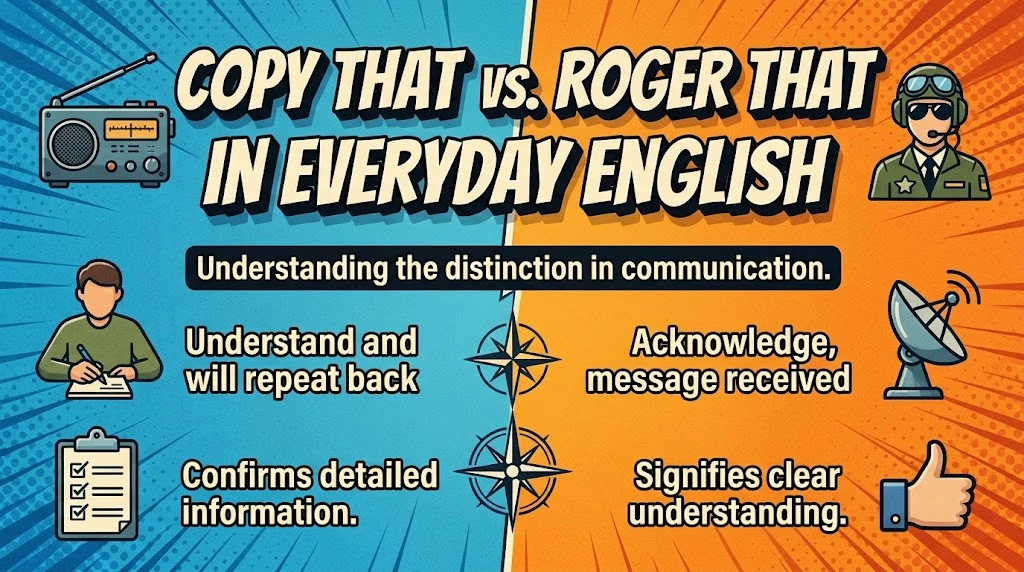
The two phrases have become part of informal American speech.
Still, they carry slightly different flavors.
When “Copy That” Sounds Natural
Use “copy that” when you want an informal acknowledgment with a radio-inspired tone.
For example:
“Send me the updated schedule when you’re done.”
“Copy that.”
It sounds brisk and casual.
When “Roger That” Sounds Natural
“Roger that” often feels a little more theatrical or radio-like.
For example:
“Meet me outside in five minutes.”
“Roger that.”
The meaning is clear, but the tone may suggest military or aviation language.
That’s sometimes intentional.
A friend might say it jokingly because it makes an ordinary instruction sound like a mission briefing.
When Plain English Is Better
Some situations call for straightforward wording.
Use expressions such as:
- Understood.
- Got it.
- I understand.
- I’ll do that.
- Agreed.
- Message received.
- I’ll take care of it.
These expressions are especially useful in:
- Business emails
- Formal documentation
- Customer service
- Legal communication
- Safety instructions
- Written procedures
- Situations where ambiguity could cause problems
You don’t need radio jargon when ordinary English communicates the meaning more precisely.
Copy That vs. Roger That: Quick Decision Guide
When you’re deciding between these expressions, ask yourself what you actually want to communicate.
| Your intended meaning | Best wording |
| I received the message | Roger / Copy that |
| I understood the information | Copy that |
| I received the instruction and will comply | Wilco |
| I agree with you | Agreed |
| I will do it | I’ll do it |
| Please repeat the message | Say again |
| Wait for further communication | Stand by |
| I’m finished transmitting and expect a reply | Over |
| The communication is finished | Out |
This approach is more reliable than memorizing one phrase as a universal replacement for another.
Copy That vs. Roger That: Which One Should You Use?
The answer depends on what you mean and where you’re communicating.
If you’re using ordinary American English, both “copy that” and “roger that” can work as informal acknowledgments.
If you want to emphasize that you’ve received or understood information, “copy that” fits naturally.
If you want a traditional radio-style acknowledgment, “roger” or “roger that” carries that established flavor.
If someone gives you an instruction and you specifically want to communicate that you’ll comply, “wilco” is the more precise traditional radio term.
For professional writing, though, plain English is often clearer.
Instead of:
“Roger that.”
you might write:
“Understood.”
Instead of:
“Copy that.”
you might write:
“I received your message.”
Instead of:
“Wilco.”
you might write:
“I’ll take care of it.”
The best phrase isn’t necessarily the most technical one. It’s the one that communicates your intended meaning without leaving room for confusion.
Read More : On Tuesday Morning vs. In the Tuesday Morning: Which Is Correct?
Copy That vs. Roger That: Key Takeaways
The difference becomes much easier once you separate receipt, understanding, agreement, and compliance.
Copy that
Usually communicates:
“I received and understood that.”
Roger that
Traditionally communicates:
“I received your message.”
Wilco
Traditionally communicates:
“I received your instruction and will comply.”
And there’s one more distinction worth remembering:
Acknowledging information doesn’t automatically mean agreeing with it or promising to act on it.
That’s the little detail that separates accurate radio terminology from the loose way these expressions often appear in movies and everyday conversation.
FAQs About Copy That vs. Roger That
What does “copy that” mean?
“Copy that” means that you received and understood a message or transmission. It comes from radio communication terminology and is now common as informal jargon in everyday English.
It doesn’t inherently mean that you agree with the message or promise to follow an instruction.
What does “roger that” mean?
“Roger that” traditionally means that a message has been received.
The term roger comes from the historical phonetic representation of the letter R, which was associated with “received.” Modern speakers also use “roger that” casually to mean “Got it” or “Understood.”
Are “copy that” and “roger that” the same?
They overlap significantly, especially in modern casual speech.
Both can acknowledge receipt of a message. Historically, however, “roger” specifically developed as an acknowledgment of receipt, while “copy” emphasizes receiving or understanding the transmission.
The distinction can become less noticeable in everyday conversation.
When should I use “copy that” vs. “roger that”?
Use “copy that” when you want an informal acknowledgment that emphasizes receipt or understanding.
Use “roger that” when you want a traditional or radio-style acknowledgment.
In ordinary professional communication, expressions such as “Understood,” “Got it,” or “I’ll take care of it” may communicate your meaning more directly.
Does “copy that” mean “I will do it”?
Not necessarily.
“Copy that” acknowledges the message. It doesn’t inherently promise compliance.
For example:
“Please review this report.”
“Copy that.”
The listener acknowledges the request. The phrase itself doesn’t explicitly say the review will happen.
Does “roger that” mean “yes”?
Not exactly.
“Roger” traditionally acknowledges receipt, not agreement.
Someone can receive a statement without agreeing with it.
For example:
“The meeting is canceled.”
“Roger.”
That means the information was received. It doesn’t necessarily mean the person approves of the cancellation.
What does “wilco” mean?
“Wilco” is an abbreviation of “will comply.”
In traditional radio terminology, it communicates both receipt of an instruction and an intention to comply with it.
That makes it more action-oriented than “roger” or “copy.”
Is “copy that” formal English?
It’s standard enough to be understood by most American English speakers, but it has a distinctly informal, radio-inspired tone.
For formal writing, alternatives such as “Understood,” “Acknowledged,” or “I received your message” are often clearer.
Can you use “roger that” in everyday conversation?
Yes.
People commonly use “roger that” informally, especially when they want a playful or radio-style tone.
For example:
“Don’t forget to bring the tickets.”
“Roger that.”
There’s no actual radio involved. The speaker is simply borrowing familiar communication jargon.
Why do people say “over and out”?
The phrase became popular through movies, television, and general cultural usage.
Traditionally, “over” indicates that the speaker has finished transmitting and expects a response. “Out” indicates that the communication is ending.
Because those functions differ, “over and out” conflicts with traditional radio terminology even though the phrase remains widely recognizable.
Conclusion
“Copy that” and “roger that” are closely related but aren’t perfect historical synonyms.
Both can acknowledge a received message. “Copy that” generally emphasizes receiving or understanding information, while “roger that” traditionally indicates that a message has been received.
Neither one automatically means “I agree” or “I’ll do it.”
That’s where “wilco” enters the picture. Derived from “will comply,” it traditionally communicates an intention to follow an instruction.
The distinction may seem tiny, but it reveals something important about effective communication. Hearing a message, understanding it, agreeing with it, and acting on it are four different things.
In casual conversation, you can use “copy that” or “roger that” without worrying about strict radio procedure. In professional or safety-sensitive communication, however, direct wording often works better.
If you mean “I understand,” say so.
If you mean “I agree,” say that.
If you mean “I’ll do it,” make the commitment clear.
Good communication doesn’t need to sound like a Hollywood radio scene. It just needs to leave the right message on the other side.