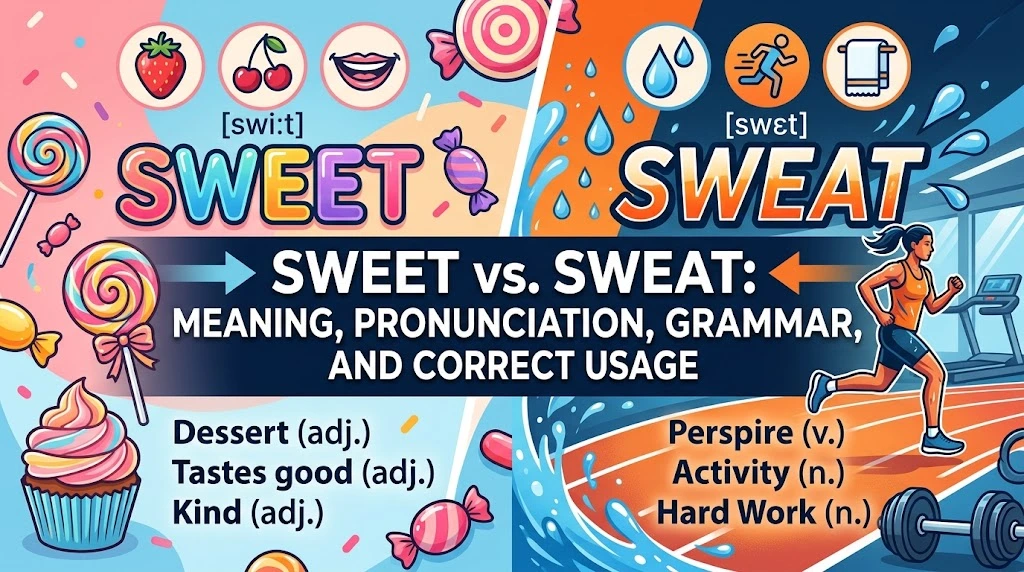
At first glance, sweet and sweat look like close relatives. They begin with the same three letters, contain similar sounds, and differ by only one vowel in spelling. Yet their meanings have almost nothing in common.
Sweet can describe a sugary taste, a pleasant smell, a kind person, or even a satisfying victory. Sweat, meanwhile, refers to the salty liquid your body produces when you’re hot, nervous, or physically active. It can also work as a verb meaning to perspire, work hard, or worry.
That small spelling difference matters.
Compare these sentences:
- The tea is sweet.
- The runner is covered in sweat.
One sentence describes taste. The other describes perspiration.
The confusion becomes even more interesting when you encounter expressions such as “Sweet!”, “No sweat,” “Don’t sweat it,” and “sweet tooth.” These words have developed several meanings that go well beyond their basic dictionary definitions.
This guide explains sweet vs. sweat from every practical angle, including meaning, pronunciation, grammar, word forms, idioms, figurative language, common mistakes, and everyday conversation.
Sweet vs. Sweat: The Basic Difference
The easiest way to separate these words is to connect each one with its central idea.
| Word | Basic meaning | Common grammatical role | Example |
| Sweet | Pleasant in taste, smell, sound, appearance, or behavior | Adjective, noun, exclamation | “The strawberries are sweet.” |
| Sweat | Salty moisture produced through the skin | Noun, verb | “I started to sweat.” |
Think of sweet as belonging to the world of pleasantness.
Think of sweat as belonging to the world of perspiration and effort.
That simple mental division solves most cases.
What Does “Sweet” Mean?
Sweet has several meanings, but its most familiar meaning relates to taste.
When food or drink contains a noticeable sugary taste, you can describe it as sweet.
For example:
- “This mango is sweet.”
- “The coffee is too sweet.”
- “She ordered a sweet dessert.”
- “I prefer sweet snacks to salty ones.”
Cambridge Dictionary defines sweet as describing food or drink that has a taste similar to sugar rather than being bitter or salty. It also lists broader meanings involving pleasant sounds, attractive qualities, kindness, and positive feelings.
However, taste is only the beginning.
You can also use sweet to describe something pleasant or attractive:
“She has a sweet voice.”
Here, sweet doesn’t mean her voice contains sugar. It means her voice sounds pleasant.
The same idea appears when describing someone’s personality:
“He’s a very sweet person.”
In this sentence, sweet means kind, caring, pleasant, or likable.
You might also describe a gesture as sweet:
“That was such a sweet thing to do.”
The gesture isn’t sugary. Its emotional quality is pleasant or thoughtful.
What Does “Sweat” Mean?
Sweat has a much more physical starting point.
As a noun, sweat means the clear, salty liquid that passes through your skin. Cambridge Dictionary lists this as the ordinary noun meaning and gives examples involving exercise, heat, and physical activity.
For example:
- “There was sweat on his forehead.”
- “She wiped the sweat from her face.”
- “The players were covered in sweat.”
- “I could feel sweat running down my back.”
As a verb, sweat means to produce sweat.
For example:
- “I always sweat when I exercise.”
- “He was sweating because the room was hot.”
- “She started sweating before the interview.”
The word can also move beyond literal perspiration. Sweat can refer to hard work or worry.
For instance:
“They sweated for months to finish the project.”
Here, the word emphasizes effort rather than actual perspiration.
Likewise:
“Don’t sweat the small stuff.”
This means don’t worry excessively about minor problems.
Sweet vs. Sweat Pronunciation
Pronunciation creates much of the confusion between these words.
They both begin with the consonant sequence /sw/ and end with /t/. The crucial difference appears in the vowel.
How to Pronounce “Sweet”
In standard US English, sweet is pronounced /swiːt/. Cambridge’s US pronunciation entry gives the same pronunciation and identifies the long /iː/ vowel.
The vowel is the same basic sound you hear in words such as:
- see
- green
- need
- sleep
- tree
The vowel is relatively long.
How to Pronounce “Sweat”
In standard US English, sweat is pronounced /swɛt/. Cambridge identifies the vowel as the sound heard in words such as head.
The key vowel is shorter and more open than the vowel in sweet.
Compare:
sweet → /swiːt/
sweat → /swɛt/
The beginning and ending are nearly identical. The vowel changes the word.
The Sound Difference
A useful way to practice the contrast is to say these pairs slowly:
- sweet / sweat
- sweet / sweat
- sweet / sweat
First stretch the vowel in sweet.
Then use the shorter vowel in sweat.
Don’t rely only on spelling. English spelling can be a slippery guide to pronunciation. Train your ear to notice the vowel instead.
Sweet vs. Sweat: Grammar and Word Forms
These words also behave differently grammatically.
Sweet as an Adjective
The most common grammatical role of sweet is adjective.
It modifies a noun:
- sweet fruit
- sweet tea
- sweet smell
- sweet song
- sweet child
- sweet gesture
- sweet personality
For example:
“We bought some sweet strawberries.”
Here, sweet tells you something about the strawberries.
Because it is an adjective, it can also take comparative and superlative forms:
- sweet
- sweeter
- sweetest
Examples:
- “This apple is sweet.”
- “That apple is sweeter.”
- “These are the sweetest strawberries I’ve ever tasted.”
The same pattern works with figurative meanings:
“Her second novel was even sweeter than her first success.”
Sweet as a Noun
Sweet can also function as a noun.
In US English, sweet can refer to sweet food, although candy is often the more natural everyday term when talking about confectionery.
For example:
“I try not to eat too many sweets.”
Cambridge’s American Dictionary notes that sweet can function as a noun for food containing a lot of sugar.
The term sweets is particularly common in British English, where it can refer to candy.
For US readers, candy will often sound more natural in everyday conversation.
Sweet as an Exclamation
There’s another useful conversational use:
“Sweet!”
In informal American English, sweet can express happiness, approval, or excitement about something. Cambridge specifically records this informal exclamation.
For example:
“I got us tickets to the concert.”
“Sweet!”
Here, sweet doesn’t describe taste at all.
It means something closer to “Great!” or “Awesome!”
Sweat as a Noun
Sweat commonly works as an uncountable noun when referring to bodily perspiration.
For example:
- “I was covered in sweat.”
- “Sweat dripped from his forehead.”
- “She wiped the sweat from her face.”
- “The shirt was soaked with sweat.”
You generally don’t say:
“I have three sweats.”
when referring to three drops of bodily perspiration.
Instead, you can use countable expressions such as:
- a drop of sweat
- a bead of sweat
- drops of sweat
- beads of sweat
Cambridge gives bead of sweat as a standard expression.
Sweat as a Verb
Sweat can also describe the action of producing perspiration.
Examples include:
- “I sweat a lot during workouts.”
- “He was sweating heavily.”
- “She started to sweat.”
- “They were sweating in the heat.”
Its verb forms can be summarized like this:
| Form | Example |
| Base form | sweat |
| Present participle | sweating |
| Past form | sweat / sweated |
| Past participle | sweat / sweated |
Cambridge’s American Dictionary lists both sweat and sweated as possible past forms, with usage varying by context and style.
Sweet vs. Sweat in Everyday English
These words appear frequently in ordinary conversation.
Common Uses of “Sweet”
You’ll often hear sweet when people talk about:
- food
- drinks
- desserts
- smells
- sounds
- kindness
- affection
- attractive things
- satisfying outcomes
- informal approval
Consider these examples:
“This lemonade is really sweet.”
“That puppy is so sweet.”
“She gave me a sweet note.”
“He has a sweet singing voice.”
“Sweet! We finished early.”
Notice how dramatically the meaning changes with context.
Common Uses of “Sweat”
Sweat commonly appears when people talk about:
- exercise
- hot weather
- physical work
- nervousness
- fear
- stress
- effort
- worry
For example:
“I always sweat during my morning workout.”
“The heat made everyone sweat.”
“He was sweating before his presentation.”
“We put a lot of sweat into this project.”
That last example shows how sweat can become a metaphor for effort.
Sweet vs. Sweat in Figurative Language

English often takes physical experiences and turns them into metaphors. Both words have developed figurative uses.
Using “Sweet” Figuratively
Sweet frequently communicates pleasure, kindness, affection, or satisfaction.
Consider these expressions:
Sweet gesture
A kind or thoughtful action.
“Bringing her flowers was a sweet gesture.”
Sweet victory
A particularly satisfying success.
“Beating their longtime rivals was a sweet victory.”
Sweet dreams
A friendly expression used when wishing someone pleasant sleep.
“Good night. Sweet dreams.”
Sweet deal
An attractive or favorable arrangement.
“They got a sweet deal on the new apartment.”
Sweet talk
Language used to charm, persuade, or flatter someone.
“He tried to sweet-talk his way out of the parking ticket.”
In each case, the meaning extends from the basic idea of something pleasant.
Using “Sweat” Figuratively
Sweat often represents effort, anxiety, or hard work.
One of the most common expressions is:
“Don’t sweat it.”
This informal American expression means don’t worry about it.
Example:
“Sorry I forgot to call.”
“Don’t sweat it. It’s fine.”
Another common expression is:
“No sweat.”
It means something is easy or not a problem.
“Can you send me the report?”
“No sweat.”
You can also say:
“Sweat it out.”
This means to wait anxiously for something to happen or endure an uncomfortable situation until it ends.
“We had to sweat it out while waiting for the final results.”
And there’s:
“Sweat over something.”
This means to work hard on something or struggle with it.
“She sweated over every detail of the presentation.”
Cambridge lists sweat it out, sweat over something, sweat blood, and sweat bullets among expressions built around the word.
Sweet vs. Sweat Idioms and Expressions
| Expression | Meaning | Example |
| sweet tooth | A strong liking for sweet foods | “I have a serious sweet tooth.” |
| sweet dreams | A friendly wish for pleasant sleep | “Good night, sweet dreams.” |
| sweet talk | Charming or flattering speech | “He tried to sweet-talk the customer.” |
| sweet spot | An ideal position, range, or condition | “The price is in the sweet spot.” |
| sweet victory | Especially satisfying success | “It was a sweet victory.” |
| no sweat | No problem; easy | “No sweat. I’ll handle it.” |
| don’t sweat it | Don’t worry | “Don’t sweat it. Everything’s fine.” |
| sweat it out | Endure an anxious wait | “We had to sweat it out.” |
| sweat over | Work hard on something | “She sweated over the report.” |
| sweat bullets | Be extremely nervous | “He was sweating bullets before the interview.” |
These expressions are worth learning as complete phrases. Trying to translate each word literally can produce strange interpretations.
Common Mistakes with Sweet and Sweat
The biggest mistakes usually come from spelling or pronunciation.
Mistake: Using “Sweet” for Perspiration
Incorrect:
“I was sweeting after the workout.”
Correct:
“I was sweating after the workout.”
The verb comes from sweat, not sweet.
Mistake: Using “Sweat” for Taste
Incorrect:
“This cake is very sweat.”
Correct:
“This cake is very sweet.”
A cake can make you sweat if the room is hot. The cake itself is sweet if it tastes sugary.
Mistake: Confusing “Sweet” and “Sweaty”
This is another common trap.
Sweet means pleasant, sugary, kind, attractive, or satisfying.
Sweaty means covered in sweat or producing a lot of sweat. Cambridge defines sweaty as an adjective describing something covered in or associated with sweat.
Compare:
“He is a sweet guy.”
This describes his personality.
“He is a sweaty guy.”
This suggests he is covered in sweat or tends to sweat heavily.
The difference is more than one letter. The meaning changes completely.
Mistake: Confusing “Sweetie” and “Sweaty”
These words can look confusing in informal writing.
Sweetie is an affectionate term for someone.
“Thanks, sweetie.”
Sweaty means covered in sweat.
“My shirt is sweaty after the workout.”
A simple memory rule helps:
Sweetie → affection
Sweaty → perspiration
Sweet vs. Sweat: A Real-Life Case Study
Imagine an English learner writing a message to a friend after a soccer match.
They want to say:
“You played really well today. You’re so sweet!”
That sentence is grammatically possible, but it doesn’t communicate the intended idea if the learner actually means that the friend played with impressive skill.
Now imagine the learner writes:
“You were really sweat today.”
That sentence is incorrect.
If the intended meaning is that the player was covered in perspiration, the correct sentence would be:
“You were really sweaty today.”
If the intended meaning is that the person behaved kindly, then:
“You were really sweet today.”
This small distinction demonstrates an important lesson: English words that look similar aren’t necessarily related in meaning.
Context matters.
The learner must identify the idea first and then choose the spelling.
Sweet vs. Sweat: Side-by-Side Examples
Sometimes the fastest way to learn the distinction is to see the words in parallel.
| Sweet | Sweat |
| “The tea is sweet.” | “I started to sweat.” |
| “She’s a sweet person.” | “His forehead was covered in sweat.” |
| “That was a sweet gesture.” | “The players were drenched in sweat.” |
| “The roses have a sweet smell.” | “I sweat when I’m nervous.” |
| “Sweet! We won the game.” | “Don’t sweat the details.” |
| “He has a sweet voice.” | “She sweated over the assignment.” |
| “This mango tastes sweet.” | “The heat made everyone sweat.” |
The pattern becomes obvious once you see enough examples.
Sweet usually points toward pleasantness.
Sweat points toward perspiration, effort, or worry.
Sweet, Sweaty, Sweetie, and Related Words
These words deserve special attention because they can cause spelling mistakes.
Sweet
Sweet is an adjective or noun and can describe taste, kindness, pleasantness, or approval.
“That was sweet of you.”
Sweaty
Sweaty is an adjective derived from sweat.
“My hands are sweaty.”
It describes something covered in sweat or associated with perspiration.
Sweetie
Sweetie is an affectionate noun.
“Come here, sweetie.”
It can be used as a term of affection toward a child, partner, friend, or another person, depending on the relationship and context.
Sweat
Sweat can be a noun or verb.
“There was sweat on his face.”
“He began to sweat.”
These relationships are easier to remember as a word family:
sweet → sweeter → sweetest → sweetie
sweat → sweaty → sweating
The spelling tells you which family you’re dealing with.
How to Remember Sweet vs. Sweat
A clever memory trick can save you from repeatedly checking the dictionary.
Memory Trick: Sweet Means Pleasant
Connect sweet with things that feel or taste good.
Think:
sweet → sugar → pleasant
That works for both literal and figurative meanings.
- sweet candy
- sweet fruit
- sweet smell
- sweet voice
- sweet person
- sweet gesture
Memory Trick: Sweat Means Perspiration
Connect sweat with physical activity.
Think:
sweat → exercise → perspiration
Imagine yourself after running up a steep hill.
You’re sweating.
You aren’t sweeting.
Memory Trick: Focus on the Vowel
This is the most useful pronunciation trick.
Sweet → /iː/
Sweat → /ɛ/
The vowel changes the word.
You can practice with another familiar contrast:
- sweet has the vowel quality found in green
- sweat has the vowel quality found in head
Cambridge’s pronunciation entries support this distinction directly.
Advanced Usage Notes for Sweet vs. Sweat
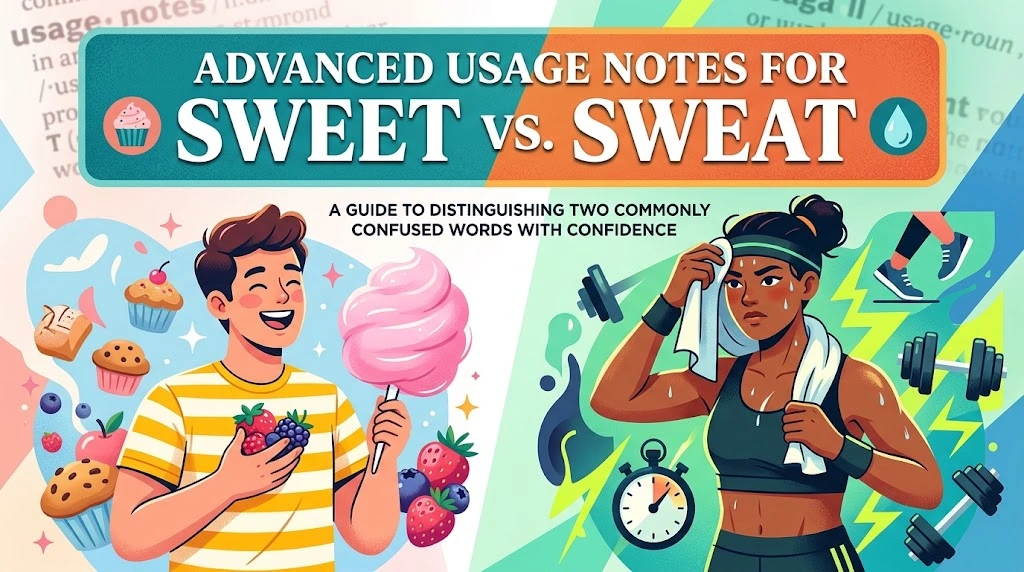
A few details become useful once the basic distinction is clear.
Is “Sweat” Countable?
When sweat means bodily perspiration, it is normally uncountable.
You usually say:
“There was sweat on the floor.”
Not:
“There were three sweats on the floor.”
If you need to count individual drops, use a countable noun:
“Three beads of sweat rolled down his face.”
However, sweats has another US English meaning. It can refer to casual athletic clothing such as sweatpants and a sweatshirt. Cambridge records sweats as a plural US noun for this type of clothing.
For example:
“I usually wear sweats at home.”
Here, sweats has nothing to do with perspiration.
Can “Sweet” Be Comparative?
Yes.
The standard forms are:
- sweet
- sweeter
- sweetest
Examples:
“This peach is sweet.”
“The second peach is sweeter.”
“That was the sweetest peach of the bunch.”
These forms work with both literal and figurative meanings.
Is “Sweet!” Formal?
Not usually.
“Sweet!” is an informal conversational expression. It works naturally among friends or in casual situations.
For formal professional writing, alternatives such as excellent, great, wonderful, or that sounds good may fit better depending on the context.
Read More : Here Is or Here Are? The Complete Guide to Using Them Correctly Every Time
Everyday Conversation Examples
Using “Sweet”
Example: Food
“This watermelon is incredibly sweet.”
Example: Personality
“Your sister is so sweet.”
Example: Kindness
“That was really sweet of you.”
Example: Approval
“You got the tickets?”
“Yep.”
“Sweet!”
Example: Sound
“She has a sweet singing voice.”
Each sentence uses sweet differently, but all the meanings connect to pleasantness or approval.
Using “Sweat”
Example: Exercise
“I always sweat a lot during cardio.”
Example: Weather
“It’s so hot that I’m sweating just sitting here.”
Example: Nervousness
“I started sweating before the interview.”
Example: Physical effort
“They worked and sweated through the entire afternoon.”
Example: Worry
“Don’t sweat the small stuff.”
These examples show how sweat can move naturally from physical perspiration to figurative anxiety and effort.
A Quick Decision Guide: Sweet or Sweat?
When you’re unsure, ask yourself what you’re trying to describe.
Use sweet when you’re talking about:
- sugar or sugary taste
- pleasant smells
- pleasant sounds
- kindness
- affection
- attractive qualities
- satisfying experiences
- informal approval
Example:
“The cookies are sweet.”
Use sweat when you’re talking about:
- perspiration
- physical heat
- exercise
- nervousness
- hard work
- worry
- certain idiomatic expressions
Example:
“I began to sweat during the workout.”
A quick mental test works surprisingly well:
Is the idea pleasant? → sweet.
Is the idea related to perspiration, effort, or worry? → sweat.
Sweet vs. Sweat: Quick Reference Table
| Category | Sweet | Sweat |
| Pronunciation | /swiːt/ | /swɛt/ |
| Main meaning | Pleasant or sugary | Perspiration |
| Common part of speech | Adjective | Noun and verb |
| Related adjective | Sweet | Sweaty |
| Comparative | Sweeter | Not normally applicable |
| Superlative | Sweetest | Not normally applicable |
| Figurative meaning | Kindness, pleasure, satisfaction | Effort, anxiety, worry |
| Informal expression | “Sweet!” | “No sweat!” |
| Common phrase | Sweet tooth | Don’t sweat it |
| Example | “She is sweet.” | “She is sweating.” |
Frequently Asked Questions About Sweet vs. Sweat
Is “sweet” a compliment?
Yes. Sweet can be a compliment when it describes someone’s kindness, behavior, personality, appearance, or a thoughtful action.
For example:
“That was sweet of you.”
The speaker is praising the person’s considerate behavior.
However, sweet can also describe food, smells, sounds, or experiences. Context determines the exact meaning.
Can “sweat” be used figuratively?
Yes.
Sweat has several figurative uses involving effort or worry. Common examples include “don’t sweat it,” “sweat the small stuff,” “sweat over something,” and “sweat it out.” Cambridge records these figurative and idiomatic uses in its current dictionary entry.
For example:
“Don’t sweat it. We can fix the mistake.”
Here, sweat means worry rather than perspire.
What is the difference between “sweetie” and “sweaty”?
Sweetie is an affectionate term for a person.
Sweaty means covered in or producing sweat.
Compare:
“Thanks, sweetie.”
“My shirt is sweaty.”
They look somewhat similar, but they belong to completely different word families.
Why do “sweet” and “sweat” look similar?
They share the spelling sw at the beginning and t at the end. The central vowel differs:
- sweet → /iː/
- sweat → /ɛ/
That small spelling difference represents a meaningful pronunciation difference. Cambridge lists the two US pronunciations as /swiːt/ and /swet/ respectively.
Is “sweat” ever plural?
Yes, but the meaning matters.
When sweat means bodily perspiration, it is normally uncountable. You can talk about drops of sweat or beads of sweat.
However, sweats is also a US English plural noun referring to casual athletic clothing such as sweatpants and sweatshirts.
For example:
“I bought two pairs of sweats.”
That sentence refers to clothing, not perspiration.
Final Takeaway: Sweet vs. Sweat
The difference between sweet and sweat looks tiny on the page, but the meanings are worlds apart.
Sweet usually connects with pleasantness. It can describe sugar, food, smells, sounds, people, gestures, experiences, and informal approval.
Sweat usually connects with perspiration. It can describe the moisture your body produces, the act of producing it, physical effort, or worry.
The pronunciation gives you another useful clue:
- sweet → /swiːt/
- sweat → /swɛt/
If you’re talking about a sugary dessert, a kind person, or a satisfying result, you probably need sweet.
If you’re talking about perspiration, exercise, hard work, or an expression such as “don’t sweat it,” you need sweat.
One final comparison makes the distinction easy to remember:
The cake is sweet. The runner is sweaty. The runner produces sweat.
That’s the whole family in one picture.
Once you connect sweet with pleasantness and sweat with perspiration, the spelling becomes much easier to remember. Cambridge Dictionary: Sweet Cambridge Dictionary: Sweat