
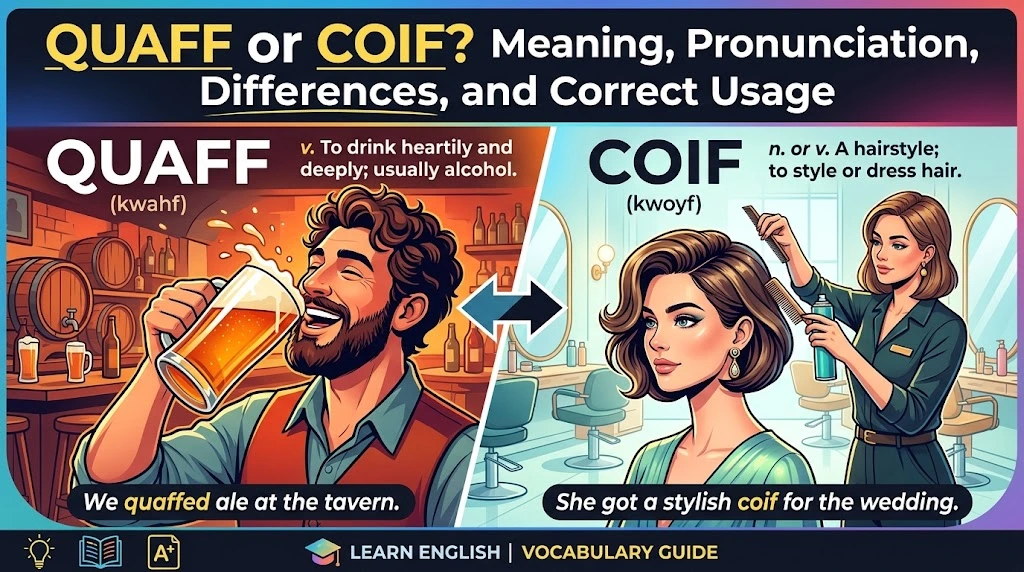
Quaff or coif? At first glance, these two words look like they belong in the same linguistic family. Their spellings are close, their final sound is similar, and one pronunciation of coif can even sound exactly like quaff in American English.
Yet their meanings take you in completely different directions.
Quaff is connected with drinking. If someone quaffs a beverage, they drink it deeply or quickly, often in a hearty way. Coif, meanwhile, has a much more complicated history. It can refer to a hairstyle or the act of styling hair. Historically, it also referred to a close-fitting cap or head covering.
That makes quaff vs. coif an especially interesting word pair. The confusion isn’t simply about spelling. It involves pronunciation, historical meaning, changing usage, and even different pronunciations of coif.
This guide breaks down the difference so you can recognize and use both words confidently.
What Does “Quaff” Mean?
Quaff is primarily a verb meaning to drink something heartily, deeply, or in a large amount, often fairly quickly.
For example:
The travelers quaffed cold water after their long journey.
The sentence doesn’t merely say that the travelers drank water. The verb quaff gives the action more force. It suggests a hearty or substantial drink.
Oxford’s American dictionary defines quaff as drinking a large amount of something quickly and marks the word as old-fashioned or literary.
Cambridge similarly defines it as drinking something quickly or in large amounts.
So if you see quaff in a modern sentence, think:
drink heartily or drink deeply.
Quaff as a Verb
The most common modern use of quaff is verbal.
You can use it with a direct object:
- They quaffed the wine.
- The guests quaffed champagne.
- The sailors quaffed their ale.
- After the race, she quaffed a glass of water.
You can also encounter the word in an intransitive construction:
- The guests gathered around the table and quaffed merrily.
However, the transitive form is especially natural when the beverage appears directly after the verb.
The regular forms are straightforward:
| Form | Example |
| Base form | They quaff the wine. |
| Third-person singular | He quaffs his drink. |
| Past tense | They quaffed the ale. |
| Past participle | She has quaffed several drinks. |
| Present participle | They are quaffing champagne. |
There’s an important stylistic point here.
You wouldn’t normally use quaff when you simply want to say that someone drank a glass of water. Drink is much more ordinary.
Quaff adds flavor.
It can make a scene sound literary, playful, exaggerated, festive, or deliberately old-fashioned.
Quaff as a Noun
Although quaff is mainly used as a verb today, it can also function as a noun.
As a noun, a quaff can mean a hearty drink or the act of drinking.
For example:
After the journey, the cold lemonade was a welcome quaff.
You may also encounter constructions such as:
He took a hearty quaff of the refreshing drink.
This noun use is considerably less common in everyday American English than the verb.
That’s worth remembering. If your goal is natural modern prose, drink will usually be the safer choice. If you’re deliberately creating a colorful or literary tone, quaff can be effective.
Quaff Pronunciation
In American English, quaff is commonly pronounced approximately:
/kwɑf/ or /kwæf/
Oxford lists American pronunciations including /kwɑːf/ and /kwæf/.
The opening qu- produces a /kw/ sound.
The important part is what happens when you compare it with coif. The words aren’t universally pronounced alike.
That distinction becomes especially important below.
Origin of the Word Quaff
The history of quaff isn’t completely settled.
Oxford dates the word to the early 16th century and says its origin was probably imitative of the sound of drinking.
Etymonline dates the verb to the 1510s and describes its origin as uncertain. It notes two major possibilities: an imitative origin or a connection with Low German quassen, meaning to overindulge in food and drink.
That uncertainty makes the history more interesting rather than less useful.
The word has been associated with the physical act of drinking for centuries. Its modern sense still carries that strong connection.
Quaff in Everyday English
Although quaff remains a valid English word, it isn’t an everyday replacement for drink.
Compare these sentences:
I drank some water.
I quaffed some water.
The first sounds completely ordinary.
The second sounds more colorful and deliberate. Depending on context, it may sound humorous, literary, or slightly archaic.
That’s one reason writers still use quaff. The word has personality.
What Does “Coif” Mean?
Coif has several related meanings, which makes it more complicated than quaff.
In modern English, coif can refer to a hairstyle or to the act of styling hair. Historically, however, a coif was a close-fitting cap or head covering.
So the word has two major semantic branches:
- Modern hair-related meaning: a hairstyle or styled hair.
- Historical clothing meaning: a close-fitting cap or head covering.
Collins lists both the hairstyle-related sense and several historical meanings involving caps and head coverings.
Coif as a Noun
As a noun, coif can mean a hairstyle or coiffure.
For example:
Her elegant coif complemented the formal gown.
Here, coif refers to the arrangement or styling of the hair.
However, this use isn’t especially common in casual American conversation. Most people would simply say hairstyle, hairdo, or hair.
You might see coif more often in:
- fashion writing
- literary descriptions
- historical writing
- beauty-related prose
- humorous descriptions of elaborate hair
The word can sound more stylized than the everyday alternatives.
Coif as a Historical Noun
The older meaning is quite different.
Historically, a coif was a close-fitting cap covering the head. Such head coverings appeared in various forms and contexts across European history.
Historical coifs could be worn by men or women. They could also appear beneath other forms of headgear.
Collins describes historical coifs as close-fitting caps and notes examples associated with medieval clothing, nuns, chain-mail coverings, and English serjeants-at-law.
This historical meaning is important because it explains why coif doesn’t originally mean “hairstyle.”
The hair-related sense developed later.
Coif as a Verb
Coif can also work as a verb meaning to style or arrange the hair.
For example:
The stylist coifed her hair before the ceremony.
Or:
His carefully coifed hair remained neat throughout the evening.
Collins lists coifed and coiffed as verb forms.
The spelling coiffed is also encountered because of the word’s relationship with French coiffer and the English word coiffure.
So you may see:
- coif
- coifs
- coifed
- coifing
- coiffed
- coiffing
In everyday writing, however, styled is usually simpler:
She styled her hair for the wedding.
Compared with:
She coifed her hair for the wedding.
The second sentence is grammatical, but it has a more literary or polished flavor.
Historical Development of Coif
The history of coif reaches back much further than the modern hairstyle sense.
Etymonline traces the noun to the late 13th century, from Old French coife, referring to a skullcap or other headgear. The verb originally meant covering someone with a cap. The sense of arranging hair appears in English much later, with evidence dating to 1835.
That progression makes semantic sense.
A word referring to a head covering eventually became associated with the broader idea of dressing or arranging the head and hair.
The modern hair-related meaning is therefore part of a longer linguistic history.
Quaff vs. Coif: The Key Difference
The easiest way to separate quaff vs. coif is to focus on meaning first.
Quaff = drink heartily.
Coif = style hair or, historically, a close-fitting cap.
Everything else follows from that distinction.
| Feature | Quaff | Coif |
| Main modern meaning | Drink deeply or quickly | Style or arrange hair |
| Historical meaning | Connected with drinking | Close-fitting cap or head covering |
| Part of speech | Mainly verb; also noun | Noun and verb |
| Commonness | Uncommon, literary | Uncommon outside specific contexts |
| Modern context | Drinking and literary writing | Hair, fashion, history |
| Historical context | Drinking | Headwear and clothing |
| US pronunciation | /kwɑf/, /kwæf/ | /kɔɪf/ or /kwɑf/, depending on sense |
| Main memory clue | Quaff = drink | Coif = hair/head covering |
There is one detail here that deserves special attention.
Are Quaff and Coif Homophones?
Sometimes, depending on the pronunciation of coif.
This is where many explanations become too simplistic.
Cambridge gives the standard US pronunciation of the historical/headwear word coif as /kɔɪf/.
However, American dictionaries also record /kwɑf/ for the hairstyle-related coif. Collins, for example, distinguishes the pronunciations associated with the different senses.
That means the hair-related coif can sound like quaff.
Consider:
She carefully coifed her hair.
The hair-related coif may be pronounced with a /kwɑf/ sound.
Meanwhile:
They quaffed the wine.
Quaff is also pronounced with a /kwɑf/-type sound in American English.
So the two words can be homophones in a particular pronunciation and sense.
But they aren’t simply identical in every pronunciation.
The historical headwear coif is commonly pronounced /kɔɪf/, which sounds like the vowel in boy.
That distinction is crucial.
Quaff vs. Coif Pronunciation
Pronunciation is one of the most interesting parts of this comparison.
Quaff
American English commonly gives quaff a pronunciation such as:
/kwɑf/
The beginning sounds like the qu- in quick.
The vowel is similar to the sound in words such as father for many American speakers.
Coif
The historical headwear sense is commonly pronounced:
/kɔɪf/
The vowel is the familiar /ɔɪ/ sound found in:
- boy
- toy
- choice
- voice
So:
coif → /kɔɪf/
sounds very different from:
quaff → /kwɑf/
The hairstyle-related pronunciation can instead be:
coif → /kwɑf/
which brings it much closer to quaff.
Cambridge specifically gives /kɔɪf/ for its US pronunciation listing, while Collins records both /kɔɪf/ and /kwɑːf/ for different senses.
A Simple Pronunciation Comparison
| Word | Pronunciation | Sound Association |
| quaff | /kwɑf/ | starts like quick |
| coif | /kɔɪf/ | rhymes with boy + /f/ |
| coif in the hairstyle sense | /kwɑf/ | can sound like quaff |
This is why context matters so much.
Example Sentences Using Quaff
The best way to understand quaff is to see how its tone changes across contexts.
Quaff in Everyday-Style Sentences
The hikers quaffed cold water after climbing the steep trail.
The guests quaffed champagne during the celebration.
After hours in the sun, he eagerly quaffed the lemonade.
These examples emphasize substantial or enthusiastic drinking.
Quaff in Literary Writing
The warriors gathered around the fire and quaffed ale.
The travelers quaffed their wine beneath the old stone archway.
He lifted the goblet and quaffed its contents.
Here, quaff helps create a historical or dramatic atmosphere.
If you replaced quaffed with drank, the meaning would remain broadly intact. The atmosphere would change.
That’s the real value of this word.
Quaff Compared With Similar Drinking Verbs
| Word | Typical Meaning | Tone |
| drink | Consume liquid | Neutral |
| sip | Drink in small amounts | Gentle/careful |
| gulp | Swallow quickly | Neutral to informal |
| swig | Drink a large mouthful | Informal |
| quaff | Drink deeply or heartily | Literary/old-fashioned |
| imbibe | Drink, often alcohol | Formal/literary |
The words aren’t perfect substitutes.
For example, someone can sip tea for twenty minutes. That person isn’t necessarily quaffing it.
Example Sentences Using Coif
Coif as a Hairstyle
Her elaborate coif attracted attention at the formal event.
The actress appeared with a carefully arranged coif.
His perfectly styled coif remained intact throughout the ceremony.
These sentences use coif as a noun connected with hair.
Coif as a Verb
The stylist coifed her hair before the photo shoot.
He spent nearly an hour coifing his hair for the performance.
The actress arrived with her hair carefully coifed.
The verb usually carries the idea of deliberate styling.
Coif in Historical Context
The medieval woman wore a linen coif beneath her outer head covering.
The soldier’s coif protected his head beneath his helmet.
The historical costume included a simple white coif.
In these examples, coif doesn’t mean hairstyle.
It means head covering.
Context does the heavy lifting.
Common Mistakes With Quaff and Coif
Mistake: Treating Them as Interchangeable
The biggest error is assuming that similar pronunciation means similar meaning.
It doesn’t.
English contains many homophones with unrelated meanings:
- right / write
- flower / flour
- pair / pear
- site / sight
- quaff / coif in certain pronunciations
Sound alone doesn’t determine meaning.
Mistake: Using Quaff for Hair
Incorrect:
She quaffed her hair before the party.
Correct:
She coifed her hair before the party.
Why? Quaff belongs to drinking. Coif can describe hair styling.
Mistake: Using Coif for Drinking
Incorrect:
He coifed the wine after dinner.
Correct:
He quaffed the wine after dinner.
Again, the semantic difference is enormous.
One word concerns hair. The other concerns drinking.
Mistake: Assuming Every Coif Sounds Like Quaff
This is also inaccurate.
The historical headwear sense of coif is commonly pronounced /kɔɪf/. The hairstyle-related pronunciation can be /kwɑf/.
So pronunciation alone doesn’t give you a universal answer.
Mistake: Thinking Coif Always Means Hairstyle
Historical texts can use coif for a physical head covering.
If you’re reading medieval, Tudor, legal, costume, or historical material, don’t automatically interpret the word as “hairstyle.”
The surrounding context matters.
Quaff vs. Coif: Memory Tricks That Actually Work
You don’t need a complicated mnemonic.
Remember Quaff With a Drink
Think:
Quaff = quaff a drink.
Imagine someone lifting a large mug and taking a hearty drink.
That mental picture matches the meaning.
Remember Coif With Hair
Connect coif with coiffure.
Both relate to hair styling.
Coif → coiffure → hairstyle
This connection works especially well because coiffure is already associated with hair.
Remember the Historical Sense
For the older meaning, think:
Coif = covering the head.
A coif historically covered the head rather than describing the drink being consumed.
The Fastest Rule
If you’re stuck, ask yourself one question:
Is the sentence about drinking or hair/headwear?
- Drinking → quaff
- Hairstyle → coif
- Historical close-fitting cap → coif
That’s enough to solve most usage questions.
Historical and Cultural Notes About Coif
The historical coif wasn’t merely decorative.
It served as a practical item of clothing and appeared in different forms across different periods.
Etymonline traces coif to Old French coife and ultimately to Late Latin forms associated with a cap or hood.
Historical references show coifs appearing in several settings. They could function as everyday head coverings, underlayers for other forms of headgear, or specialized pieces of clothing.
The word also developed a connection with English legal history.
Collins records a white coif formerly worn by English serjeants-at-law and notes that coif could also refer to the rank itself.
That gives the word an unusual historical range.
A single word can therefore lead you from medieval clothing to legal history and then into modern hairstyling.
Language has a long memory.
Quaff or Coif in Modern American English
Neither word belongs among the most common everyday vocabulary.
However, that doesn’t make either word obsolete.
Quaff Today
Quaff survives particularly well in:
- literary writing
- historical fiction
- fantasy writing
- humorous descriptions
- descriptions of drinking
- discussions of wine, beer, and champagne
Its slightly theatrical flavor can be useful.
For example:
The pirates quaffed rum beneath the moonlight.
The verb immediately creates an atmosphere.
Compare:
The pirates drank rum beneath the moonlight.
The second sentence is perfectly clear. The first has more dramatic color.
Coif Today
Coif appears in:
- fashion writing
- beauty writing
- historical descriptions
- literary prose
- discussions of elaborate hairstyles
Still, hairstyle is usually more natural in ordinary American conversation.
You’d probably say:
I like your hairstyle.
rather than:
I like your coif.
The second sentence isn’t necessarily wrong. It simply has a different register.
Quaff vs. Coif and Related Words
Understanding nearby vocabulary makes the distinction even easier.
Words Related to Quaff
Drink is the broadest and most neutral choice.
Sip suggests small, careful amounts.
Gulp emphasizes quick swallowing.
Swig is informal and often suggests a large drink.
Imbibe is more formal and can sound literary.
Quaff suggests drinking deeply, heartily, or quickly. Its old-fashioned or literary flavor often makes it more expressive than drink. Oxford and Cambridge both identify the drinking sense while Oxford marks it as old-fashioned or literary.
Words Related to Coif
Hairstyle is the everyday choice.
Hairdo is casual and familiar.
Coiffure is more formal or stylistic.
Coif can refer to a hairstyle or the act of arranging hair.
The relationship between coif and coiffure is particularly useful for vocabulary learners.
If the sentence is about arranging hair, the coif/coiffure connection can point you in the right direction.
A Practical Editing Guide for Quaff or Coif
When editing your writing, use this quick test.
If the sentence describes drinking
Use quaff when you specifically want the sense of hearty or substantial drinking.
The guests quaffed champagne.
For ordinary drinking, use drink instead.
The guests drank champagne.
If the sentence describes hair
Use coif when you want a more literary or stylistic word for hair arrangement.
The actress wore an elaborate coif.
For everyday writing, hairstyle is usually clearer.
The actress wore an elaborate hairstyle.
If the sentence describes historical clothing
Use coif.
The costume included a linen coif.
Here, quaff would make no sense because the subject isn’t drinking.
Quaff vs. Coif: Side-by-Side Examples
The following examples make the contrast easy to spot.
| Confusing Sentence | Better Sentence | Explanation |
| She quaffed her hair. | She coifed her hair. | Coif can mean style hair. |
| He coifed the ale. | He quaffed the ale. | Quaff means drink heartily. |
| The nun wore a quaff. | The nun wore a coif. | A historical coif can be a head covering. |
| They quaffed champagne. | They quaffed champagne. | Quaff correctly describes hearty drinking. |
| Her coif looked elegant. | Her coif looked elegant. | Coif can describe a hairstyle. |
| He drank a tiny sip and called it a quaff. | He took a tiny sip. | Quaff suggests substantial drinking rather than a small sip. |
The pattern becomes obvious once you stop focusing on spelling.
Meaning comes first.
Real-Life Case Study: A Word Choice Error

Imagine a student writing a historical story about a royal banquet.
The student writes:
The prince coifed a goblet of wine before addressing the court.
At first glance, the sentence might look plausible because coif and quaff have similar letters.
But the verb is wrong.
The intended meaning is clearly that the prince drank the wine.
The corrected sentence is:
The prince quaffed a goblet of wine before addressing the court.
Now imagine the same student describing the prince’s appearance:
The prince wore an elaborate coif beneath his ceremonial headpiece.
Here, coif works because the sentence describes historical headwear.
This tiny distinction can change the entire image created by a sentence.
What the Case Study Shows
The problem isn’t simply spelling.
It’s semantic selection.
When two words look or sound similar, ask:
- What action or object am I describing?
- Is the context modern or historical?
- Am I talking about drinking?
- Am I talking about hair?
- Am I talking about a head covering?
- Does the word fit the tone of the sentence?
That process catches most errors quickly.
Read More : Scrap vs. Scrape: Meaning, Differences, Examples, and Correct Usage
Interesting Facts About Quaff and Coif
Quaff Has a Long History
Quaff has been recorded in English since the early 16th century. Oxford places it in the early 1500s and describes its origin as probably imitative.
Coif Is Much Older
The noun coif appears in English by the late 13th century. Its early meaning concerned headwear rather than modern hairstyling.
The Hair Sense Came Later
The English sense of coif meaning to arrange hair is recorded from the 19th century. Etymonline gives 1835 for this sense.
Coif Has More Than One Pronunciation
This is perhaps the most surprising fact.
Depending on meaning and dialect, coif may be pronounced /kɔɪf/ or /kwɑf/.
Quaff Is More Than a Fancy Way to Say Drink
The word doesn’t merely indicate liquid consumption. It traditionally suggests drinking deeply, heartily, or in a substantial amount.
A Quick Comparison: Quaff or Coif?
| Question | Correct Answer |
| Which word relates to drinking? | Quaff |
| Which word relates to styling hair? | Coif |
| Which word historically means a close-fitting cap? | Coif |
| Can quaff be a noun? | Yes |
| Can coif be a verb? | Yes |
| Can coif and quaff sound alike? | Yes, in some pronunciations |
| Are they always homophones? | No |
| Is quaff common in casual speech? | No, it is relatively literary or old-fashioned |
| Is coif common in casual speech? | Not usually |
| Is coiffure related to coif? | Yes |
FAQs About Quaff or Coif
What does “quaff” mean?
Quaff means to drink something deeply, heartily, or quickly. It often describes consuming a relatively large amount of a beverage. The word is generally more literary or old-fashioned than the everyday verb drink.
What does “coif” mean?
Coif can mean a hairstyle or the act of styling hair. Historically, it also referred to a close-fitting cap or other head covering.
Are “quaff” and “coif” homophones?
They can be. The hairstyle-related pronunciation of coif can be /kwɑf/, which matches a common American pronunciation of quaff. However, coif is also commonly pronounced /kɔɪf/ for its historical headwear sense.
How do you pronounce “quaff”?
In American English, quaff is commonly pronounced with a /kwɑf/-type pronunciation. Dictionaries also record pronunciation variation such as /kwæf/.
How do you pronounce “coif”?
For the historical headwear meaning, a common pronunciation is /kɔɪf/. The vowel is the same general sound found in boy and choice. The hairstyle-related word can also be pronounced /kwɑf/.
Can “quaff” be used as a noun?
Yes. The noun quaff can refer to a hearty drink or the act of drinking. However, the noun is much less common than the verb in contemporary English.
Can “coif” be used as a verb?
Yes. Coif can mean to arrange or style someone’s hair. The forms coifed and coiffed are both encountered.
What was a historical coif?
A historical coif was a close-fitting cap or head covering. Different versions appeared across periods and social settings. The word could also refer to specialized legal or protective headwear.
Is “coif” related to “coiffure”?
Yes. The words are historically connected through French forms associated with head covering and hair dressing. The modern hairstyle sense of coif is closely related to the concept expressed by coiffure.
What is the easiest way to remember “quaff” vs. “coif”?
Use this simple rule:
Quaff = drink. Coif = hair or head covering.
If you’re talking about a beverage, choose quaff when you want the sense of hearty drinking. If you’re talking about hair or historical headwear, choose coif.
Which word should you use when talking about drinking?
Use quaff when you specifically mean drinking heartily or deeply. In ordinary conversation, drink is usually more natural.
Which word should you use when talking about styling hair?
Use coif if you want a literary or stylistic term for arranging hair. In everyday American English, style or do your hair will usually sound more natural.
Conclusion: Quaff or Coif?
The difference between quaff and coif becomes simple once you focus on meaning rather than appearance.
Quaff belongs to the world of drinking. It means to drink deeply, heartily, or quickly, and it often carries a literary or old-fashioned tone.
Coif belongs primarily to the world of hair and headwear. It can describe a hairstyle or the act of styling hair. Historically, it referred to a close-fitting cap or head covering.
Pronunciation adds one fascinating wrinkle. Coif can have different pronunciations depending on its sense and dialect. In some American usage, the hairstyle-related coif can sound like quaff, making the two genuine homophones in that context. The historical headwear pronunciation, however, commonly uses the /ɔɪ/ sound.
The easiest rule to carry forward is short and memorable:
Quaff a drink. Coif your hair.
Once that distinction sticks, these two easily confused words stop being a linguistic stumbling block and become two useful pieces of English vocabulary.
Sources and Further Reading
- Oxford Advanced American Dictionary — “quaff”
- Cambridge Dictionary — “quaff”
- Cambridge Dictionary — “coif” pronunciation
- Collins Dictionary — “coif”
- Etymonline — “quaff” etymology
- Etymonline — “coif” etymology