
Swap vs. swop looks like a simple spelling question. Change one vowel and suddenly you have two forms of the same word.
But is one spelling wrong? Is swop strictly British? Do the two words have different meanings? And which one should you use in professional writing?
The short answer is straightforward: swap is the standard and much more widely used spelling in modern English. Swop is a recognized variant, especially associated with British English, and it carries essentially the same meaning. Major dictionaries such as Cambridge, Oxford, and Collins list swop as a variant or mainly British form of swap.
That small spelling difference, however, tells an interesting story about regional English, word history, pronunciation, and changing usage.
If you’re writing for an American or international audience, swap is usually the safest choice. If you’re reading British English, you may occasionally encounter swop without it being a spelling error.
Let’s unpack the difference.
What Do “Swap” and “Swop” Mean?
At their core, swap and swop mean the same thing: to exchange one thing for another.
For example:
Can we swap seats?
This means one person takes another person’s seat while the other person takes theirs.
You can also swap physical objects:
I swapped my old phone for a newer model.
You can exchange responsibilities:
We swapped shifts on Friday.
Or you can exchange information:
We spent the evening swapping stories.
Cambridge defines swap as giving something and receiving something else in return. It also recognizes swop as a mainly UK form of swap.
Swap: Meaning and Definition
Swap works as both a verb and a noun.
As a verb, it means to exchange, trade, or replace something with something else.
Examples:
- I want to swap seats.
- She swapped her blue jacket for a black one.
- We swapped phone numbers.
- They swapped shifts.
- Can we swap places?
As a noun, swap refers to the exchange itself or to something exchanged.
Examples:
- Let’s do a swap.
- We made a straight swap.
- The children organized a book swap.
- It was a fair swap.
Oxford also lists swap as a noun meaning an act of exchanging one thing or person for another.
Swop: Meaning and Definition
Swop has essentially the same meaning.
It can function as a verb and a noun, although its use is much less widespread than swap.
For example:
- Can we swop seats?
- She swopped her red scarf for a blue one.
- They decided to swop jobs.
- We made a swop.
Cambridge describes swop as mainly UK for swap, while its Learner’s Dictionary calls it another UK spelling of swap.
So if you see swop in British writing, don’t automatically reach for the red pen.
Common Examples of Swap and Swop
| Meaning | Swap | Swop |
| Exchange seats | Can we swap seats? | Can we swop seats? |
| Exchange clothes | We swapped clothes. | We swopped clothes. |
| Exchange jobs | They swapped jobs. | They swopped jobs. |
| Exchange stories | We swapped stories. | We swopped stories. |
| Exchange possessions | She swapped her book. | She swopped her book. |
The meaning remains essentially unchanged. The main difference is which spelling your audience is more accustomed to seeing.
Swap vs. Swop: The Key Difference
The most useful way to understand swap vs. swop is to separate spelling from meaning.
| Feature | Swap | Swop |
| Basic meaning | Exchange or trade | Exchange or trade |
| Part of speech | Verb and noun | Verb and noun |
| Pronunciation | Usually the same word sound | Usually the same word sound |
| Modern frequency | Very common | Much less common |
| US English | Standard form | Rare |
| British English | Standard and dominant form | Recognized variant |
| Professional writing | Usually preferred | Usually less suitable for broad audiences |
| English learners | Recommended default | Mainly useful for recognizing British usage |
Cambridge, Oxford, and Collins all treat the two forms as closely connected rather than as words with fundamentally different meanings.
Is the Difference Mainly Spelling?
Yes.
The a in swap becomes an o in swop. That creates two written forms, but it doesn’t normally create two different meanings.
Think of it as a regional spelling variation rather than a semantic contrast.
This distinction matters because learners sometimes assume that swap means one kind of exchange while swop means another. That’s not how the modern dictionaries treat them.
Do Swap and Swop Sound Different?
Generally, no meaningful pronunciation difference separates them.
Cambridge gives swop the same UK pronunciation as swap, /swɒp/, while its US pronunciation is represented as /swɑːp/.
Oxford likewise gives the corresponding pronunciations for swap and swop.
That means the distinction usually appears on the page rather than in conversation.
If someone says:
“Let’s swop seats.”
you probably won’t hear a special sound that tells you the speaker chose swop rather than swap.
Where Did “Swap” Come From?
The history of swap reaches back several centuries.
Oxford traces the word to Middle English, where it originally carried a sense related to striking or throwing forcibly. Oxford explains that the modern exchange-related meanings developed from an earlier sense involving striking hands as a token of agreement.
Collins gives a similar historical explanation. It dates the word to the 14th century and describes its earlier sense as connected with striking hands when concluding a bargain.
That connection makes more sense when you picture an old-fashioned bargain.
Two people agree on a deal. They strike hands. The gesture marks the agreement. Over time, the word develops into the broader idea of making an exchange.
The modern meaning eventually becomes much more flexible.
Today, you can swap:
- seats
- clothes
- jobs
- shifts
- stories
- ideas
- houses
- currencies
- financial obligations
- possessions
The word has traveled a long way from its older bargaining associations.
Why Did “Swop” Appear?
Swop developed as a variant spelling of swap. Modern dictionaries don’t generally treat it as a completely independent word with a separate meaning.
Collins explicitly defines swop in British English as a variant spelling of swap.
Oxford lists swop as another form of swap and provides examples with the same basic meanings.
This is a useful reminder that English spelling hasn’t always followed one neat, centralized system.
Different regions, writers, publishers, and historical periods have produced alternative spellings. Some survive. Others fade away.
In this case, swop survived but never became as dominant as swap.
Swap vs. Swop: Meaning, Grammar, and Pronunciation
The two forms can perform similar grammatical jobs.
As Verbs
Both can describe an exchange:
I swapped my seat with James.
I swopped my seat with James.
The first sentence will look more familiar to most modern English readers.
As Nouns
Both forms can refer to an exchange:
We made a swap.
We made a swop.
Again, the first is much more familiar across modern English.
Cambridge explicitly lists swap as a noun meaning an exchange or something exchanged and identifies swop as the UK equivalent.
Verb Forms
The different spelling also affects the written forms of the verb.
Swap:
- swap
- swaps
- swapped
- swapping
Swop:
- swop
- swops
- swopped
- swopping
Cambridge lists swopped as the past tense and past participle of swop, while Collins gives the corresponding swops, swopping, and swopped forms.
Notice something important here: the double consonant remains in the past and -ing forms.
So:
- swapped
- swapping
- swopped
- swopping
are the standard formations.
Regional Usage of Swap vs. Swop
English changes as it crosses borders.
A word can be perfectly understandable in several varieties while remaining much more common in one than another.
Swap in American English
Swap is the normal spelling in American English.
American dictionaries and general English resources recognize swap as the standard form for exchanging or trading something. Collins’ American English entry also lists swop as an alternative spelling, but identifies it as primarily British.
For American readers, therefore, swap is the natural choice:
Let’s swap seats.
We swapped our old car for a newer one.
I’ll swap shifts with you.
Swop may be understood, but it can look distinctly British or simply unfamiliar.
Swap and Swop in British English
British English gives swop considerably more room than American English does.
Cambridge labels swop mainly UK, while Oxford lists it as another form of swap.
However, this doesn’t mean British speakers use swop and swap equally.
The important point is that swap is also completely normal British English.
So this is not a simple situation where:
American English = swap
British English = swop
That would be misleading.
A better description is:
Swap is widely used in both American and British English, while swop is a mainly British variant.
Australian and New Zealand English
In Australian and New Zealand writing, swap is the safer general form.
Readers may understand swop because the word exists in British-oriented English and dictionaries recognize it. However, there is little reason to choose the less familiar spelling when writing for a broad audience.
If clarity is your goal, swap does the job without creating a regional spelling question.
Canadian English
Canadian English also generally favors swap.
Because Canadian English operates with influences from both British and American English, regional variation can appear. Still, swap is the straightforward modern choice for general writing.
Other English-Speaking Regions
The same principle applies elsewhere.
English varieties can preserve regional vocabulary and spelling choices. Yet swap has broad international recognition, which makes it especially useful in writing intended for readers from different countries.
For international websites, educational resources, business documents, and general online content, swap is therefore the practical default.
Regional Usage Summary
| English variety | Preferred general form | Status of “swop” |
| American English | swap | Uncommon, mainly associated with British usage |
| British English | swap | Recognized mainly British variant |
| Australian English | swap | Less common |
| New Zealand English | swap | Less common |
| Canadian English | swap | Less common |
| International English | swap | Recognizable but less common |
The table shouldn’t be read as a rigid rule for every speaker. Regional English is messy in the best possible way. People inherit vocabulary from families, communities, books, schools, media, and other varieties of English.
How Common Is Swap Compared With Swop?

The most important modern usage fact is the large difference in familiarity and frequency between the two spellings.
Collins identifies swap as a high-frequency vocabulary item while presenting swop as its variant.
That distinction matters when choosing a word for a large audience.
A dictionary can recognize a word without suggesting that every writer should use it in every context.
Consider the difference between these statements:
- “Swop is a word.”
- “Swop is the most common spelling.”
The first can be true while the second is false.
That distinction solves much of the confusion around this topic.
Usage Frequency Over Time
Historical language data also helps explain why swap feels so much more familiar today.
The Collins entries provide access to Google Books Ngram trend data for both swap and swop, reflecting their presence in published material over time.
The broader lesson is more useful than pretending a single corpus number tells the whole story: the existence of a variant doesn’t make the variants equally common.
Published English tends to favor established spellings, especially when one form has become dominant across multiple major English varieties.
Why Frequency Matters
Frequency isn’t the same thing as correctness.
A rare word isn’t automatically wrong. A common word isn’t automatically better in every situation.
However, frequency matters when your goal is maximum recognition.
If you’re writing a business email for readers in New York, London, Toronto, Sydney, and Singapore, swap is unlikely to make anyone stop and wonder what you mean.
Swop might.
That’s enough reason to prefer the dominant form in broad-audience writing.
What Do Dictionaries Say About “Swap” and “Swop”?
The dictionary evidence is remarkably consistent.
Cambridge
Cambridge lists swap as the main entry and identifies UK swop as an alternative. Its separate swop entry describes it as mainly UK for swap.
Oxford
Oxford lists swap as the main word and gives swop as another form. It also provides examples of swop functioning in the same exchange-related contexts.
Oxford Learner’s Dictionaries: swap
Oxford Learner’s Dictionaries: swop
Collins
Collins describes swop in British English as a variant spelling of swap. It also records the noun and verb uses of both forms.
Collins English Dictionary: swap
Taken together, these references support a clear conclusion: swop is a recognized English variant, not simply a random misspelling.
At the same time, the dictionary evidence does not suggest that swop has replaced or overtaken swap.
Real-Life Examples of “Swap” and “Swop”
The best way to understand the distinction is to see it in action.
Everyday Conversation
Swap:
Can we swap seats? I can’t see the screen.
Swop:
Can we swop seats? I can’t see the screen.
Both communicate the same idea.
Another example:
I’ll swap my sandwich for your apple.
A British speaker could also use:
I’ll swop my sandwich for your apple.
The meaning remains intact.
Workplace and Professional Writing
In a workplace email, swap is usually the cleaner choice:
Could you swap shifts with me next Tuesday?
Or:
We need to swap the two meeting rooms.
Using swop isn’t necessarily incomprehensible. However, it introduces a regional flavor that may serve no useful purpose.
When your readers come from different English-speaking backgrounds, the familiar form wins by default.
Online and Digital Communication
Informal online writing can preserve regional vocabulary.
A British forum user might write:
Anyone want to swop football cards?
Another might write:
Anyone want to swap football cards?
Neither sentence creates a serious communication problem.
Online communities often tolerate spelling variation more readily than formal publications do.
“Swap” as a Noun
The noun deserves special attention because swap appears frequently in compounds and everyday expressions.
Examples include:
- book swap
- house swap
- job swap
- shift swap
- clothes swap
- card swap
- gift swap
- currency swap
Oxford gives examples such as job swap and straight swap, showing how naturally the noun fits into modern English.
In finance, swap has also developed specialized meanings. A financial swap can involve exchanging financial obligations or payment arrangements. Cambridge and Collins both document financial uses of swap.
That specialized vocabulary overwhelmingly uses swap, not swop.
Case Study: Choosing the Right Spelling in Professional Writing
Imagine a company preparing an employee handbook for an international workforce.
The handbook contains this sentence:
Employees may request to swop shifts with another qualified employee.
Nothing is inherently mysterious about the sentence. A reader can understand it.
Now compare:
Employees may request to swap shifts with another qualified employee.
The second version immediately looks familiar to a much wider group of English readers.
That difference matters in professional communication.
The goal of an employee handbook isn’t to showcase regional spelling. Its job is to communicate policies efficiently.
What Should the Editor Choose?
Swap is the practical choice.
Why?
- It is broadly recognized.
- It works naturally in American English.
- It is also standard in British English.
- It avoids an unnecessary regional marker.
- It matches common modern business usage.
The lesson isn’t that swop is forbidden. The lesson is that context determines whether a variant earns its place.
If the handbook were deliberately written in a strongly regional British style, retaining swop could be a conscious stylistic decision.
Why “Swap” Dominates Modern Usage
Several forces help explain why swap has become the overwhelmingly familiar spelling.
Familiarity and Simplicity
Readers encounter swap in ordinary conversation, education, journalism, websites, business writing, and technical language.
The more frequently a spelling appears, the more automatic its recognition becomes.
There’s no mystery here. Familiarity compounds over time.
Standardization of Written English
Modern publishing relies heavily on standardized spelling.
Editors, dictionaries, educational institutions, style guides, and digital writing tools all contribute to consistency.
Once one spelling becomes dominant across several major varieties of English, it gains a practical advantage.
American and International Influence
American English has enormous influence on global written communication, particularly through business, entertainment, technology, and online media.
That doesn’t mean American English single-handedly created the dominance of swap. British English itself uses swap extensively.
The better explanation is that swap works comfortably across major English varieties, while swop carries a more noticeable British association.
Digital Writing and Spell-Checking
Modern writers also encounter language through keyboards, search engines, writing software, dictionaries, and spell-check systems.
These tools tend to reinforce established vocabulary.
That doesn’t mean a spell-checker determines whether a word is legitimate. It simply means digital environments can make familiar forms easier to encounter and reproduce.
When Is “Swop” Acceptable?
There are situations where swop is perfectly reasonable.
Informal British Usage
If you’re writing dialogue for a British character, swop may fit naturally.
For example:
“Do you want to swop seats?”
The spelling can help preserve a particular regional voice.
Regional or Personal Style
A British writer may naturally use swop because they’ve encountered it throughout their life.
There’s no need to “correct” every regional variant simply because another form is more internationally common.
Historical or Quoted Material
Suppose you’re reproducing an old document that contains swop.
Changing the spelling could alter the original source.
In quotations, historical documents, literary analysis, and archival work, preserving the original wording can matter more than enforcing modern spelling preferences.
When to Prefer “Swap”
Choose swap when:
- You’re writing in American English.
- You’re writing for international readers.
- You’re preparing business documents.
- You’re writing academic material.
- You’re creating educational content for English learners.
- You’re writing website copy for a global audience.
- You aren’t intentionally preserving a British regional style.
- You simply want the most broadly familiar form.
When you’re uncertain, swap is the sensible default.
Read More : Headed vs. Heading: Meaning, Grammar, Differences, and Correct Usage
Swap vs. Swop in Everyday Conversation
Spoken English makes this distinction surprisingly unimportant.
Because swap and swop generally share the same pronunciation within the same regional variety, listeners don’t normally know which spelling the speaker has in mind.
Imagine someone says:
“Let’s swap cars tomorrow.”
Nothing in the sound itself requires you to think about spelling.
The distinction becomes visible when the word appears in writing.
That’s why the swap vs. swop question is mainly an orthographic and regional usage issue rather than a pronunciation problem.
Common Mistakes to Avoid
Assuming “Swop” Is Always Wrong
This is the biggest mistake.
Swop is a recognized variant. Cambridge calls it mainly UK for swap, Oxford lists it as another form, and Collins describes it as a variant spelling.
So calling every occurrence of swop a spelling error would ignore established dictionary evidence.
Assuming Both Forms Are Equally Common
The opposite mistake is just as unhelpful.
The fact that both forms are recognized doesn’t mean they have equal status in everyday usage.
Swap is much more broadly familiar.
Recognition and frequency are two different questions.
Using “Swop” in American Contexts Without a Reason
American readers can generally understand swop, but it isn’t the normal spelling.
If you’re writing an American business email, article, school assignment, or report, swap is the natural choice.
Treating Swap and Swop as Different Meanings
Don’t invent a semantic distinction that isn’t there.
These sentences describe the same basic action:
We swapped seats.
We swopped seats.
The spelling changes. The fundamental meaning doesn’t.
Confusing Swap With Similar Words
Swap isn’t interchangeable with every exchange-related word.
Consider these terms:
| Word | Typical meaning |
| Swap | Exchange one thing for another |
| Exchange | Broad, neutral term for giving one thing and receiving another |
| Trade | Exchange, often involving goods, services, or commercial activity |
| Barter | Trade goods or services without using money |
| Switch | Change from one thing, option, position, or state to another |
| Replace | Put one thing or person in the place of another |
For example:
I swapped my old phone for a new one.
This emphasizes the exchange.
I replaced my old phone with a new one.
This emphasizes the removal of the old item and its substitution with another.
The words overlap, but they aren’t identical in every context.
Swap vs. Swop: A Quick Decision Guide
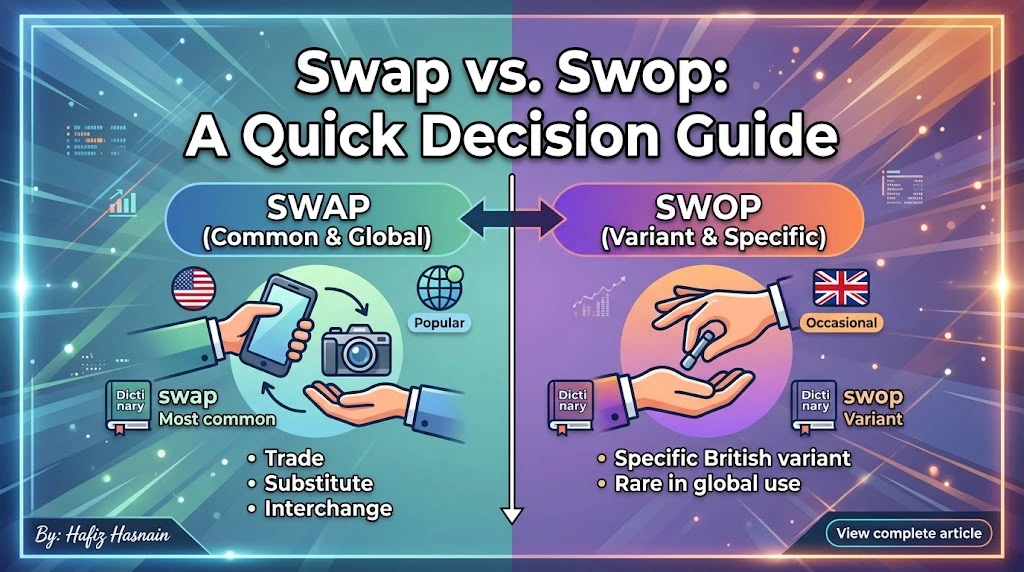
Still unsure?
Use this simple rule:
When in doubt, use “swap.”
Choose swap for general modern writing.
Choose swop when you intentionally want or need the British variant.
| Situation | Recommended form |
| American English | Swap |
| International audience | Swap |
| Academic writing | Swap |
| Business writing | Swap |
| SEO content | Swap |
| English-learning materials | Swap |
| General British English | Swap |
| Deliberately British regional voice | Swap or Swop |
| Historical quotation | Preserve original spelling |
| Recognizing British usage | Know both forms |
The important point is that swap is not merely an American spelling. British dictionaries and British English resources recognize and use it as well.
Practical Editing Checklist
Before publishing a sentence containing swap or swop, ask yourself:
- Who is the audience?
- Which variety of English am I using?
- Am I writing formally or informally?
- Have I used the same spelling consistently?
- Am I preserving a quotation?
- Does the regional spelling add something useful?
- Would the more familiar form make the sentence easier to scan?
For most general-purpose writing, the answer will point toward swap.
Consistency also matters.
If a document uses swap twenty times and suddenly switches to swop, readers may assume the change has a purpose. If it doesn’t, the variation simply looks accidental.
Frequently Asked Questions About Swap vs. Swop
What Is the Difference Between “Swap” and “Swop”?
Swap and swop have essentially the same meaning: to exchange one thing for another.
The primary difference is spelling and regional usage. Swap is much more common and broadly accepted, while swop is mainly associated with British English. Cambridge and Collins both identify swop as a UK variant of swap.
Is “Swop” a Correct Word?
Yes. Swop is a recognized English word and spelling variant.
It appears in major dictionaries, including Cambridge, Oxford, and Collins. However, being a recognized variant doesn’t make it equally common in every English variety.
Is “Swop” Still Used in the UK?
Yes.
Cambridge labels swop as mainly UK, while Oxford lists it as another form of swap.
That said, swap is also completely standard in British English, so British writers aren’t limited to swop.
Which Spelling Is Better for Professional Writing?
For most professional writing, swap is the safer choice.
It has broad international recognition and doesn’t strongly signal a particular regional spelling preference.
If a company follows a specific British house style that uses swop, consistency with that style can take priority.
Is “Swop” Used in American English?
It can be recognized in American English, but it is uncommon and chiefly associated with British English.
Collins explicitly describes it as a chiefly British alternative spelling in its American English entry.
For American readers, use swap unless there’s a specific reason to retain swop.
Do “Swap” and “Swop” Have Different Pronunciations?
Generally, no.
Within the same regional variety, they normally have the same pronunciation. Cambridge provides the same UK pronunciation for both forms.
Can “Swap” Be a Noun?
Absolutely.
Examples include:
Let’s do a swap.
We organized a book swap.
It was a straight swap.
Oxford and Cambridge both document noun uses of swap.
Should English Learners Use “Swap” or “Swop”?
Swap is the better default.
It is widely recognized across major varieties of English and appears frequently in everyday and professional contexts.
Learning to recognize swop is still useful, particularly when reading British English.
Is “Swop” a Spelling Mistake?
Not necessarily.
If the context is British English, swop can be a legitimate variant. If you’re writing standard American English, however, swap is the normal spelling.
Context matters more than a simple right-or-wrong label.
Swap vs. Swop: Final Verdict
The swap vs. swop debate becomes much easier once you separate meaning, spelling, and regional usage.
Both words can describe an exchange. Both can function as verbs and nouns. Both are recognized by major dictionaries. Their usual pronunciation is also essentially the same within a given variety of English.
The real distinction lies in frequency and regional association.
Swap is the dominant modern form. It works naturally in American English, British English, and international English. It is also the better default for business writing, educational material, websites, and other content aimed at a broad audience.
Swop is a legitimate variant, especially in British English. It hasn’t disappeared, but it is considerably less widespread.
So the easiest rule to remember is:
Use “swap” when you want the broadly recognized modern spelling. Recognize “swop” as a mainly British variant.
There’s no need to treat swop as a mysterious spelling error. At the same time, there’s little reason to choose it over swap when writing for readers across different English varieties.
In other words, when the spelling choice feels like a coin toss, swap is the safe bet.