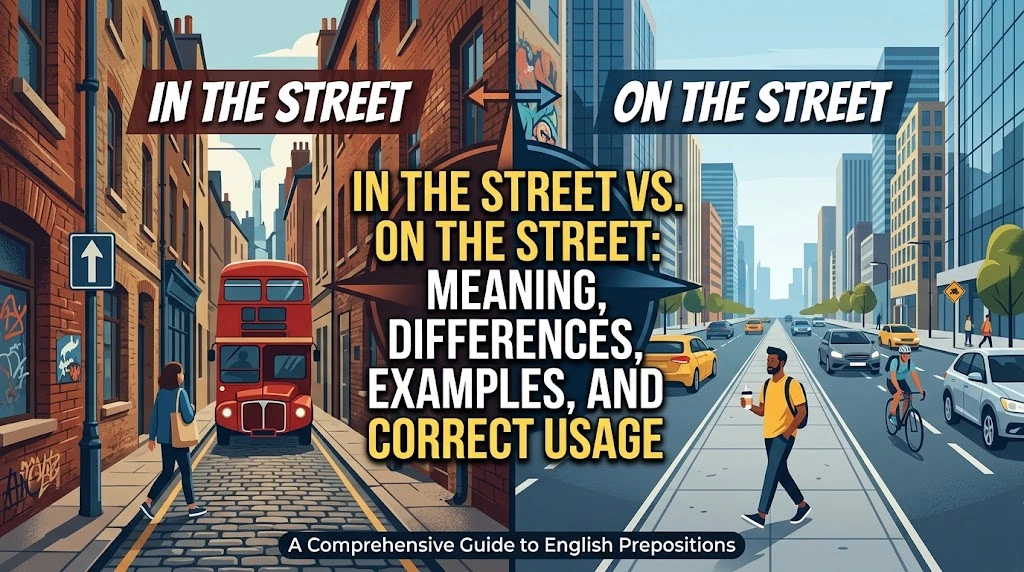
English prepositions are tiny words with surprisingly big jobs.
Change in to on, and the sentence can paint a different picture. That’s exactly what happens with in the street vs. on the street.
Compare these two sentences:
- The child is in the street.
- The child is on the street.
Both are grammatically possible. However, they don’t necessarily put the child in the same place.
In American English, in the street commonly emphasizes physical presence within the roadway or street area. On the street usually gives a broader location or refers to a particular street, especially when discussing addresses, homes, businesses, or general street activity.
That small distinction becomes important when precision matters.
If you say, “I live on Main Street,” you’re identifying an address or location. If you say, “The dog ran into the street,” you’re describing movement into the roadway.
The preposition changes the mental picture.
This guide explains in the street vs. on the street in detail, including American and British usage, addresses, traffic situations, idioms, common mistakes, examples, and the role of at.
In the Street vs. On the Street: The Quick Answer
Both in the street and on the street are correct English expressions. The right choice depends on what you mean.
In standard American English, a useful starting point is:
Use “on the street” for a general street location or a named street. Use “in the street” when you want to emphasize physical presence within the roadway.
For example:
- She lives on Oak Street.
- The children were playing in the street.
- There is a restaurant on Main Street.
- A bicycle was lying in the street.
The first and third sentences identify locations along named streets. The second and fourth focus more strongly on something physically occupying the street itself.
Cambridge gives the example “His store is on Main Street,” which reflects the standard address/location pattern.
Quick Comparison: In the Street vs. On the Street
| Expression | Main idea | Example |
| in the street | Within the street or roadway | The ball rolled in the street. |
| on the street | Along or associated with a street | She lives on Pine Street. |
| on the street | General public/street location | I saw him on the street. |
| on the street | Established figurative expression | That’s the word on the street. |
| in the street | Physical street activity | People were dancing in the street. |
The distinction isn’t an ironclad mathematical rule. English speakers sometimes choose differently depending on region, context, and the exact image they want to create.
What Does “In the Street” Mean?
The Core Meaning of “In the Street”
In the street usually places someone or something within the physical area of the street.
In American English, that often means the roadway where vehicles travel.
Consider:
The dog is in the street.
The sentence creates a fairly specific image. You probably picture the dog somewhere in the roadway rather than safely inside a nearby house.
Now compare:
The dog is on the street.
That sentence can describe a broader situation. The dog could be somewhere along the street, depending on the context.
The word in therefore gives the location a stronger sense of physical containment or position within a defined area.
Common Real-Life Uses of “In the Street”
You’ll often see in the street when something physically occupies the roadway.
Examples include:
- A child was playing in the street.
- A tree fell in the street during the storm.
- There was a large hole in the street.
- The cyclist fell in the street.
- A truck stopped in the street.
- The ball rolled into the street.
- Several protesters were standing in the street.
The phrase works especially well when the exact physical position matters.
For example:
A pedestrian was standing in the street, blocking traffic.
The second part makes the meaning even clearer. The person isn’t simply somewhere in the neighborhood. The person is occupying the roadway.
Why “In the Street” Can Sound More Urgent
In American English, in the street can create a sense of immediacy because readers often associate the roadway with moving vehicles.
That’s why it appears naturally in warnings:
- Don’t stand in the street.
- Keep the children out of the street.
- There’s debris in the street.
- A car is blocking the street.
The expression itself doesn’t automatically mean danger. Context creates that impression.
For instance:
Musicians performed in the street during the festival.
There isn’t necessarily anything dangerous about the sentence. The writer simply wants to emphasize activity taking place within the street space.
What Does “On the Street” Mean?
The Core Meaning of “On the Street”
On the street has a broader range of uses.
In American English, it commonly describes a location along a street or identifies a street associated with a person, building, business, or activity.
For example:
She lives on Maple Street.
The house isn’t literally sitting on the pavement. The phrase simply identifies the street where she lives.
The same pattern appears in:
- The office is on Fifth Avenue.
- Their restaurant is on Main Street.
- I grew up on Jefferson Street.
- There’s a pharmacy on this street.
This usage is so established that trying to replace on with in sounds unnatural in standard American English.
Cambridge specifically gives “His store is on Main Street” as an example.
Living, Working, and Staying on a Street
When you describe someone’s connection to a particular street, on is generally the natural choice.
Examples:
- I live on Oak Street.
- She works on Market Street.
- They opened a bakery on King Street.
- We stayed at a hotel on River Road.
- My grandparents lived on Washington Avenue.
Notice that these sentences don’t describe someone standing inside the roadway.
They’re location statements.
A Useful Rule for Addresses
If you’re giving a street name as part of a location, use on in American English.
Correct:
I live on Main Street.
Not standard American usage:
I live in Main Street.
Likewise:
- The office is on First Avenue.
- The store is on Broadway.
- The school is on Madison Street.
Street names function as location references rather than containers.
In the Street vs. On the Street: Why the Meaning Changes
The difference becomes easier when you picture what the speaker wants you to notice.
Imagine a street from above.
BUILDINGS
┌─────────────────┐
│ │
│ SIDEWALK │
└─────────────────┘
═══════════════════
ROADWAY
═══════════════════
┌─────────────────┐
│ SIDEWALK │
│ │
└─────────────────┘
BUILDINGS
If someone is physically standing in the roadway, in the street can emphasize that position:
The man is in the street.
If you’re simply identifying a location along the street, on the street is more natural:
The pharmacy is on the street.
The distinction isn’t really about whether the street is technically a surface or a container. That’s a useful mental shortcut, but real English usage depends on convention, context, and viewpoint.
In the Street vs. On the Street: Real-Life Examples
Children Playing
Consider:
The children are playing in the street.
This can suggest that they’re actually in the roadway.
Now compare:
The children are playing on the street.
In American English, this can sound broader or less precise. It may refer to street-level activity without strongly placing the children in the traffic lane.
If the point is safety, in the street gives the stronger physical image.
A Car
Both in and on can appear with vehicles, but the meaning can shift.
The car is in the street.
This can emphasize that the car is physically in the roadway.
The car is on the street.
This can describe the car’s general street location or its presence along the street.
Context decides which detail matters.
For example:
A broken-down car is in the street and is blocking traffic.
Here, in works naturally because the roadway position matters.
But:
There are several parked cars on the street.
Here, on the street describes the broader street environment.
A House
For an address:
The house is on Cedar Street.
That is the normal construction.
You wouldn’t normally say:
The house is in Cedar Street.
The second version sounds unnatural in standard American English.
On the Street for Public Space
On the street can also refer to street-level public life.
For example:
- There were food vendors on the street.
- I met several interesting people on the street.
- The festival brought thousands of people onto the street.
- Street performers entertained people on the street.
Here, the expression doesn’t necessarily identify a precise traffic lane.
It can refer to the wider environment where people walk, shop, meet, perform, and interact.
Oxford’s American dictionary examples include expressions such as “along/down/up the street,” “across the street,” and “in the street,” showing that English uses several prepositions with street depending on the spatial relationship being described.
Figurative Meanings of “On the Street”
One reason on the street can confuse learners is that it isn’t always literal.
“On the Street” and Homelessness
Consider:
He ended up on the street.
This can mean that someone became homeless or lost access to stable housing.
The phrase isn’t simply saying that the person stood on a road.
Similarly:
She was forced onto the streets.
The expression can refer to homelessness or living without stable shelter.
The phrase on the street has established idiomatic uses beyond physical location.
“Word on the Street”
Another common expression is:
What’s the word on the street?
This means something like:
What are people saying or what is the common informal information circulating?
For example:
The word on the street is that the company will open another location.
Here, on the street is completely figurative.
It doesn’t mean that information is literally sitting on pavement.
Oxford also records “word on the street” as an established expression for public opinion or commonly circulating information.
“The Man on the Street”
You may also encounter:
The man on the street
This expression refers broadly to an ordinary member of the public.
For example:
The survey asked what the average person on the street thought about the change.
The phrase isn’t describing a particular man standing beside a curb. It uses street as a symbol of ordinary public life.
“On the Streets” vs. “In the Streets”
The plural forms introduce another layer of meaning.
On the Streets
On the streets can refer to:
- street life
- homelessness
- urban environments
- public activity
- people living or operating outside conventional institutions
For example:
The organization works with young people on the streets.
The meaning depends heavily on context.
In the Streets
In the streets often emphasizes activity occurring within public streets.
Examples:
- Protesters gathered in the streets.
- Celebrations continued in the streets.
- Crowds filled the streets after the victory.
The phrase often creates a vivid public scene.
Cambridge lists take to the streets as an idiomatic expression associated with people publicly expressing opposition or protest.
In the Street vs. On the Street in American English
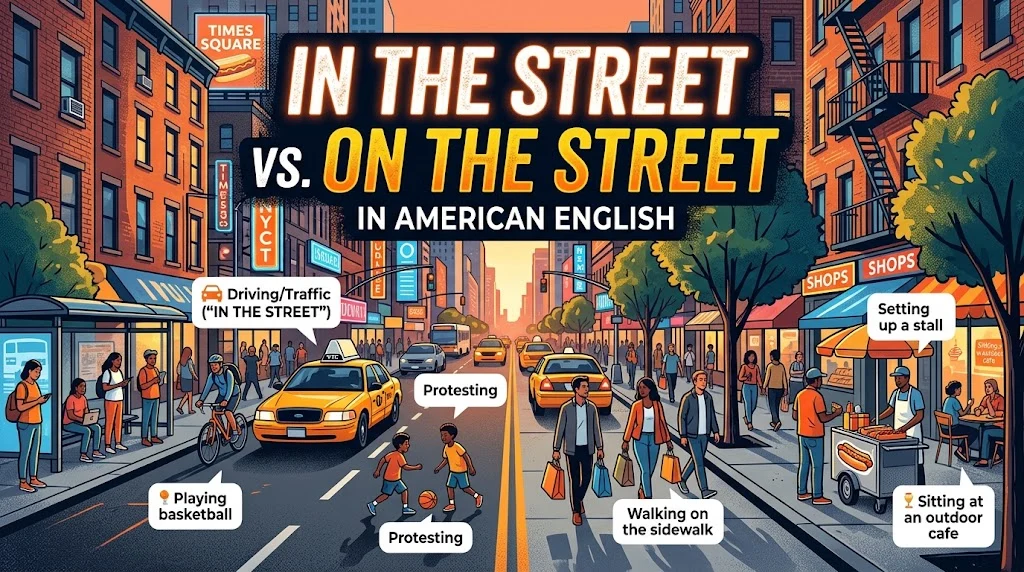
For American English, the distinction can be summarized this way:
“On the Street” Is Common for:
- addresses
- street names
- homes
- businesses
- offices
- general street locations
- ordinary public activity
- idiomatic expressions
Examples:
She lives on Main Street.
The café is on Oak Avenue.
I saw him on the street yesterday.
“In the Street” Is Common for:
- roadway position
- objects physically occupying the road
- people physically standing in the roadway
- situations where traffic position matters
- vivid descriptions of street activity
Examples:
A child ran into the street.
There was a fallen tree in the street.
Don’t leave your bicycle in the street.
This isn’t a rigid formula. Native speakers can choose differently when the context allows more than one interpretation.
British English vs. American English
This is one of the most important details to understand.
American and British English don’t always use street prepositions in exactly the same way.
In American English, on the street is especially common for general street location, while in the street often carries a more specific roadway meaning.
British English can use in the street more broadly.
For example, a British speaker may naturally say:
I met him in the street.
That doesn’t necessarily mean the person was standing in the middle of a traffic lane.
This regional variation is well documented in learner and usage discussions.
Oxford also illustrates British usage with examples such as “in the street” and describes High Street as the British term corresponding broadly to the North American Main Street concept.
A Practical American-English Rule
If your goal is standard US English, this rule will keep you out of most trouble:
Use “on” for a street name or general street location. Use “in” when the physical roadway itself is important.
For example:
- I live on Main Street.
- The store is on Main Street.
- The dog is in the street.
- The truck stopped in the street.
Is “At the Street” Correct?
Yes, but at has a different job.
English often uses at when the speaker thinks of a location as a particular point rather than an extended area.
That’s why you naturally hear:
- at the corner
- at the end of the street
- at the intersection
- at the entrance to the street
For example:
I’ll meet you at the corner of Main Street and First Avenue.
Here, at identifies a specific point.
Cambridge gives the example “They live at the bottom of our street,” demonstrating how at can identify a particular position within a street’s layout.
“At the Street” vs. “On the Street”
Compare:
The restaurant is on Main Street.
This identifies the restaurant’s street location.
Now:
We met at the corner of Main Street and Oak Avenue.
This identifies a precise meeting point.
The prepositions aren’t interchangeable because they frame the location differently.
Common Natural Expressions With “At”
- at the end of the street
- at the beginning of the street
- at the corner
- at the intersection
- at the traffic light
- at the street entrance
The bare phrase at the street is much less common than these more specific constructions.
Common Mistakes With In the Street vs. On the Street
Mistake: “I Live in Main Street”
In standard American English, say:
I live on Main Street.
A street name used as an address normally takes on.
Cambridge’s Main Street entry uses exactly this pattern: “His store is on Main Street.”
Mistake: Using “On” When the Roadway Matters
Suppose a child is standing directly where cars are driving.
The child is in the street.
This makes the physical position clear.
Compare:
The child is on the street.
That version can be understood more broadly and may not tell the reader whether the child is in the roadway.
Mistake: Thinking “In” Always Means Indoors
English doesn’t use in only for rooms and enclosed buildings.
We can say:
- in the water
- in the park
- in the city
- in the street
These expressions show that in can describe a person or object as being within an area.
The exact spatial relationship depends on the noun.
Mistake: Using “At” Everywhere
Learners sometimes treat at as a universal location preposition.
It isn’t.
Compare:
- I live on Main Street.
- The car is in the street.
- Meet me at the corner.
Each preposition highlights a different relationship.
How Verbs Influence In the Street vs. On the Street
The verb can influence which preposition sounds natural because verbs tell us what is happening in the location.
Verbs Often Seen With “In the Street”
- stand
- lie
- fall
- run
- block
- stop
- gather
- protest
- play
Examples:
A cyclist fell in the street.
Several people gathered in the street.
A fallen branch was lying in the street.
These sentences focus on physical occupation or activity within the street area.
Verbs Often Seen With “On the Street”
- live
- work
- shop
- stay
- open
- operate
- meet
- walk
Examples:
She lives on Pine Street.
The company opened an office on Market Street.
We met on the street outside the theater.
However, don’t memorize these verbs as fixed rules.
Context still wins.
For example, walk can appear with either expression:
I was walking on the street.
I was walking in the street because the sidewalk was blocked.
The second sentence specifically emphasizes that the person was using the roadway.
Case Study: A News Report About an Accident
Imagine a reporter writes:
A pedestrian was struck by a vehicle while standing in the street.
The phrase in the street immediately tells readers that the pedestrian occupied the roadway.
Now change it:
A pedestrian was struck by a vehicle while standing on the street.
The sentence remains understandable. However, it gives less precise information about the pedestrian’s exact position.
For accident reports, that distinction can matter.
The same principle applies to:
- traffic warnings
- emergency announcements
- police reports
- safety instructions
- weather reports
- descriptions of road hazards
When the exact physical position matters, in the street can provide greater precision.
Case Study: Giving an Address
Now consider a completely different situation.
Someone asks:
Where is your office?
You answer:
It’s on Jefferson Avenue.
That’s the natural American English construction.
You wouldn’t normally say:
It’s in Jefferson Avenue.
Why?
Because you’re identifying the street associated with the office rather than saying the office is physically contained within the roadway.
This same pattern applies to homes, stores, restaurants, schools, and other buildings.
Case Study: Children Playing Outside
Consider:
The children were playing in the street.
This creates a vivid image of children occupying the street area.
Now:
The children were playing on the street.
This may sound broader in American English. It doesn’t necessarily specify whether they were actually in the traffic lane.
If safety is the point, the first sentence is more precise.
For example:
The parents called the children inside because they were playing in the street.
The roadway interpretation becomes particularly strong because the surrounding context involves a safety concern.
Case Study: A Street Festival
Now imagine a neighborhood festival.
Local musicians performed in the street.
The writer may be emphasizing that the street itself became the event space.
But:
Local musicians performed on the street.
This can also work, especially when the phrase refers generally to street-level performance.
The difference isn’t always a matter of grammatical correctness. Sometimes it’s a matter of focus.
That’s an important lesson with English prepositions: not every contrast produces a strict right-versus-wrong answer.
Why Precision Matters in Professional Writing
Small prepositions can carry useful information in professional writing.
Consider these examples:
A worker was standing in the street.
versus:
A worker was standing on the street.
If you’re writing a safety report, the first sentence can communicate a more specific physical situation.
Likewise:
The office is on Main Street.
is much more useful as a location statement than:
The office is in Main Street.
Clear prepositions reduce ambiguity.
That matters in:
- business communication
- directions
- journalism
- technical writing
- safety notices
- property descriptions
- reports
- customer service messages
Good writing doesn’t make readers stop and decode basic location information.
In the Street vs. On the Street: A Practical Decision Guide
When you’re unsure, ask yourself what you want the reader to picture.
Use “In the Street” When:
- Someone is physically in the roadway.
- An object is lying within the roadway.
- Traffic is interacting with the location.
- You want to emphasize physical occupation of the street.
- A street is functioning as the physical space for an activity.
Examples:
The ball rolled into the street.
A truck broke down in the street.
The protesters gathered in the street.
Use “On the Street” When:
- You’re giving a street address.
- You’re naming where a building or business is located.
- You’re referring to a general street location.
- You’re talking about street-level public life.
- You’re using an established expression.
Examples:
The bookstore is on Main Street.
She lives on Oak Avenue.
I saw him on the street.
The word on the street is that prices will increase.
Use “At” When:
- You mean a specific point.
- You’re talking about a corner.
- You’re identifying an intersection.
- You’re describing the end or beginning of a street.
- You’re identifying a meeting point.
Examples:
Meet me at the corner.
The restaurant is at the end of the street.
We stopped at the intersection.
In the Street vs. On the Street: A Simple Memory Trick
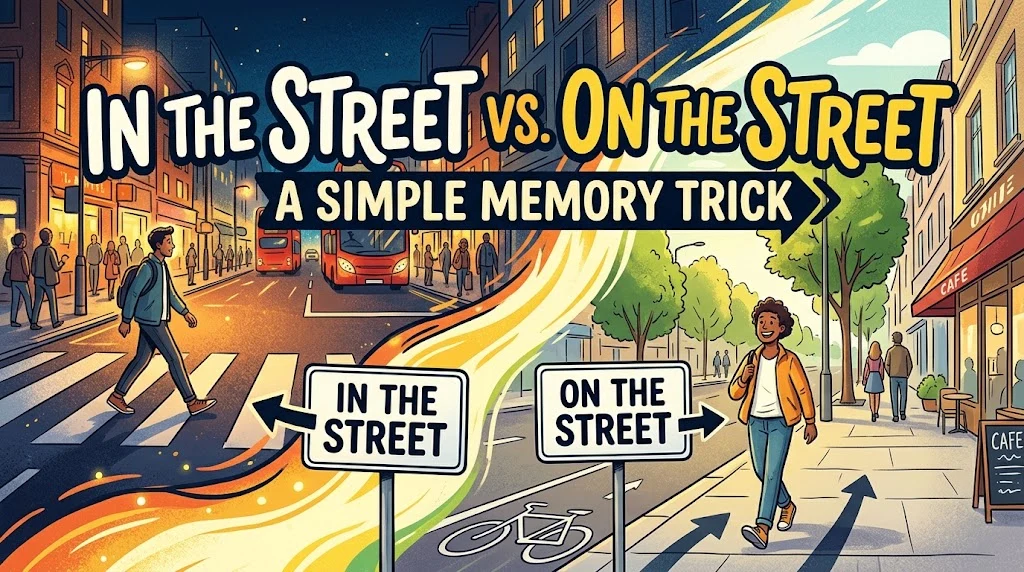
Don’t try to memorize dozens of isolated examples.
Instead, ask:
Am I identifying the street, or am I placing something physically inside it?
If you’re identifying the street, on is usually your answer in American English.
She lives on Main Street.
If you’re emphasizing physical presence inside the roadway, in is usually the better choice.
She is standing in the street.
For at, think of a dot on a map.
Meet me at the corner.
So the memory trick becomes:
ON = street location
IN = physical street space
AT = specific point
It’s not a perfect rule for every idiom or regional variety. Still, it’s a highly useful starting point.
In the Street vs. On the Street: Comprehensive Comparison Table
| Situation | Natural American English | Why |
| Street address | on Main Street | Identifies a street location |
| Business location | on Oak Avenue | Identifies where the business is |
| Home location | on Pine Street | Standard address construction |
| Person in roadway | in the street | Emphasizes physical position |
| Object in roadway | in the street | Emphasizes where it lies |
| General street location | on the street | Broad location |
| Word-of-mouth information | word on the street | Established idiom |
| Homelessness | on the street | Established expression |
| Street corner | at the corner | Specific point |
| End of a street | at the end of the street | Specific position |
| Intersection | at the intersection | Precise point |
| Protest activity | in/on the street | Depends on physical focus and regional usage |
| Street performance | on/in the street | Depends on context and regional preference |
A Note About “On the Street” and “In the Street” Interchangeability
Can you use the two expressions interchangeably?
Sometimes, but not always.
They overlap when the exact physical position doesn’t matter.
For example:
I saw an old friend on the street.
This simply establishes a public street setting.
But:
I saw an old friend in the street.
In American English, this may suggest the person was physically in the roadway.
That’s a meaningful difference.
The same issue appears in:
There was a bicycle on the street.
versus:
There was a bicycle in the street.
The first can describe a general street location. The second more strongly suggests that the bicycle was in the roadway.
Context can make either sentence clear.
Read More : Quaff or Coif? Meaning, Pronunciation, Differences, and Correct Usage
Real-Life Expressions You Should Know
Several common expressions use on the street in fixed or semi-fixed ways.
“Word on the Street”
Meaning: information or rumors circulating among people.
The word on the street is that the restaurant is closing.
“On the Streets”
Meaning varies by context. It can refer to public street life, homelessness, or urban culture.
The organization provides meals to people living on the streets.
“The Man on the Street”
Meaning: an ordinary member of the public.
The reporter asked the man on the street what he thought.
“Take to the Streets”
Meaning: go into public streets, often to demonstrate or protest.
Thousands of people took to the streets.
Cambridge lists take to the streets as an established idiom associated with public protest.
“On Main Street”
Besides literal location, Main Street can carry a broader American cultural meaning associated with small businesses and ordinary communities. Cambridge records both the literal street meaning and this broader US usage.
Common Questions About In the Street vs. On the Street
What does “in the street” mean?
In American English, in the street commonly means physically within the street or roadway.
For example:
The dog is in the street.
The sentence emphasizes the dog’s physical position in the road.
When should I use “on the street”?
Use on the street for a general street location and especially for street names and addresses.
She lives on Main Street.
The restaurant is on Fifth Avenue.
Is “I live in Main Street” correct?
Not in standard American English.
Use:
I live on Main Street.
The same pattern applies to named streets and avenues.
Can “in the street” and “on the street” mean the same thing?
Sometimes they can overlap.
However, they often emphasize different locations. In the street can highlight physical presence within the roadway, while on the street commonly gives a broader location or address.
Is “at the street” correct?
At can be correct when it identifies a specific point associated with a street.
Natural examples include:
- at the corner
- at the end of the street
- at the intersection
The bare phrase at the street is less common.
Should I say “in the street” or “on the street” for a car?
It depends on the intended meaning.
The car is in the street.
This can emphasize that the car occupies the roadway.
There are several cars on the street.
This describes cars generally present along the street.
Is “living on the street” related to homelessness?
It can be.
Living on the street is an established expression that can describe someone without stable housing. Context determines whether the phrase is literal or idiomatic.
Do British and American English use these expressions differently?
Yes.
American English commonly uses on the street for general street location, while British English can use in the street more broadly in everyday location contexts.
The difference doesn’t mean one variety is correct and the other is wrong. It reflects regional usage.
Final Comparison: In the Street vs. On the Street vs. At the Street
The easiest way to keep these expressions straight is to focus on the speaker’s intended viewpoint.
| Preposition | Think of it as | Example |
| In | Within the street space | The child is in the street. |
| On | Along or associated with the street | She lives on Main Street. |
| At | A particular point | Meet me at the corner. |
There is one especially useful American English rule to remember:
If you’re giving an address, use “on.” If you’re emphasizing physical position in the roadway, “in” is often more precise. If you’re pointing to a specific spot, “at” may be the right choice.
That rule handles most everyday situations.
The bigger lesson is that English prepositions don’t work like interchangeable labels. They tell the reader how to visualize a relationship.
In the street can place something inside the physical street space.
On the street can identify a street location, describe broader street activity, or form an established idiom.
At can narrow the location down to a particular point.
Once you focus on the intended picture rather than memorizing isolated rules, in the street vs. on the street becomes much easier to handle.
And when writing in American English, remember the simplest distinction:
Live on the street. Stand in the street. Meet at the corner.
That trio captures the difference neatly.
Sources and Further Reading
- Cambridge Dictionary — Main Street
- Cambridge Dictionary — Street
- Oxford Advanced Learner’s Dictionary — Street
- Oxford Learner’s Dictionaries — Street