Sometimes, “make a difference” is exactly the right phrase. It sounds natural, positive, and encouraging. You can use it when talking about someone’s kindness, a workplace contribution, social change, personal support, or an action that improves a situation.
However, the phrase can become vague when you use it repeatedly.
Consider the sentence, “Her work made a difference.” It sounds positive, but what did her work actually do? Did it improve results? Influence a decision? Help someone? Create lasting change? Contribute to a larger project?
That distinction matters.
Learning other ways to say “make a difference” gives you more control over your writing. Instead of relying on one broad expression, you can choose a phrase that tells the reader exactly what happened.
For example:
- Have an impact emphasizes an effect or result.
- Contribute to emphasizes participation or support.
- Influence emphasizes the ability to affect an outcome.
- Improve focuses on making something better.
- Transform suggests a major change.
- Matter emphasizes importance.
- Leave a mark suggests a lasting impression.
The best alternative isn’t always the fanciest one. It is the one that matches your intended meaning.
What Does “Make a Difference” Mean?
The expression “make a difference” generally means to have an effect, cause a change, or matter in a particular situation. In American English, dictionaries also recognize the meaning “to have an effect” or “matter.”
For example:
“Your advice made a difference.”
This sentence means the advice affected the situation in a meaningful way.
Likewise:
“Small changes can make a big difference.”
Here, the expression suggests that relatively minor actions can produce noticeable results.
The phrase can describe practical, emotional, professional, or social effects.
Simple Definition
In simple terms, to make a difference means to change something in a meaningful way or to be important to an outcome.
You might use it to talk about:
- Helping another person
- Improving a situation
- Affecting a decision
- Supporting a project
- Changing an outcome
- Creating social progress
- Making someone feel valued
- Contributing to a team’s success
- Influencing future results
- Leaving a lasting impression
English also uses the phrase in a second common sense where “make a difference” means “matter.”
For example:
“It doesn’t make a difference which option you choose.”
That means the choice doesn’t matter or won’t affect the outcome.
So, context matters. Not every use of “make a difference” refers to positive social change.
Grammar and Sentence Structure
Grammatically, “make a difference” is a verb phrase built around the verb make and the noun phrase a difference. EnglishClub describes it as a common verb-plus-noun collocation.
Common patterns include:
| Pattern | Example |
| make a difference to + noun | Your help made a difference to the team. |
| make a difference in + area/situation | The policy made a difference in employee morale. |
| make a big difference | Better planning can make a big difference. |
| make a significant difference | The changes made a significant difference. |
| make a positive difference | Her work made a positive difference. |
| make all the difference | One extra hour of preparation made all the difference. |
| make no difference | The timing made no difference to the final result. |
The phrase can also appear in questions:
“Will this change really make a difference?”
Or negative statements:
“It won’t make much difference.”
This flexibility explains why the expression appears in everyday conversations as well as professional communication.
When Should You Use “Make a Difference”?
One reason this phrase remains so useful is its versatility.
You can use “make a difference” when you want to highlight a meaningful result without specifying exactly how that result occurred. That makes it especially effective when the broader effect matters more than the mechanism.
In Everyday Conversation
The expression sounds completely natural in casual speech.
“Thanks for helping me. It really made a difference.”
“Getting enough sleep makes a huge difference in how I feel.”
“Even a small gesture can make a difference.”
These sentences don’t require highly technical language. The phrase communicates the idea quickly.
In Work and Business Communication
You can also use it at work.
“Your feedback could make a difference to the final proposal.”
“The new process has made a noticeable difference in productivity.”
“Her leadership made a real difference during the transition.”
However, professional writing often benefits from greater precision.
Instead of:
“Our campaign made a difference.”
You could write:
“Our campaign increased customer engagement by 18%.”
The second sentence gives the reader something concrete to evaluate.
In Academic Writing
The expression can work in academic writing, especially when the tone is accessible.
Still, academic prose often favors more precise verbs such as affect, influence, contribute to, improve, or produce.
Compare:
“The policy made a difference in student performance.”
with:
“The policy improved student performance.”
The second version immediately tells the reader what kind of difference occurred.
In Personal and Community Contexts
This is where “make a difference” often feels especially natural.
“Volunteers can make a difference in their communities.”
“Your support made a difference during a difficult time.”
“One thoughtful message can make a difference in someone’s day.”
The phrase works because it carries a warm and encouraging tone without sounding overly dramatic. English-learning resources commonly use it to describe positive effects on people, situations, and communities.
Is “Make a Difference” Professional?
Yes. “Make a difference” is professional, polite, and grammatically correct.
You can safely use it in:
- Business emails
- Interviews
- Presentations
- Team meetings
- Cover letters
- Workplace conversations
- Speeches
- Reports
- General professional communication
The real issue isn’t professionalism. It is precision.
A sentence such as:
“I want to make a difference at this company.”
is perfectly professional. Yet it doesn’t tell an employer much about what you intend to accomplish.
A stronger version might be:
“I want to improve customer retention and help the team build stronger client relationships.”
Now the reader can see the intended contribution.
So, don’t avoid “make a difference.” Instead, know when a more specific expression will communicate more information.
How to Choose the Right Alternative to “Make a Difference”
The easiest way to select an alternative is to ask yourself one question:
What kind of difference am I actually describing?
If you mean an effect, use impact.
If you mean participation, use contribute.
If you mean improvement, use improve.
If you mean influence, use influence.
If you mean major change, use transform.
If you mean importance, use matter.
This simple distinction prevents you from swapping phrases mechanically.
15+ Other Ways to Say “Make a Difference”
Have an Impact
“Have an impact” is one of the strongest professional alternatives to “make a difference.”
It emphasizes the effect something has on a person, situation, organization, or outcome.
“The training program had a significant impact on employee performance.”
This wording sounds especially natural in:
- Business reports
- Academic writing
- Research
- Presentations
- Performance reviews
- Professional discussions
Best when: you want to emphasize a measurable or noticeable effect.
Tone: Professional and neutral.
Make a Difference vs. Have an Impact
“Her advice made a difference.”
is broad.
“Her advice had a significant impact on the decision.”
is more specific.
The second sentence tells the reader what changed.
Make an Impact
“Make an impact” is closely related to “make a difference,” but it often sounds more active and results-oriented.
“The new marketing strategy made a strong impact on brand awareness.”
It works well when discussing:
- Career achievements
- Leadership
- Marketing
- Social initiatives
- Business performance
- Personal accomplishments
You might hear:
“She wants to make an impact in education.”
This suggests that she wants her work to produce meaningful results.
Best when: you want to emphasize the visible or meaningful effect of an action.
Tone: Professional, energetic, and motivational.
Create Change
When you want to emphasize actively causing change, “create change” can work well.
“Community leaders can create change by listening to residents.”
The expression commonly appears in discussions about:
- Social issues
- Education
- Organizations
- Community development
- Advocacy
- Leadership
However, “create change” isn’t a perfect synonym in every sentence.
If someone helps a coworker through a difficult day, saying they “created change” sounds unnatural. In that situation, “made a difference” or “helped” works better.
Best when: you are talking about changing a situation, system, behavior, or community.
Bring About Change
“Bring about change” is a more formal alternative.
It emphasizes causing a new situation or condition to develop.
“The reforms brought about significant changes in the education system.”
This phrase works particularly well in:
- Formal essays
- Reports
- Policy discussions
- Historical writing
- Academic contexts
The phrase carries more weight than “make a difference.”
Compare:
“The new policy made a difference.”
with:
“The new policy brought about significant changes.”
The second sentence suggests a clearer cause-and-effect relationship.
Best when: an action directly causes a meaningful change.
Contribute To
Sometimes “make a difference” means helping something succeed.
In that case, “contribute to” may be the better choice.
“Her research contributed to the development of the new treatment.”
“Everyone contributed to the project’s success.”
This expression doesn’t necessarily mean that one person caused the entire result. Instead, it highlights their share in a larger effort.
That distinction matters.
If ten people work on a project, each person may contribute to its success. Not everyone independently creates the final result.
Best when: you want to emphasize effort, support, resources, ideas, or participation.
Tone: Neutral to professional.
Play a Role
“Play a role” is useful when something is one factor among several.
“Communication plays an important role in building trust.”
“Experience played a major role in her decision.”
This phrase is slightly weaker than “make a difference” when the latter implies a noticeable result.
You wouldn’t normally replace every occurrence of “make a difference” with “play a role.”
Instead, use it when you want to show that something contributed to an outcome without claiming sole responsibility.
Best when: several factors contribute to a result.
Have an Effect
“Have an effect” focuses directly on the consequence of an action.
“The change had an immediate effect on productivity.”
“Stress can have a serious effect on concentration.”
This expression can describe either positive or negative results.
That makes it broader than “make a difference,” which often carries a positive or meaningful tone.
Best when: you want a neutral way to describe a consequence.
Effect vs. Impact
These words overlap heavily.
- Effect focuses on the result or consequence.
- Impact often emphasizes a stronger or more noticeable effect.
For example:
“The announcement had an effect on sales.”
“The announcement had a major impact on sales.”
The second sentence gives the result greater force.
Influence
If the difference involves affecting a person’s decision, behavior, opinion, or outcome, use “influence.”
“Her mentor influenced her career choice.”
“Customer feedback influenced the company’s decision.”
This alternative is particularly useful because it identifies the mechanism of the difference.
Instead of saying:
“His advice made a difference.”
you could say:
“His advice influenced my decision.”
Now the reader knows exactly what changed.
Best when: one person, factor, or action affects another person’s thinking, behavior, or decision.
Improve
When “make a difference” means make something better, the simplest alternative may be “improve.”
“The update improved website performance.”
“Better lighting can improve the customer experience.”
This is often stronger than a vague phrase because improve tells readers the direction of the change.
You don’t need to write:
“The update made a positive difference to website performance.”
when you can simply say:
“The update improved website performance.”
The shorter sentence packs more information into fewer words.
Best when: something becomes better because of an action.
Enhance
“Enhance” is another way to say improve or strengthen something, particularly in professional or formal writing.
“The redesign enhanced the user experience.”
“Additional training enhanced the team’s technical skills.”
It often sounds more polished than “make a difference,” although you shouldn’t use it merely to sound sophisticated.
Best when: an action improves quality, value, effectiveness, appearance, or performance.
Tone: Professional and polished.
Transform
“Transform” is much stronger than “make a difference.”
It means to change something substantially or fundamentally.
“Digital technology transformed the way customers shop.”
“The program transformed access to education.”
Don’t use transform for tiny improvements.
If changing a button color improves a website slightly, saying it “transformed the website” may overstate the result.
Think of the difference this way:
Improve = make better.
Transform = fundamentally change.
Best when: the change is substantial, dramatic, or fundamental.
Make an Improvement
“Make an improvement” can replace “make a difference” when you’re specifically talking about an improvement.
“The company made several improvements to its customer service.”
However, “improve” is usually cleaner.
Instead of:
“The company made an improvement to the process.”
write:
“The company improved the process.”
The shorter construction is more direct.
Best when: you want to identify an actual improvement rather than a general effect.
Leave a Mark
“Leave a mark” is more figurative.
It suggests that someone or something has created a lasting impression or influence.
“Her leadership left a lasting mark on the organization.”
“The experience left a mark on his career.”
This expression can sound more emotional than “make a difference.”
It works especially well when discussing:
- Careers
- Legacies
- Art
- Leadership
- Personal experiences
- Historical influence
Best when: the effect remains memorable or meaningful over time.
Matter
Sometimes “make a difference” simply means “matter.”
Consider:
“Your opinion makes a difference.”
You could say:
“Your opinion matters.”
The second version is shorter and more personal.
Likewise:
“Every small effort makes a difference.”
can become:
“Every small effort matters.”
Matter is particularly effective when talking about emotional importance, personal value, or significance.
Best when: the original meaning is “be important.”
Count
“Count” can express the idea that something has value or significance.
“Every vote counts.”
“Even small acts of kindness count.”
It sounds more conversational than “have an impact” or “bring about change.”
This makes it useful for motivational messages and everyday conversations.
Best when: you want to emphasize that an action or effort is valuable.
Make a Meaningful Contribution
For professional or academic contexts, “make a meaningful contribution” can provide more detail than “make a difference.”
“She made a meaningful contribution to the research project.”
The phrase emphasizes the value of someone’s participation rather than simply stating that their work had an effect.
It works well in:
- Academic writing
- Performance reviews
- Cover letters
- Professional biographies
- Research descriptions
- Team discussions
Best when: you want to highlight someone’s valuable contribution to a larger effort.
Quick Comparison of the Best Alternatives
| Alternative | Main Meaning | Tone | Best Context |
| Have an impact | Produce an effect | Professional | Business, academic |
| Make an impact | Create noticeable results | Professional | Careers, leadership |
| Create change | Cause change | Neutral | Social issues, organizations |
| Bring about change | Cause a new condition | Formal | Essays, policy |
| Contribute to | Add effort or support | Neutral | Projects, teams |
| Play a role | Be one contributing factor | Neutral | Analysis, explanations |
| Have an effect | Produce a consequence | Neutral | General, academic |
| Influence | Affect decisions or behavior | Professional | People, decisions |
| Improve | Make something better | Neutral | General, business |
| Enhance | Improve quality or value | Professional | Business, technical |
| Transform | Change substantially | Strong | Major changes |
| Make an improvement | Introduce an improvement | Neutral | Projects, processes |
| Leave a mark | Create a lasting impression | Figurative | Legacy, careers |
| Matter | Be important | Conversational | Personal situations |
| Count | Have value | Casual | Everyday speech |
| Make a meaningful contribution | Add valuable support | Professional | Work, research |
Other Ways to Say “Make a Difference” by Context

The right alternative depends heavily on where you’re using it.
Professional Ways to Say “Make a Difference”
In business writing, specificity usually beats inspirational language.
Instead of:
“Our new system will make a difference.”
try:
“Our new system will improve processing speed.”
Or:
“Our new system will reduce manual work.”
For professional communication, strong alternatives include:
- Have an impact
- Improve outcomes
- Contribute to
- Influence decisions
- Enhance performance
- Drive change
- Deliver results
- Add value
The key is to connect the phrase to an actual outcome.
Other Ways to Say “Make a Difference” in a Resume
Resume writing benefits from concrete action verbs.
Instead of:
“Made a difference in customer satisfaction.”
write:
“Improved customer satisfaction through faster response times.”
Instead of:
“Made a difference to team productivity.”
write:
“Improved team productivity by streamlining the reporting process.”
A resume should show what you changed, how you changed it, and what happened afterward whenever the evidence is available.
Strong alternatives include:
- Improved
- Increased
- Reduced
- Strengthened
- Influenced
- Contributed to
- Led
- Enhanced
- Streamlined
- Delivered
This approach turns a broad claim into a measurable achievement.
Other Ways to Say “Make a Difference” in an Interview
The phrase works naturally in interviews.
For example:
“I want to make a difference by helping customers solve problems quickly.”
That’s a good starting point.
However, a stronger interview answer explains what “make a difference” actually means.
“I want to improve the customer experience by reducing response times and making complex issues easier to resolve.”
The second statement gives the interviewer something tangible.
A useful formula is:
Action + area of impact + result
For example:
“I improved the onboarding process, which helped new employees become productive more quickly.”
That’s much stronger than simply saying:
“I made a difference.”
Other Ways to Say “Make a Difference” in Academic Writing
Academic writing often benefits from precise verbs.
Depending on your meaning, consider:
- Affect
- Influence
- Contribute to
- Improve
- Increase
- Reduce
- Produce
- Result in
- Lead to
- Have an effect on
For example:
“The intervention made a difference in student performance.”
could become:
“The intervention improved student performance.”
Or:
“The intervention contributed to higher student performance.”
The best version depends on the evidence. If the intervention directly improved performance, improved is clear. If it was only one factor among several, contributed to is more careful.
Other Ways to Say “Make a Difference” in Personal Messages
Personal writing often calls for warmth rather than formality.
Natural alternatives include:
- Matter
- Mean a lot
- Help
- Make things better
- Have an impact
- Be important
- Count
For example:
“Your support made a difference.”
could become:
“Your support meant a lot to me.”
That version shifts the focus from the result to the emotional value of the support.
Other Ways to Say “Make a Difference” for Social Causes
When discussing community work, charity, advocacy, or social progress, these expressions work particularly well:
- Create positive change
- Bring about change
- Make an impact
- Improve lives
- Contribute to change
- Drive change
- Inspire change
- Support positive change
For example:
“Volunteers make a difference in their communities.”
could become:
“Volunteers help create positive change in their communities.”
The second version makes the nature of the contribution clearer.
Common Mistakes When Using Alternatives to “Make a Difference”
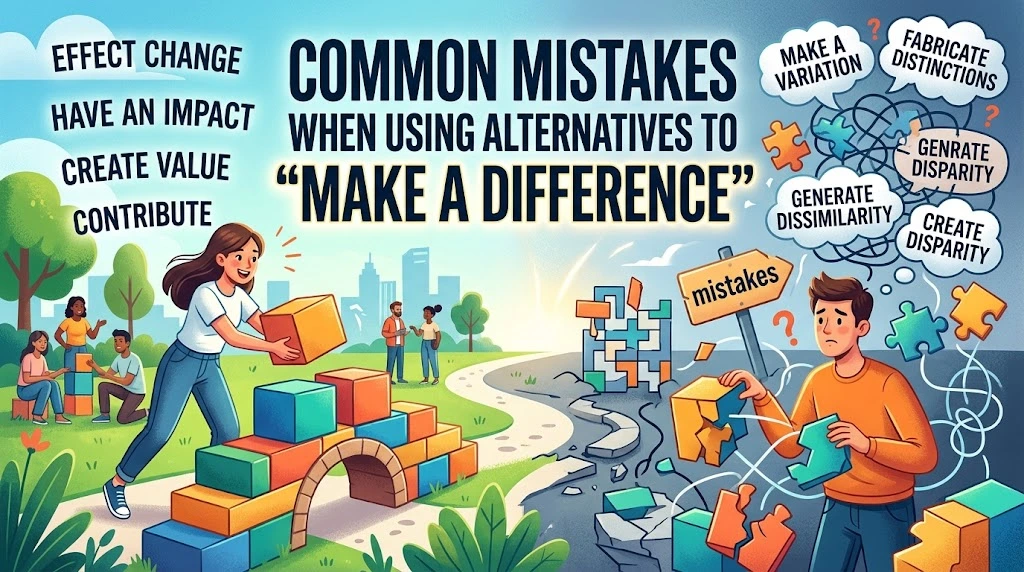
Replacing a phrase isn’t simply a matter of finding a synonym and dropping it into the same sentence.
Different expressions carry different meanings.
Using “Transform” for a Minor Change
Don’t call every improvement a transformation.
“The new font transformed the report.”
This sounds exaggerated unless the font change genuinely altered the report in a major way.
A better choice might be:
“The new font improved the report’s readability.”
Precision makes the writing more credible.
Treating “Matter” as a Universal Replacement
Matter works when “make a difference” means be important.
“Your opinion matters.”
But it doesn’t replace every meaning.
You wouldn’t normally write:
“The new software mattered productivity.”
Instead:
“The new software improved productivity.”
The grammatical structure and meaning both change.
Read More : Other Ways to Say “Proud of You ❤️”: 20+ Meaningful Alternatives With Examples
Using “Contribute” Without Explaining the Contribution
Contribute usually needs a clear object or context.
“She contributed to the project.”
That’s complete.
But:
“She contributed.”
may leave the reader wondering what she contributed.
In professional writing, specify the contribution whenever possible:
“She contributed to the project’s research and data analysis.”
Confusing “Effect” and “Affect”
This is one of the most common problems in English.
Effect is usually a noun:
“The change had a positive effect.”
Affect is usually a verb:
“The change affected productivity.”
A useful shortcut is:
Effect = result.
Affect = influence.
There are exceptions, but this distinction works for most everyday writing.
Choosing a Stronger Word Than the Evidence Supports
Words such as transform, revolutionize, dramatically improve, and reshape sound powerful.
That doesn’t make them appropriate.
If your evidence shows a small improvement, say improved.
If several factors contributed to the result, say contributed to.
If you changed a major system, transformed may be justified.
Good writing isn’t about making every sentence sound enormous. It’s about making every claim accurate.
“Make a Difference” Before-and-After Examples
The easiest way to understand these alternatives is to see them in action.
Everyday Example
Original:
“Getting enough sleep makes a difference in how I feel.”
More precise:
“Getting enough sleep improves my mood and energy.”
The second sentence identifies the actual effects.
Workplace Example
Original:
“Her leadership made a difference to the team.”
Alternative:
“Her leadership improved team communication and productivity.”
The alternative tells the reader what changed.
Resume Example
Weak:
“Made a difference in customer service.”
Stronger:
“Improved customer response times by streamlining support requests.”
The stronger sentence replaces a broad claim with a specific achievement.
Academic Example
General:
“The program made a difference in student outcomes.”
More precise:
“The program improved student outcomes by providing additional tutoring.”
The revised version explains both the result and the mechanism.
Community Example
General:
“Volunteers make a difference in the community.”
More specific:
“Volunteers improve access to food and essential services for local families.”
The second sentence shows what “difference” actually means.
A Simple Decision Guide for Choosing the Right Phrase
When you’re unsure which alternative to use, match the meaning first.
| If you mean… | Try… |
| Something produced an effect | Have an impact |
| Something produced a noticeable result | Make an impact |
| Something caused change | Create change |
| Something caused substantial change | Bring about change |
| Someone helped with a larger effort | Contribute to |
| Something was one factor in an outcome | Play a role |
| Something caused a consequence | Have an effect |
| Something affected a decision or behavior | Influence |
| Something became better | Improve |
| Quality or performance became better | Enhance |
| Something changed fundamentally | Transform |
| Something created a lasting impression | Leave a mark |
| Something was important | Matter |
| Something had value | Count |
| Someone provided valuable support | Make a meaningful contribution |
This table captures an important principle: synonyms aren’t interchangeable simply because they share a general meaning.
Case Study: Choosing the Right Alternative
Imagine a company introduces a new customer-support system.
The broad statement might be:
“The new system made a difference.”
That’s true but incomplete.
Now consider what actually happened.
If response times improved:
“The new system improved response times.”
If customers reported higher satisfaction:
“The new system had a positive impact on customer satisfaction.”
If the system was only one factor in the improvement:
“The new system contributed to higher customer satisfaction.”
If it fundamentally changed the company’s support operation:
“The new system transformed the customer-support process.”
If the system influenced management decisions:
“The new system influenced how managers allocated support resources.”
Same basic situation. Five different expressions.
That’s why choosing other ways to say “make a difference” isn’t simply about avoiding repetition. It’s about expressing the exact relationship between an action and its result.
Frequently Asked Questions About Other Ways to Say “Make a Difference”
What are the best alternatives to “make a difference”?
Some of the most useful alternatives are have an impact, make an impact, contribute to, influence, improve, create change, bring about change, have an effect, transform, matter, and leave a mark.
The best choice depends on your intended meaning.
For example, use improve when something becomes better. Use influence when someone affects a decision. Use matter when you mean something is important.
What is a professional way to say “make a difference”?
“Have an impact” is one of the safest professional alternatives.
Other strong options include:
- Contribute to
- Improve
- Influence
- Enhance
- Have an effect on
- Make a meaningful contribution
- Drive change
For highly professional writing, choose the expression that describes the actual result rather than simply choosing the most impressive phrase.
What is another way to say “make a positive difference”?
You could say:
- Have a positive impact
- Create positive change
- Improve the situation
- Make things better
- Improve people’s lives
- Contribute positively
- Bring about positive change
For example:
“The program made a positive difference in the community.”
could become:
“The program improved access to essential services in the community.”
The second version is more precise.
What is another way to say “make a big difference”?
Depending on the context, try:
- Have a significant impact
- Make a major impact
- Greatly improve
- Substantially improve
- Transform
- Bring about significant change
- Have a major effect
For example:
“The training made a big difference.”
could become:
“The training significantly improved employee performance.”
Can I use “make a difference” in a job interview?
Yes. “Make a difference” sounds natural and professional in interviews.
The key is to explain what kind of difference you want to make.
Instead of:
“I want to make a difference.”
try:
“I want to improve the customer experience by solving problems faster and building stronger client relationships.”
The second answer sounds more convincing because it connects motivation with action.
Is “make a difference” formal or informal?
“Make a difference” is neutral.
It works in casual conversations, professional communication, interviews, presentations, speeches, and many forms of writing.
It may sound too broad in highly technical or analytical writing when you need to identify a precise effect.
In those cases, a word such as improve, influence, affect, increase, reduce, or contribute may communicate more effectively.
What is the best alternative to “make a difference” in business writing?
There isn’t one universal replacement.
Use:
- Have an impact for results or effects.
- Improve for better performance.
- Contribute to for teamwork.
- Influence for decisions.
- Enhance for quality or effectiveness.
- Drive change when leading a broader shift.
The strongest business writing usually connects the action to a concrete outcome.
Is “make an impact” the same as “make a difference”?
They overlap, but they aren’t always identical.
“Make a difference” is broader and often warmer.
“Your support made a difference.”
“Make an impact” emphasizes the effect produced.
“Her research made an impact on the field.”
Both can describe meaningful results. However, “make a difference” often works more naturally in personal and motivational contexts.
Final Thoughts on Other Ways to Say “Make a Difference”
“Make a difference” is a useful expression because it can cover many kinds of meaningful effects. It can describe a small act of kindness, a professional achievement, a major social movement, or simply something that matters.
Still, broad language isn’t always the strongest language.
When you know exactly what happened, say exactly what happened.
Use “have an impact” when you mean an effect. Choose “contribute to” when someone adds support to a larger effort. Use “influence” when something affects a decision or behavior. Choose “improve” when something becomes better. Reserve “transform” for substantial changes. When you mean importance, “matter” may be the cleanest choice.
Think of these alternatives as different tools in the same toolbox. A hammer isn’t better than a screwdriver. It simply does a different job.
The same principle applies to words.
The best alternative to “make a difference” isn’t the biggest or most sophisticated phrase. It’s the one that tells the truth about the difference being made.
Once you understand that distinction, your writing becomes clearer, more precise, and much less repetitive.