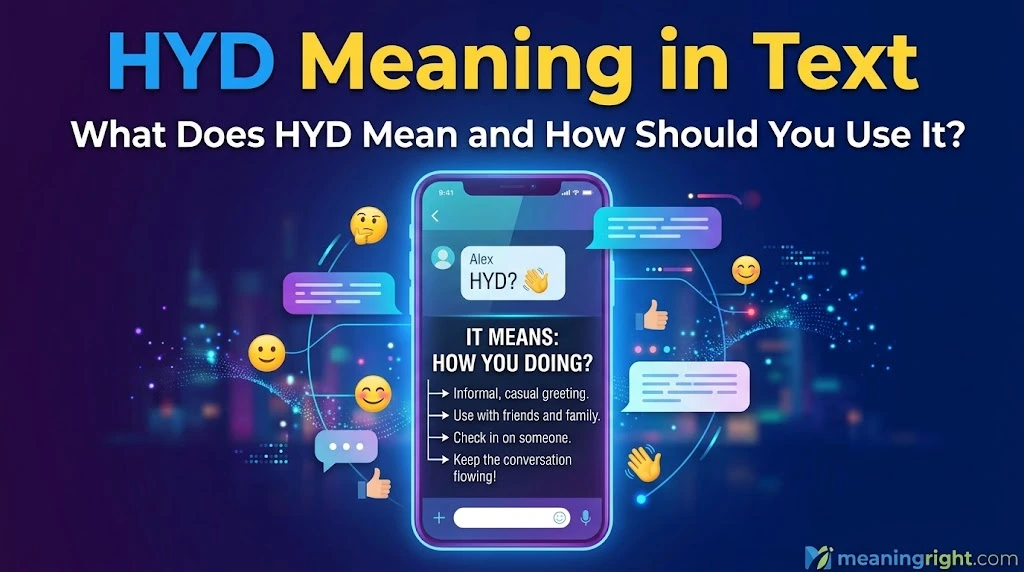
Have you ever opened a message that simply says “HYD?” and wondered what those three letters mean?
In most casual conversations, the HYD meaning in text is “How You Doing?” It’s a short, informal way to ask someone how they’re doing, how they’re feeling, or how things are going.
You might see HYD in text messages, social media DMs, group chats, gaming conversations, or dating-app messages. Depending on who sends it and what comes next, the message can sound friendly, caring, casual, or even slightly flirty.
However, HYD doesn’t automatically mean someone has romantic feelings. Context does most of the heavy lifting.
There’s another wrinkle, too. HYD can mean something completely different outside texting. For example, HYD is also the airport code associated with Hyderabad, India. In technical writing, the same three letters can appear as an abbreviation for specialized terms.
So, what does HYD mean in text? How should you respond? Is HYD flirty? And how is it different from WYD, HRU, and HBU?
Let’s break it down.
What Does HYD Mean in Text?
The most common HYD meaning in text is:
HYD = How You Doing?
In natural standard English, the complete question would usually be:
How are you doing?
HYD simply compresses the informal phrase into three letters. It works much like other texting abbreviations that turn familiar expressions into quick messages.
For example:
“Hey, HYD?”
usually means:
“Hey, how are you doing?”
The sender may want to know how you’re feeling. They may also simply be opening a conversation.
That’s an important distinction. A three-letter message doesn’t automatically reveal the sender’s deeper intentions.
Quick Meaning of HYD
| Feature | Explanation |
| HYD | How You Doing? |
| Full natural question | How are you doing? |
| Type | Informal texting abbreviation |
| Main purpose | Check-in or conversation opener |
| Typical tone | Casual and conversational |
| Can it be flirty? | Yes, depending on context |
| Is it formal? | No |
| Common settings | Texts, DMs, chats, dating apps |
In everyday texting, the simplest interpretation is usually the best one: someone is asking how you’re doing.
What Does HYD Stand For?
HYD uses the first letters of the main words in “How You Doing?”
- H = How
- Y = You
- D = Doing
The complete phrase isn’t grammatically standard because it leaves out “are.” The standard question is “How are you doing?”
Still, shortened forms like “How you doing?” are well established in casual speech and informal communication. BBC Learning English, for example, discusses “How you doing?” as an informal version of “How are you doing?” used in everyday conversation.
That distinction matters when you’re writing rather than texting.
HYD belongs to casual digital communication. “How are you doing?” works in a much wider range of situations.
HYD Meaning in Text: The Basic Idea
At its heart, HYD is a social check-in.
The sender may be asking:
- How are you?
- How are you feeling?
- How’s everything going?
- How’s your day going?
- How have things been?
- What’s going on with you?
The exact intention can shift slightly.
Consider these examples:
“Morning! HYD?”
This probably means the sender wants a quick update.
Now consider:
“I heard about what happened. HYD?”
That sounds more caring. The context gives the abbreviation additional emotional weight.
Finally:
“Heyyy HYD 👀”
That could feel playful or flirtatious depending on the relationship.
The abbreviation itself hasn’t changed. The surrounding conversation has.
Why Do People Use HYD Instead of “How Are You Doing?”
Texting rewards speed.
When people communicate through phones, they often shorten familiar expressions because both sides already understand the intended meaning. HYD takes a complete conversational question and turns it into three letters.
That saves typing, but efficiency isn’t the only reason.
HYD can also feel:
- More relaxed
- More spontaneous
- Less formal
- More conversational
- Easier to send as an opener
Compare these:
“How are you doing?”
and
“HYD?”
The first sounds complete and neutral. The second feels like a quick digital nudge.
It’s similar to the difference between waving at someone from across a room and walking over to introduce yourself with a formal greeting. The message is basically the same, but the social texture changes.
HYD as a Friendly Check-In
One of the most common uses of HYD is simply checking on someone.
A friend might text:
“Hey, HYD?”
There may be no hidden message at all. They could genuinely want to know whether you’re having a good day.
This becomes even clearer when the sender adds context:
“HYD? You sounded stressed yesterday.”
Now the message carries a stronger sense of concern.
Another example:
“HYD after your exam?”
Here, HYD asks about your condition or experience after a specific event.
Case Study: A Friend Checking In
Imagine you told your friend that you had an important interview.
The next morning, they send:
“HYD?”
The natural interpretation is:
“How are you doing after the interview?”
The abbreviation isn’t cold or dismissive. In this situation, it may actually be a compact way of showing that they remembered what you were going through.
HYD as a Conversation Starter
Sometimes people send HYD because they don’t know how else to begin a conversation.
Instead of writing:
“Hey, I haven’t talked to you in a while and wanted to see how things are going.”
they can simply write:
“Hey, HYD?”
It’s a low-pressure opener.
The recipient can answer briefly or use it as an invitation to start a longer conversation.
For example:
A: HYD?
B: Pretty good! Just finished work. You?
A: Same here. What are you doing tonight?
The first message is small, but it creates an opening.
Is HYD Flirty?
HYD can be flirty, but HYD isn’t inherently flirty.
This is one of the biggest misconceptions surrounding the abbreviation.
If a close friend sends:
“HYD?”
there’s no reason to assume romantic interest.
If someone you’ve been flirting with sends:
“Heyyy, HYD?”
the same abbreviation may carry a more playful tone.
The difference comes from context, not the three letters themselves.
Signs That HYD May Be Flirty
HYD may feel flirtatious when it appears alongside:
- Flirty emojis
- Compliments
- Playful teasing
- Late-night messages
- References to meeting up
- Romantic conversation
- Repeated attempts to keep talking
- Personal questions
- Clearly romantic language
For example:
“HYD 👀 Been thinking about you.”
The second sentence changes everything.
Compare that with:
“Hey, HYD? How was your test?”
That sounds much more like a friendly check-in.
A Simple Rule
Don’t judge someone’s intentions from HYD alone.
Look at what they say before and after it.
One abbreviation is a clue. The entire conversation is the evidence.
HYD as a Low-Effort Greeting
Sometimes HYD really is just a quick greeting.
People are busy. They may want to talk without composing a long opening message.
A person might send:
“hyd”
while waiting for a bus, taking a break at work, or scrolling through their phone.
That doesn’t necessarily mean they’re uninterested.
Likewise, it doesn’t necessarily mean they deeply care about you.
It’s simply a short way to knock on the conversational door.
HYD Meaning in Different Contexts
The same abbreviation can create different impressions depending on the situation.
Casual Friend Chat
In a conversation between friends, HYD usually means:
“How are you doing?”
The tone is relaxed and familiar.
Social Media DM
A stranger or acquaintance might use HYD as an opener.
For example:
“Hey, HYD?”
This can be an attempt to start talking without immediately asking something personal.
Dating Conversation
On a dating app, HYD can function as a casual icebreaker.
For example:
“Hey! HYD?”
The message doesn’t prove romantic interest. However, because dating apps are designed for romantic or social connections, the context naturally makes a flirty interpretation more plausible.
After an Argument
HYD can also become more emotionally significant after conflict.
For example:
“I know things were weird yesterday. HYD?”
Here, the abbreviation is still asking how the person is doing. The surrounding situation makes it sound more cautious and caring.
After a Long Silence
Suppose someone hasn’t contacted you for several months:
“Hey, long time. HYD?”
This is primarily a reconnection message.
The sender is reopening communication without making the situation overly serious.
HYD in Professional Conversations
HYD is generally too informal for professional communication.
That doesn’t mean informal language is always wrong at work. Some teams communicate casually, especially through internal chat platforms.
Still, context matters.
Writing:
“HYD?”
to a close coworker may be perfectly understandable.
Sending:
“HYD?”
to a new client or potential employer is another matter.
A safer professional alternative would be:
“Hi, I hope you’re doing well.”
Or:
“How are you doing?”
Or, if the purpose is work-related:
“How is the project going?”
Professional communication benefits from clarity. There’s little reason to make the reader decode an abbreviation when the complete phrase takes only a few extra words.
Where to Avoid HYD
Avoid HYD in:
- Job applications
- Cover letters
- Formal business emails
- Academic papers
- Official documents
- Client proposals
- Customer-service communication
- Formal reports
- Professional introductions
Use HYD when the relationship and setting clearly support casual language.
HYD vs. WYD
HYD and WYD look similar, but they ask different questions.
| Abbreviation | Meaning | Main Focus |
| HYD | How You Doing? | Your well-being or how things are going |
| WYD | What You Doing? | Your current activity |
| HRU | How Are You? | Your condition or well-being |
| HBU | How About You? | Returning the question |
Consider this exchange:
HYD?
“I’m good. Just tired.”
The sender asked about your condition.
Now compare:
WYD?
“Watching a movie.”
The sender asked what you’re currently doing.
The distinction is small but useful.
HYD vs. WYD Example
HYD:
“Hey, how are you doing?”
WYD:
“Hey, what are you doing?”
HYD is about how you’re doing.
WYD is about what you’re doing.
That’s the easiest way to remember it.
HYD vs. HRU
HRU stands for “How Are You?”
It’s another texting abbreviation used to ask about someone’s well-being.
| HYD | HRU |
| How You Doing? | How Are You? |
| More conversational | More direct |
| Informal | Informal |
| Often used as an opener | Often used as an opener |
For practical purposes, they can serve almost the same social function.
However, HYD contains the idea of doing. HRU is a more direct abbreviation of How Are You?
HYD vs. HBU
HBU means:
How About You?
It’s different from HYD because HBU normally responds to something someone has already said.
For example:
A: I’m doing great today.
B: Nice! HBU?
Here, HBU means:
“How about you?”
A natural HYD exchange could instead begin:
A: HYD?
B: I’m good. HBU?
Notice how the two abbreviations can appear together.
HYD starts the check-in. HBU returns it.
HYD vs. “How Are You Doing?”
The full phrase is the grammatically standard form:
How are you doing?
HYD is the texting shortcut.
The difference is mostly about register.
| Version | Formality | Best Use |
| HYD? | Very casual | Texts and DMs |
| How you doing? | Casual speech/stylized writing | Informal conversation |
| How are you doing? | Neutral to casual | General conversation |
| How are you? | Neutral | Broad range of situations |
| I hope you’re doing well. | Polite/professional | Emails and formal communication |
BBC Learning English specifically notes that people often omit “are” in informal speech when saying “How you doing?” The standard written form remains “How are you doing?”
That distinction is worth remembering if you’re learning English.
Is “How You Doing?” Grammatically Correct?
In standard written English, the complete form is:
How are you doing?
“How you doing?” drops the auxiliary verb are.
However, language doesn’t always behave like a grammar worksheet.
People regularly shorten phrases in casual speech. “How you doing?” is an established informal greeting and can also appear deliberately in dialogue or stylized writing.
So the practical rule is simple:
Use “How are you doing?” when correctness and broad acceptability matter.
Use HYD when you’re intentionally writing casual text.
This isn’t unusual. Spoken English frequently contains reduced forms that people understand immediately even though they don’t follow formal written conventions.
HYD on Social Media and Messaging Apps

HYD doesn’t acquire a fundamentally different definition just because it appears on a particular platform.
You may encounter it in:
- Instagram DMs
- Snapchat conversations
- WhatsApp chats
- iMessage
- Text messages
- Discord chats
- Gaming messages
- Dating apps
- Social-media conversations
The platform can influence the tone, though.
A message from a close friend on WhatsApp may feel warmer than the same three letters from a stranger on a social platform.
That’s why the platform should be treated as a clue rather than a dictionary definition.
HYD in Dating Apps
Dating apps provide an especially interesting context.
Someone might send:
“Hey, HYD?”
It’s a perfectly ordinary conversation opener.
The problem is that it’s also incredibly broad.
The sender could be:
- Genuinely interested
- Trying to break the ice
- Looking for something to talk about
- Sending a casual greeting
- Testing whether you’re interested in chatting
If you want the conversation to continue, a response with a little substance works better than simply saying “good.”
For example:
“Doing pretty well! Just finished dinner. How about you?”
That gives the other person something to respond to.
How to Respond to HYD
There’s no single correct response.
Your answer should match the sender’s tone and your relationship.
Friendly Replies to HYD
Try:
“I’m good! How about you?”
“Doing pretty well. You?”
“I’m great! How’s your day going?”
These responses are warm without overcomplicating things.
Casual Replies to HYD
If you want to keep it short:
“Good, you?”
“Not bad!”
“Doing okay.”
“Pretty good. Hbu?”
These work well when the conversation is already informal.
More Detailed Replies
If you actually want to talk, give the sender a small detail.
For example:
“I’m doing pretty well. Work was crazy today, though. How about you?”
That response does two things. It answers the question and creates a new conversational thread.
Flirty Replies to HYD
If you’re interested in the sender, you can respond playfully:
“Better now that you texted.”
Or:
“I’m good. What made you think of me?”
Or:
“Doing good. How are you, trouble?”
The key is to match the existing tone.
Don’t turn a completely ordinary “HYD?” into a romantic declaration unless the conversation already supports that direction.
When You Don’t Want to Continue Talking
You can keep your answer brief:
“I’m doing okay, thanks.”
Or:
“Good, thanks!”
You don’t owe someone a long conversation simply because they sent HYD.
How to Tell What HYD Really Means
When you’re unsure about the sender’s intention, examine the surrounding clues.
Look at Who Sent It
A close friend probably means a simple check-in.
A dating match may be opening a romantic conversation.
A stranger may simply be trying to start talking.
Look at What Came Before It
If you recently discussed a stressful event, HYD may show genuine concern.
If you haven’t spoken for months, it may be an attempt to reconnect.
If you’ve been flirting, the same message may carry romantic undertones.
Look at What Comes After It
This is one of the strongest clues.
Compare:
“HYD?”
with:
“HYD? I was thinking about you.”
The second message gives you much more information about the sender’s intention.
Consider Timing
A message at noon may feel like an ordinary check-in.
A late-night message could still be innocent, but the surrounding conversation becomes more important.
Timing alone doesn’t prove anything.
Watch for Follow-Up Questions
Someone who genuinely wants to know how you’re doing may continue with:
“What happened?”
“Are you feeling better?”
“How did your appointment go?”
A person who only wanted a quick greeting may simply exchange a few words and move on.
Common Misconceptions About HYD
HYD Is Always Flirty
False.
HYD is not inherently romantic.
Friends use it. Family members can use it. Acquaintances can use it.
Romantic meaning comes from context.
HYD and WYD Mean the Same Thing
False.
HYD asks about your well-being.
WYD asks what you’re doing.
They’re close cousins, not twins.
HYD Means the Sender Deeply Cares
Not necessarily.
Someone can care about you deeply and use HYD. Someone else can send HYD simply because they’re bored.
The abbreviation doesn’t reveal the depth of someone’s feelings.
You Need to Give a Long Answer
No.
A simple:
“I’m good, you?”
is completely acceptable.
HYD Is Appropriate Everywhere
Definitely not.
It’s casual texting language. Formal communication usually deserves a complete phrase.
Other Meanings of HYD
Although “How You Doing?” is the main interpretation in texting, HYD can represent other things in different contexts.
This is where context becomes essential.
HYD as an Airport Code
HYD is the IATA airport code for Rajiv Gandhi International Airport in Hyderabad, India.
So if someone says:
“My flight lands in HYD tomorrow.”
they aren’t asking how you’re doing.
They’re referring to Hyderabad.
This meaning is especially easy to identify when HYD appears near words such as:
- Flight
- Airport
- Boarding
- Landing
- Ticket
- Departure
- Arrival
- Hyderabad
- Travel
For example:
“DEL to HYD”
is clearly travel-related. In this context, HYD refers to the Hyderabad airport code.
HYD in Technical Contexts
HYD can also appear as a technical abbreviation, particularly where shortened labels are common.
In engineering and technical documentation, context determines whether HYD refers to a specific hydraulic-related term or another specialized label.
That means you shouldn’t automatically translate every occurrence of HYD into “How You Doing?”
The safest rule is simple:
If HYD appears in a casual message, think “How You Doing?” If it appears in a specialized document, inspect the context first.
A Simple Context Test for HYD
When you encounter HYD, ask three questions:
Where did I see it?
If it’s in a text message, texting slang is likely.
What surrounds it?
If it appears beside “hey,” “hbu,” or an emoji, the conversational meaning is likely.
If it appears beside “flight,” “airport,” or “boarding,” another meaning may apply.
Who sent it?
A friend, dating match, coworker, or stranger may use the same abbreviation for different social reasons.
This three-step approach prevents most misunderstandings.
HYD Conversation Examples
Friendly Example
Alex: Hey, HYD?
Sam: I’m doing good! Just relaxing. You?
Alex: Same. Long day.
Here, HYD is simply a friendly check-in.
Flirty Example
Alex: Heyyy, HYD? 👀
Sam: Better now. You?
Alex: Good. I was hoping you’d reply.
The flirtation doesn’t come from HYD itself. The later messages create that tone.
Reconnecting Example
Alex: Hey! It’s been forever. HYD?
Sam: I’m good! Can’t believe it’s been that long.
Here, HYD helps reopen an old conversation.
Caring Example
Alex: HYD? You seemed upset earlier.
Sam: Honestly, not great.
Alex: Want to talk about it?
In this example, the context makes HYD feel genuinely concerned.
Low-Effort Example
Alex: hyd
Sam: good u
Alex: good
Not every HYD conversation turns into a deep discussion.
Sometimes it’s simply a few quick messages.
Quick Comparison: HYD and Similar Abbreviations
| Abbreviation | Full Meaning | What It Asks |
| HYD | How You Doing? | How are you doing? |
| WYD | What You Doing? | What are you doing? |
| HRU | How Are You? | How are you? |
| HBU | How About You? | And you? |
| HBU2 | How About You, Too? | A very informal follow-up |
The most useful distinction is between HYD and WYD.
If someone sends HYD, tell them how you’re doing.
If they send WYD, tell them what you’re doing.
For example:
HYD?
“I’m good. A little tired.”
versus:
WYD?
“I’m watching a movie.”
That tiny difference can completely change your reply.
Is HYD Appropriate for Formal English?
Usually, no.
HYD is built for quick, informal communication. Formal writing benefits from complete wording.
Instead of:
“HYD?”
write:
“How are you doing?”
Or, for professional communication:
“I hope you’re doing well.”
If you’re writing an academic assignment, don’t use HYD unless you’re discussing the abbreviation itself or quoting informal dialogue.
The same principle applies to most texting abbreviations.
Know your audience before you shorten your language.
HYD Meaning in Text: A Practical Cheat Sheet
| If You See HYD… | It Most Likely Means… |
| “Hey, HYD?” | How You Doing? |
| “HYD today?” | How are you doing today? |
| “HYD after the exam?” | How are you doing after the exam? |
| “HYD 👀” | A playful or possibly flirty check-in |
| “HYD? Everything okay?” | A concerned check-in |
| “Flight to HYD” | Hyderabad airport |
| “DEL–HYD” | Travel between Delhi and Hyderabad |
| Technical document | Check the specialized context |
Why Context Beats the Abbreviation
Acronyms are shortcuts. Shortcuts depend on shared understanding.
That’s why the same three letters can produce entirely different meanings.
Consider:
“HYD? 😊”
This almost certainly looks like a casual message.
Now compare:
“The aircraft’s HYD system requires inspection.”
Treating both as texting slang would obviously make no sense.
The surrounding words tell you which interpretation fits.
This is an important habit when reading internet slang: don’t decode abbreviations in isolation.
Is HYD the Same as “How Are You?”
Not exactly, but they perform a very similar function.
HYD literally expands to “How You Doing?”
“How are you?” is a separate expression.
In ordinary conversation, however, both can be used as greetings or check-ins.
You could answer either one with:
“I’m good, thanks. How about you?”
The main difference is style.
HYD feels more abbreviated and digital.
How are you? feels more complete and neutral.
Is HYD the Same as “How Are You Doing?”
Yes in practical meaning, although not in grammatical form.
HYD is the abbreviated texting version.
How are you doing? is the standard full question.
Think of them as different outfits for the same basic message. One is casual and compact. The other is complete and broadly appropriate.
Can HYD Be Used With Family?
Yes.
There is nothing inherently romantic or inappropriate about HYD.
A family member might send:
“Hey, HYD?”
They could simply be checking on you.
The relationship determines the tone.
That’s why claims such as “HYD always means someone likes you” are misleading. The abbreviation doesn’t carry a fixed romantic signal.
Can HYD Be Used by a Guy or a Girl?
Yes. The meaning doesn’t change based on the sender’s gender.
If a guy sends:
“HYD?”
it normally means “How you doing?”
If a girl sends:
“HYD?”
it normally means the same thing.
What changes is the relationship and conversational context, not the basic definition.
A friend, crush, sibling, or acquaintance can all use HYD.
Is HYD Rude?
Generally, no.
It’s simply informal.
However, any short message can feel different depending on the situation.
For example:
“HYD?”
from a close friend can feel perfectly natural.
But receiving:
“HYD?”
from someone you’ve never spoken to may feel abrupt.
That’s not because HYD is rude. It’s because the relationship hasn’t established the casual tone yet.
What Is the Best Reply to HYD?
If you’re unsure, use the safest response:
“I’m good! How about you?”
It works in most casual situations.
If you’re having a difficult day, you can be honest:
“Honestly, not great today. But I’m getting through it. How are you?”
If you don’t want to continue the conversation:
“I’m doing okay, thanks!”
If you’re interested in the person:
“I’m doing pretty good. What about you?”
The response should reflect what you actually want from the conversation.
Read More : Maximal vs Maximum: Meaning, Differences, Examples, and Correct Usage
HYD Meaning in Text: Key Takeaways
The HYD meaning in text is usually straightforward:
HYD = How You Doing?
It’s a casual abbreviation used to ask how someone is doing.
However, the social meaning can vary.
HYD can function as:
- A friendly check-in
- A casual greeting
- A conversation starter
- A way to reconnect
- A dating-app opener
- A playful message
- A potentially flirty opener
But HYD isn’t automatically flirty.
That’s the biggest point to remember.
The sender, relationship, previous conversation, timing, emojis, and follow-up messages all influence the tone.
Outside texting, HYD can also refer to other things. In travel contexts, for example, HYD refers to Hyderabad’s airport code.
So when you encounter HYD, don’t interpret the letters in isolation. Look at the whole sentence and the situation around it.
Frequently Asked Questions About HYD
What does HYD mean in text?
HYD most commonly means “How You Doing?” It’s an informal texting abbreviation used to ask how someone is doing or to start a conversation.
What does HYD stand for?
HYD stands for “How You Doing?” The standard full English question is “How are you doing?”
Is HYD flirty?
Not necessarily. HYD can be friendly, casual, caring, or flirty. The surrounding conversation determines the tone.
Is HYD the same as WYD?
No. HYD means “How You Doing?” while WYD means “What You Doing?” HYD asks about your well-being. WYD asks about your current activity.
How should you respond to HYD?
A simple response such as “I’m good! How about you?” works well. You can also provide more detail if you want to continue the conversation.
Can HYD be used professionally?
It’s better to avoid HYD in formal professional communication. Use “How are you doing?” or “I hope you’re doing well” instead.
Does HYD mean “How are you doing?”
Yes. In texting, HYD is commonly used as a shortened version of the informal phrase “How You Doing?” Its practical meaning is usually “How are you doing?”
What does HYD mean from a guy?
It normally means “How You Doing?” The sender’s gender doesn’t change the basic definition. Whether the message is friendly or flirty depends on the relationship and context.
What does HYD mean from a girl?
It generally means “How You Doing?” It can be a friendly check-in, conversation starter, or potentially flirty opener depending on the situation.
Can HYD have another meaning?
Yes. Context can change the meaning. HYD is also associated with Hyderabad in travel contexts because it is the airport code for Rajiv Gandhi International Airport.
Is “How You Doing?” grammatically correct?
In standard English, “How are you doing?” is the complete grammatical form. “How you doing?” is an informal shortened form commonly heard in speech and casual communication.
Is HYD the same as HRU?
They’re very similar. HRU means “How Are You?” while HYD means “How You Doing?” Both can function as casual check-ins.
Final Takeaway: What Does HYD Mean in Text?
If someone sends you “HYD?”, the most likely meaning is simple:
“How You Doing?”
They’re probably asking how you’re doing, how you’re feeling, or how things are going.
The message can be friendly, casual, caring, or flirtatious. The abbreviation itself doesn’t tell you which one.
Look at the relationship. Check the previous messages. Notice what they say afterward. Those clues reveal far more than three letters ever could.
And remember the context rule: if HYD appears in a casual message, “How You Doing?” is the natural interpretation. If it appears in travel or technical material, check the surrounding information before assuming it’s texting slang.
In short, HYD is a compact way to open the door to a conversation. What happens after that is what really tells you what the sender means.