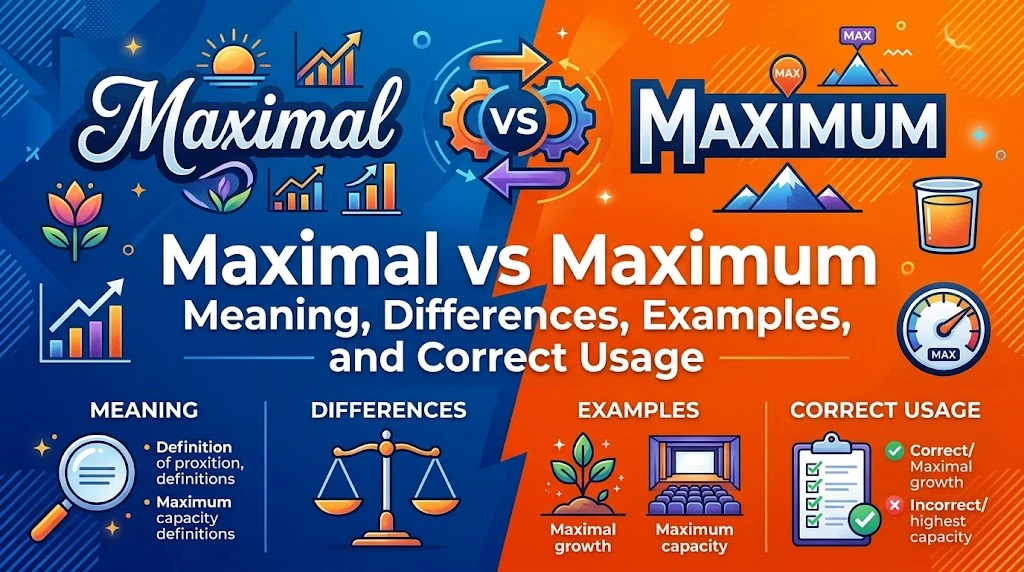
At first glance, maximal and maximum look like two versions of the same word. Both relate to something being at an extreme or reaching a high point. In everyday conversation, they can even seem interchangeable.
Mathematics tells a different story.
In technical writing, the distinction between maximal vs maximum can completely change the meaning of a statement. A maximum is the greatest value or element in a relevant collection. A maximal element is one that cannot be extended or improved under the rules of the particular problem.
That difference sounds small. It isn’t.
Imagine several hikers standing on different trails. The person standing at the highest point is the maximum if every other hiker is below them. A hiker can be maximal when there is no permitted step upward from their current position, even though another hiker may be higher on a different, incomparable trail.
That’s the heart of the distinction.
This guide explains maximal vs maximum in everyday English, mathematics, set theory, graph theory, optimization, computer science, science, and sports. It also shows exactly when you should use each word.
Maximal vs Maximum at a Glance
The fastest way to understand the difference is to focus on what each word asks you to prove.
| Feature | Maximum | Maximal |
| Basic meaning | Greatest overall | Cannot be extended or improved under the relevant rules |
| Main question | “Is anything greater?” | “Can this be made greater while preserving the rules?” |
| Everyday use | Very common | Less common and more formal |
| Mathematical use | Greatest element/value | Element with nothing greater above it in the relevant order |
| Can several exist? | Not in a standard total order | Yes |
| Must it be globally greatest? | Yes | No |
| Common technical fields | Mathematics, statistics, science, business | Mathematics, graph theory, computer science |
| Example | Maximum score | Maximal independent set |
A useful memory trick is:
Maximum asks for the biggest. Maximal asks whether you can go any farther.
That single distinction solves many confusing examples.
What Does “Maximum” Mean?
Maximum refers to the greatest amount, value, degree, or level within a defined range or collection.
Suppose five students receive these scores:
72, 81, 88, 94, 97
The maximum score is 97 because no score in the collection exceeds it.
The important idea is comparison. A maximum isn’t merely large. It is the largest relevant value.
Maximum as a Noun
As a noun, maximum identifies the greatest value or amount.
Examples include:
- “The maximum score is 100.”
- “The car reached a maximum speed of 120 mph.”
- “The maximum temperature today was 95°F.”
- “The building has a maximum occupancy of 500 people.”
- “The experiment produced a maximum yield of 42 grams.”
In each case, the word points toward an uppermost value.
Maximum as an Adjective
Maximum can also describe something that reaches or allows the highest relevant level.
Consider:
- maximum speed
- maximum capacity
- maximum pressure
- maximum efficiency
- maximum effort
- maximum output
- maximum load
Here, maximum often describes a limit or upper bound.
For example, if a machine has a maximum load of 2,000 pounds, the figure tells you the greatest load the stated specification permits.
Maximum as a Mathematical Concept
Mathematics gives maximum a particularly precise meaning.
For a set SS, an element mm is a maximum when:
m≥xm \geq x
for every xx in SS.
In plain English, nothing in the relevant set is greater than the maximum.
For example:
S={3,7,11,15}S=\{3,7,11,15\}
The maximum is:
1515
because 15 is greater than or equal to every other element.
A maximum therefore represents a global comparison within the chosen collection.
Maximum Examples
You encounter maximum values constantly:
- The highest temperature recorded during a day
- The highest score on a test
- The greatest profit among several business strategies
- The largest number in a finite list
- The greatest value reached by a function over a specified domain
- The largest matching in a graph
- The largest independent set in a graph
The context changes. The basic idea does not: maximum means greatest under the comparison being used.
What Does “Maximal” Mean?
Maximal sounds similar to maximum because both words come from the same general idea of reaching an extreme. However, technical usage gives maximal a more specialized meaning.
Something is maximal when you cannot extend or improve it while still satisfying the conditions of the problem.
That does not necessarily mean it is the largest possible object.
This distinction becomes especially important when elements cannot all be directly compared.
Maximal in Everyday English
In ordinary English, maximal can mean extremely high, complete, or as great as possible.
You might encounter phrases such as:
- maximal effort
- maximal response
- maximal effect
- maximal activation
- maximal intensity
In these contexts, maximal often emphasizes an extreme degree rather than a formal mathematical relationship.
For example:
“The athlete performed a maximal effort sprint.”
The sentence describes an effort pushed to an extreme level. It doesn’t necessarily claim that the athlete produced the highest measurable performance among every athlete who has ever competed.
That’s an important nuance.
Maximal in Mathematics
In mathematics, the word becomes much more exact.
An element is maximal when there is no strictly greater element that remains relevant under the given ordering.
Suppose an ordered set contains an element mm. If there is no element xx such that:
m<xm < x
then mm is maximal.
Notice what this definition does not say.
It doesn’t say that mm is greater than every other element.
It only says that nothing lies above mm in the relevant order.
That is why a mathematical problem can contain several maximal elements.
Maximal Examples
Maximal objects appear throughout mathematics and computer science:
- maximal elements in partially ordered sets
- maximal subsets
- maximal independent sets
- maximal matchings
- maximal cliques
- maximal feasible solutions
In each case, the central idea is not simply “largest.”
Instead, the object has reached a point where the permitted property-preserving extension stops.
Maximal vs Maximum: The Core Difference
The cleanest explanation of maximal vs maximum is this:
Maximum means greatest overall.
Maximal means unable to be extended upward under the relevant rules.
Consider this simplified picture:
MAXIMUM
▲
│
│
greatest element
│
────────────┼────────────
other comparable elements
MAXIMAL
▲ ▲
│ │
maximal maximal
element element
No permitted step upward
from either position
The maximum sits above everything else in a comparable system.
Maximal elements may sit at several different “tops” when the system doesn’t allow every element to be compared.
The Simplest Way to Remember the Difference
Ask one question:
“Do I mean the greatest one?”
If the answer is yes, use maximum.
Now ask:
“Do I mean one that cannot be extended while preserving the required property?”
If the answer is yes, maximal may be the correct technical term.
Can Something Be Maximal but Not Maximum?
Absolutely.
Consider these sets:
A={1,2}A=\{1,2\}
and
B={1,3}B=\{1,3\}
Suppose the comparison is based on set inclusion.
Neither set contains the other:
- AA doesn’t contain BB.
- BB doesn’t contain AA.
Therefore, neither one is greater than the other under inclusion.
If no permitted larger set preserves the required property, both can be maximal.
However, neither one is necessarily a maximum because a maximum would have to contain every other relevant set.
This example captures why the words diverge in partial orders.
Can There Be More Than One Maximum?
Under an ordinary total ordering, there cannot be two different maximum elements.
Suppose both aa and bb were maximum elements. Then:
a≥ba\geq b
and
b≥ab\geq a
Under the usual ordering of numbers, that means:
a=ba=b
So two distinct numbers cannot both be the maximum.
Maximal elements are different. A partially ordered set can have several of them.
Maximum vs Maximal in Mathematics
Mathematics uses these terms carefully because vague language can produce incorrect conclusions.
Maximum of a Set
For a set SS, the maximum is an element mm satisfying:
m∈Sm\in S
and
m≥xm\geq x
for every x∈Sx\in S.
For example:
S={4,9,12,17}S=\{4,9,12,17\}
has maximum:
1717
because 17 is at least as large as every other member.
However, not every set has a maximum.
Consider:
S=(0,1)S=(0,1)
There is no maximum.
Why?
Every number inside the interval is less than 1. Yet 1 itself isn’t included. If you choose any number such as 0.9, you can find a larger number such as 0.95 that still belongs to the set.
So the set has an upper bound, but no maximum element.
That distinction matters in calculus and analysis.
Maximal Element of a Set
A maximal element depends on the ordering relation.
An element mm is maximal if there is no element xx satisfying:
m<xm<x
under that order.
The phrase “under that order” matters enormously.
If you change the ordering, the identity of maximal elements can change.
Maximum, Maximal, Minimum, and Minimal
These four terms are easy to mix up.
| Term | Meaning |
| Maximum | Greatest element |
| Maximal | No greater comparable element exists |
| Minimum | Least element |
| Minimal | No smaller comparable element exists |
The same relationship works in reverse.
A minimum must be below every relevant element. A minimal element only needs to have nothing strictly below it in the relevant order.
Partial Orders vs Total Orders
The distinction between maximal and maximum becomes much easier once you understand partial orders.
What Is a Total Order?
A total order allows every pair of elements to be compared.
Ordinary numbers provide the simplest example.
For any two real numbers aa and bb, one of these must hold:
a≤ba\leq b
or
b≤ab\leq a
or both when they are equal.
Because every pair is comparable, the concept of “highest” behaves exactly as you expect.
What Is a Partial Order?
A partial order does not require every pair of elements to be comparable.
Set inclusion is a classic example.
Suppose:
A={1,2}A=\{1,2\}
and:
B={2,3}B=\{2,3\}
Neither set contains the other.
Therefore:
A⊈BA\nsubseteq B
and
B⊈AB\nsubseteq A
The two sets are incomparable under inclusion.
A partially ordered set is often called a poset. A partial order must satisfy reflexivity, antisymmetry, and transitivity.
Simple Partial-Order Example
Imagine these sets:
{1},{2},{1,2}\{1\},\{2\},\{1,2\}
Under set inclusion:
{1,2}
/ \
{1} {2}
Here, {1,2}\{1,2\} is the maximum because it contains both smaller sets.
Now remove {1,2}\{1,2\}:
{1} {2}
The remaining sets are incomparable.
Both can be maximal.
Neither is a maximum.
That’s the difference in one picture.
Maximal vs Maximum in Set Theory
Set theory provides some of the clearest examples of this distinction.
Maximum Under Set Inclusion
Suppose a collection contains:
{a},{b},{a,b}\{a\},\{b\},\{a,b\}
Under inclusion, {a,b}\{a,b\} contains both other sets.
Therefore, it is the maximum element of the collection.
Maximal Sets
Now imagine a collection of subsets that must satisfy a particular condition.
A set may be maximal if you cannot add another element without breaking that condition.
For example, imagine selecting students for a committee where no two selected students can have a scheduling conflict.
A committee can be maximal if you cannot add another student without creating a conflict.
That committee isn’t automatically the largest possible conflict-free committee.
Another committee might contain more students.
So:
- Maximal: cannot add anyone without violating the rule.
- Maximum: contains more people than every other valid committee.
This example translates the mathematical distinction into something much easier to visualize.
Maximal vs Maximum in Graph Theory
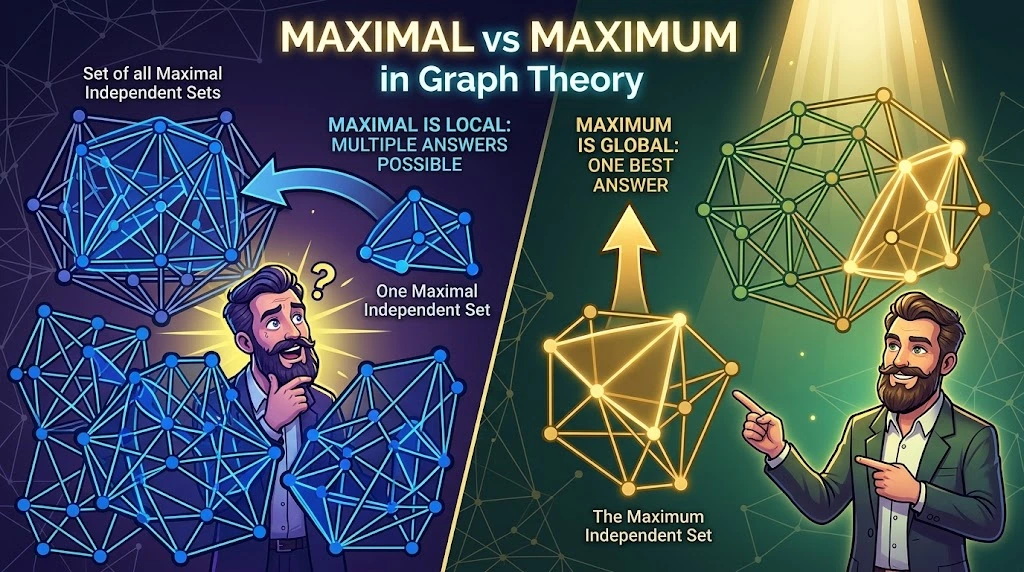
Graph theory uses the difference constantly.
A graph consists of vertices and edges. You can think of vertices as points and edges as connections between them.
Maximum in Graph Theory
A maximum independent set is an independent set with the largest possible number of vertices.
An independent set contains vertices where no two selected vertices are adjacent. The size of the largest such set is commonly denoted α(G)\alpha(G). Finding a maximum independent set is an NP-hard optimization problem in general.
So if a graph has several independent sets containing:
- 2 vertices
- 3 vertices
- 4 vertices
- 5 vertices
then an independent set containing 5 vertices is a maximum independent set, assuming 5 is the largest possible size.
Maximal in Graph Theory
A maximal independent set cannot accept another vertex without losing independence.
That does not mean it contains the largest possible number of vertices.
NetworkX’s documentation gives a direct definition: a maximal independent set is one where adding another node would make the set no longer independent.
This creates an important possibility:
A maximal independent set can be smaller than a maximum independent set.
Maximum vs Maximal Independent Set
Imagine a graph where one independent set contains four vertices and another contains three.
If neither set can accept another vertex without creating an edge between selected vertices, both may be maximal.
Only the four-vertex set is maximum.
That’s why the terms cannot simply be swapped.
Maximum vs Maximal Matching
The same idea applies to matchings.
A maximum matching contains the largest possible number of edges under the matching rules.
A maximal matching is a matching that cannot accept another edge without violating those rules.
Again:
maximum = largest
maximal = cannot be extended
This distinction matters when algorithms search for practical solutions instead of globally optimal ones.
Maximal vs Maximum in Optimization
Optimization asks you to find the best solution according to an objective.
That makes maximum especially important.
Maximum Optimization
Suppose a company wants to maximize profit.
Different production plans produce:
| Plan | Profit |
| A | $40,000 |
| B | $52,000 |
| C | $61,000 |
| D | $57,000 |
If all four plans satisfy the constraints, Plan C provides the maximum profit.
It produces the greatest objective value.
Maximal Solutions Under Constraints
A maximal solution can be different.
Imagine you’re building a delivery route. You keep adding deliveries while respecting vehicle capacity and scheduling restrictions.
Eventually, no additional delivery can be added without breaking a constraint.
The route is maximal with respect to the allowed extension.
But another route might serve more customers.
So the first route can be maximal without being maximum.
That’s a crucial distinction in algorithm design.
Maximum vs Maximal Optimization Example
Suppose three valid solutions have values:
- Solution A: 80
- Solution B: 90
- Solution C: 100
If Solution A cannot be locally extended without violating a constraint, it may be maximal.
But Solution C is maximum because it has the greatest objective value.
Maximality does not guarantee optimality.
That’s one of the most important lessons in this entire topic.
Maximal vs Maximum in Computer Science
Computer science frequently deals with structures that must satisfy strict constraints.
Maximal Structures in Algorithms
Common examples include:
- maximal independent sets
- maximal matchings
- maximal cliques
- maximal feasible solutions
Algorithms may construct a maximal object because reaching one can be much easier than proving that it is the largest possible object.
Maximum Structures in Algorithms
Maximum versions ask a harder question:
What is the largest valid structure that exists?
For example:
- maximum independent set
- maximum clique
- maximum matching
These problems often require more computation than simply finding an object that cannot be extended.
For maximum independent set specifically, the general optimization problem is NP-hard. NetworkX therefore provides approximation functionality rather than pretending that a simple greedy procedure always finds the true optimum.
Why the Distinction Matters
Consider a scheduling algorithm.
A maximal schedule might mean:
“No additional compatible task can be inserted.”
A maximum schedule might mean:
“This schedule contains the greatest possible number of compatible tasks.”
Those statements are very different.
The first describes a stopping condition. The second describes a global optimum.
Maximal vs Maximum in Science and Everyday Contexts
Outside pure mathematics, the distinction becomes more flexible.
Maximum in Measurements
Scientists commonly use maximum when discussing the greatest observed or possible value under a defined condition.
Examples include:
- maximum temperature
- maximum pressure
- maximum velocity
- maximum concentration
- maximum output
- maximum heart rate
The word works naturally because measurements often produce an identifiable upper value.
Maximal in Scientific Descriptions
Maximal often describes the degree or intensity of a process.
For example:
- maximal activation
- maximal response
- maximal effort
- maximal contraction
- maximal stimulation
The word can emphasize that a process has reached an extreme operational state.
That doesn’t always mean the value represents a universal or mathematically greatest quantity.
Maximal vs Maximum in Biology, Medicine, and Sports
Sports science provides a particularly interesting example because maximal and maximum can appear in the same discussion.
Maximal Effort vs Maximum Performance
A runner can perform a maximal effort without necessarily producing the world’s maximum performance.
The first phrase describes the athlete’s effort level.
The second concerns the highest performance value within a defined comparison.
For example, an athlete may run a personal-best 100-meter time. That’s maximum performance within that athlete’s current record set, but the effort can also be described as maximal.
The two concepts overlap without being identical.
Maximum Heart Rate vs Maximal Exercise
Maximum heart rate refers to a heart-rate value, usually expressed in beats per minute.
Maximal exercise describes an exercise condition or effort level.
Compare:
“The athlete reached a maximum heart rate of 190 beats per minute.”
with:
“The athlete completed a maximal exercise test.”
The first sentence focuses on a measured value.
The second focuses on the intensity of the test.
Maximal Response in Medicine and Biology
Researchers may describe a response as maximal when a stimulus produces the greatest response observed under the experimental conditions.
That wording is especially useful when the emphasis falls on the experimental state rather than simply ranking numbers.
VO₂ Max: Why the Name Uses “Max”
Few examples cause more confusion than VO₂ max.
The term refers to maximal oxygen uptake, commonly written as:
V˙O2max\dot V O_2\text{max}
It describes the highest rate at which oxygen can be taken up and used under the relevant testing conditions.
The American College of Sports Medicine uses VO₂max for maximal oxygen uptake and distinguishes it from VO₂peak, which refers to peak oxygen uptake.
So why is the abbreviation max rather than maximal?
Because the full expression is commonly understood as maximum oxygen uptake or maximal oxygen uptake, depending on the terminology used in the field.
This creates an interesting language point: the abbreviation max doesn’t mean that the adjective maximal and the noun maximum are mathematically identical.
A VO₂ Max Case Study
Imagine an athlete completes an incremental treadmill test.
The workload rises gradually:
Low intensity
↓
Moderate intensity
↓
High intensity
↓
Very high intensity
↓
Maximal exercise
↓
VO₂max measurement
The athlete’s maximal exercise effort describes the testing condition.
The VO₂max value describes the measured physiological capacity.
That’s why both maximal and maximum can appear in the same scientific discussion without being redundant.
Maximal vs Maximum in Economics and Business
Business decisions often involve optimization.
Suppose a factory wants to maximize revenue while respecting:
- labor limits
- machine capacity
- material availability
- delivery schedules
- customer demand
The maximum revenue is the greatest revenue achievable under those constraints.
A maximal production plan, however, could describe a plan that cannot be expanded without breaking one of the constraints.
Those aren’t necessarily the same.
Maximum Profit
If five strategies produce:
| Strategy | Annual Profit |
| A | $1.2 million |
| B | $1.5 million |
| C | $1.8 million |
| D | $1.6 million |
| E | $1.7 million |
Strategy C provides the maximum profit.
The comparison is global.
Maximal Growth or Output
A business process might be called maximal when it has reached a point where additional output isn’t possible under the current resource constraints.
Yet another configuration might produce a higher overall profit because it uses resources differently.
That’s why maximal does not automatically mean optimal.
Maximal vs Maximum in Everyday English
The technical distinction matters most in specialized fields. Everyday English usually feels simpler.
When “Maximum” Sounds Natural
Use maximum for ordinary limits and highest values:
- maximum speed
- maximum capacity
- maximum weight
- maximum temperature
- maximum score
- maximum amount
- maximum distance
For most readers, these phrases sound completely natural.
When “Maximal” Sounds Natural
Use maximal when you’re describing an extreme degree, especially in formal or technical writing:
- maximal effort
- maximal response
- maximal activation
- maximal intensity
- maximal stimulation
The word has a more specialized flavor.
When You Shouldn’t Substitute One for the Other
Consider these examples:
“The elevator has a maximal capacity of 12 people.”
This isn’t the most natural choice. Maximum capacity is standard.
Now consider:
“The athlete produced maximal effort during the final sprint.”
Here, maximal effort works naturally in sports and exercise contexts.
The practical rule is simple:
Use maximum for the highest value or limit. Use maximal when emphasizing an extreme state or an object that cannot be extended under specific rules.
Maximal vs Maximum: Grammar and Word Forms
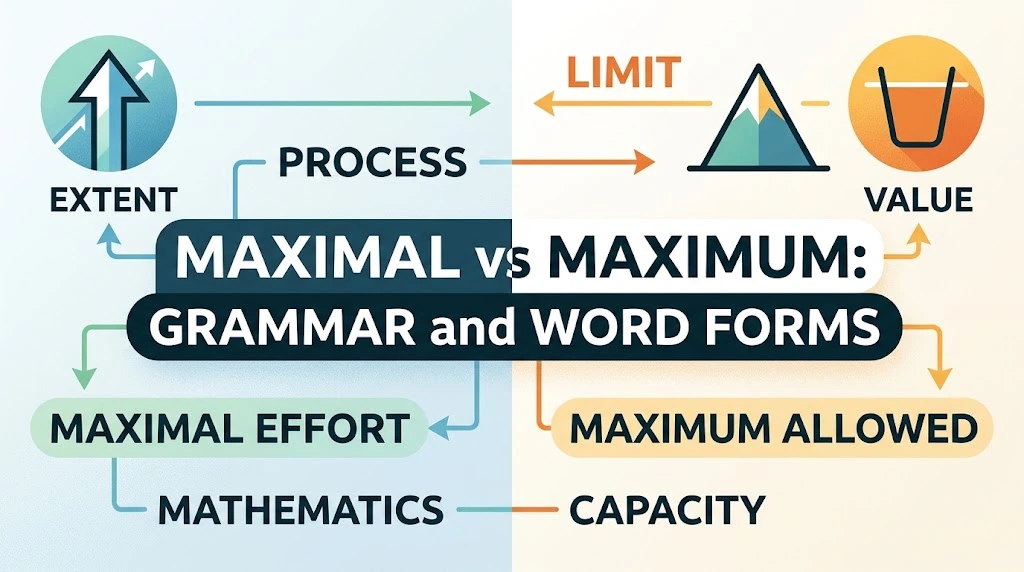
Understanding the related word forms helps prevent awkward usage.
Maximum as a Noun and Adjective
As a noun:
“The maximum was 98.”
As an adjective:
“The maximum temperature was 98°F.”
The word can therefore name the upper value or modify a noun describing that value.
Maximal as an Adjective
Maximal functions primarily as an adjective.
Examples:
- maximal effort
- maximal response
- maximal subset
- maximal matching
- maximal independent set
You wouldn’t normally use maximal as a direct replacement for the noun maximum.
Related Words
Several related terms appear in technical writing:
| Word | General meaning |
| Maximum | Greatest value or element |
| Maximal | Unable to be extended under the relevant conditions |
| Maximize | Make as large or great as possible |
| Maximization | The process of seeking the greatest value |
| Maximality | The condition of being maximal |
| Maximally | To the greatest relevant degree |
Knowing these forms makes the broader maximal vs maximum distinction easier to recognize.
Read More :
Common Mistakes With Maximal and Maximum
These words create predictable mistakes.
Mistake: Treating Them as Perfect Synonyms
In casual English, the substitution may not cause confusion.
In mathematics, however, it can make a statement false.
A maximum must be globally greatest under the relevant order.
A maximal element doesn’t have to be globally greatest.
Mistake: Assuming Maximal Means “The Largest”
This is probably the most important error.
A maximal independent set isn’t necessarily the largest independent set.
It simply cannot accept another vertex while remaining independent.
Mistake: Assuming There Can Be Only One Maximal Element
Several maximal elements can exist in a partially ordered set.
This happens because some elements may be incomparable.
A maximum, by contrast, must dominate every relevant element under the order.
Mistake: Confusing Maximal With Local Maximum
These concepts can sound similar because both involve a sense of “no further improvement.”
However, they belong to different mathematical frameworks.
A local maximum of a function is a point whose function value is at least as high as nearby values within a specified neighborhood.
A maximal element belongs to an ordering framework and has no strictly greater comparable element.
They should not be treated as synonyms.
Mistake: Assuming Every Large Object Is Maximum
Size alone doesn’t establish maximum status.
You must know whether a larger valid object exists.
That is why mathematical definitions matter more than intuition.
Maximal vs Maximum Examples
A few examples can make the distinction stick.
Example: Everyday Language
“The stadium has a maximum capacity of 60,000.”
This means 60,000 is the highest stated capacity.
Now:
“The athlete gave a maximal effort.”
This describes the athlete’s effort as being pushed to an extreme level.
Example: Numbers
Consider:
S={2,5,8,11}S=\{2,5,8,11\}
The maximum is:
1111
Every number is comparable with every other number.
Example: Sets
Suppose two valid subsets cannot be enlarged without breaking a required property.
They can both be maximal.
However, if one valid subset contains every other valid subset, it is the maximum.
Example: Graphs
A graph can contain several maximal independent sets.
NetworkX gives a path graph with four nodes as an example having three maximal independent sets: {0, 2}, {0, 3}, and {1, 3}.
Yet the maximum independent set asks for the largest possible independent set rather than simply any unextendable one.
Example: Optimization
A solution that cannot be improved by an allowed single extension can be maximal.
A solution with the highest objective value across all feasible solutions is maximum.
The first is a stopping point.
The second is a global winner.
Maximal vs Maximum Comparison Table
| Question | Maximum | Maximal |
| Does it mean “greatest”? | Yes | Not necessarily |
| Does it need to dominate all others? | Yes, under the relevant order | No |
| Can multiple exist? | No in a total order | Yes |
| Can it be smaller than another valid object? | No, if “maximum” refers to the same comparison | Yes |
| Does it depend on constraints? | Often | Essentially |
| Does it describe an unextendable object? | Not specifically | Yes |
| Common in everyday speech? | Very common | Less common |
| Common in graph theory? | Yes | Yes |
| Example | Maximum independent set | Maximal independent set |
| Guarantees global optimality? | Yes | No |
A Step-by-Step Method for Choosing Maximal or Maximum
When you’re unsure which word to use, don’t guess.
Run through these questions.
Ask Whether You Mean “Greatest”
If you’re talking about the highest value in a defined collection, maximum is usually correct.
Examples:
- maximum score
- maximum speed
- maximum profit
- maximum temperature
Ask Whether You Mean “Cannot Be Extended”
If the object has reached a point where adding or improving something would violate the rules, maximal may be correct.
Examples:
- maximal independent set
- maximal matching
- maximal subset
- maximal feasible structure
Check the Context
The same general idea can use different wording in different fields.
| Context | Likely choice |
| Everyday limits | Maximum |
| Highest numerical value | Maximum |
| Mathematics | Both, depending on definition |
| Graph theory | Both |
| Computer science | Both |
| Exercise science | Maximal and maximum |
| Business optimization | Usually maximum for the objective |
| Formal descriptions of extreme states | Maximal |
Test the Sentence
Try replacing the word with greatest.
If the sentence still captures your meaning, maximum may be right.
Then try replacing it with:
“cannot be extended while preserving the required property.”
If that captures your meaning, maximal may be right.
This simple test works surprisingly well.
Read More : 17+ Other Ways to Say “As You Can See” (With Examples)
Maximal vs Maximum: Quick Decision Chart
Use this shortcut when writing:
What do you mean?
│
┌─────────┴─────────┐
│ │
Greatest overall? Cannot be extended?
│ │
▼ ▼
MAXIMUM MAXIMAL
│ │
Highest value Unextendable
Global optimum Under constraints
Largest object May not be largest
Here are some quick examples:
- Highest possible score → Maximum
- Largest valid subset → Maximum
- Cannot add another element without breaking a rule → Maximal
- Largest independent set → Maximum
- Independent set that cannot accept another vertex → Maximal
- Highest profit → Maximum
- Effort pushed to an extreme → Maximal
- VO₂ max measurement → Maximum terminology
- Maximal exercise effort → Maximal terminology
Why the Difference Between Maximal and Maximum Matters
At first, this distinction can look like mathematical hair-splitting.
It isn’t.
In optimization, algorithms, graph theory, and formal mathematics, confusing the two can lead to completely different conclusions.
Imagine someone says:
“We found a maximal solution, so we found the best solution.”
That conclusion doesn’t follow.
A maximal solution may simply be impossible to extend under the current rules. Another valid solution could still be better.
By contrast, when you find a true maximum, you have established that no relevant alternative is greater.
That’s the real dividing line:
Maximal describes a boundary. Maximum describes the top.
Frequently Asked Questions About Maximal vs Maximum
Is maximal the same as maximum?
No. In everyday English, the meanings can overlap. In mathematics and computer science, they are distinct.
Maximum means greatest under the relevant ordering. Maximal means that no strictly greater comparable element exists.
What is the difference between maximal and maximum?
A maximum is globally greatest. A maximal element simply cannot be increased within the relevant structure or ordering.
A maximal element can therefore be smaller than another valid element that isn’t comparable to it under the relevant order.
Can something be maximal but not maximum?
Yes.
This is one of the defining differences between the terms. A maximal object may have no permitted extension even though another valid object is larger.
Can there be multiple maximal elements?
Yes.
Partially ordered sets can contain multiple maximal elements because some elements may be incomparable.
Can there be multiple maximum elements?
Not as distinct elements in a standard antisymmetric ordering.
If two elements were both maximum, each would have to be at least as large as the other. Antisymmetry then forces them to be equal.
Is every maximum also maximal?
Yes, under the standard mathematical definitions.
If an element is greater than or equal to every element in the set, there can’t be another strictly greater element above it.
So every maximum is maximal.
The reverse isn’t necessarily true.
What is a maximal element in mathematics?
A maximal element is an element for which no strictly greater comparable element exists under the relevant ordering.
It doesn’t need to be greater than every element.
What is a maximum in mathematics?
A maximum is an element that is greater than or equal to every element in the relevant set.
It is therefore a global top element with respect to that ordering.
What is the difference between maximal and maximum in graph theory?
A maximum graph structure has the largest possible size.
A maximal graph structure cannot be extended while preserving the required property.
For example, a maximum independent set is the largest independent set. A maximal independent set is one to which no additional vertex can be added without creating an edge between selected vertices.
Is VO₂ max a maximum or maximal value?
VO₂ max refers to maximal oxygen uptake and is conventionally written with “max.” The terminology concerns a physiological maximum under testing conditions rather than the mathematical concept of a maximal element in a partial order. ACSM materials use VO₂max for maximal oxygen uptake and distinguish VO₂peak as peak oxygen uptake.
Which word should I use in everyday English?
Use maximum when you mean the highest amount, value, capacity, limit, or score.
Use maximal when you mean an extreme degree or a state that cannot be extended or increased under particular conditions.
For ordinary phrases such as maximum capacity and maximum speed, maximum is the natural choice.
Final Takeaways
The difference between maximal vs maximum becomes simple once you stop treating the words as interchangeable.
Maximum means greatest overall.
Maximal means unable to be extended or improved under the relevant rules.
That distinction leads to several important conclusions:
- A maximum is the greatest element or value in the relevant collection.
- A maximal element has nothing strictly greater above it under the relevant ordering.
- Every maximum is maximal in the standard mathematical setting.
- Not every maximal element is a maximum.
- A partially ordered set can contain several maximal elements.
- A maximum is unique when the underlying order is antisymmetric.
- Maximum independent set means the largest independent set.
- Maximal independent set means an independent set that cannot accept another vertex.
- Maximum is usually the better choice for ordinary limits and highest values.
- Maximal often appears in formal, scientific, mathematical, and technical descriptions.
- VO₂ max uses “max” as part of established physiological terminology and shouldn’t be confused with mathematical maximality.
The easiest rule to carry with you is this:
If you mean “the greatest,” choose maximum. If you mean “nothing more can be added or improved under the rules,” choose maximal.
Once that distinction clicks, the terminology stops looking like two nearly identical words. Instead, each one has a clear job.