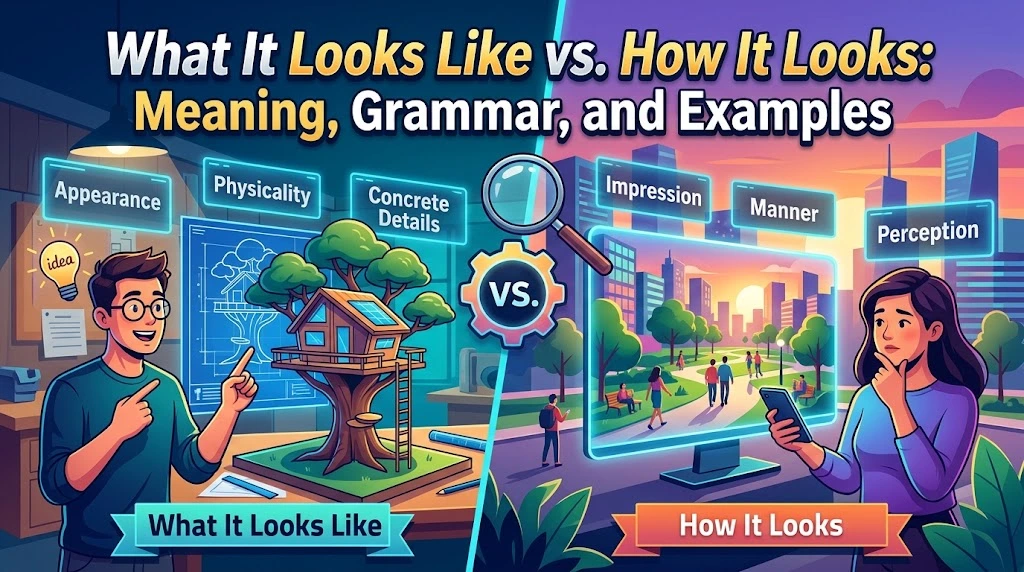
Have you ever wondered whether to say “what it looks like” or “how it looks”? You’re not alone. These expressions often confuse English learners because they both describe appearance. However, they follow different grammatical patterns and can communicate slightly different ideas.
For example, you might ask, “What does your new house look like?” when you want someone to describe its appearance. On the other hand, “How does your new house look?” often asks for an assessment of its appearance or condition.
Here’s the key point: “What it looks like” and “how it looks” are both correct English. However, “how it looks like” is generally incorrect in standard English.
The confusion happens because English uses both what and how to ask questions about appearance. The word like also plays an important role in one of these patterns, which makes it easy to combine the expressions incorrectly.
This guide explains the difference between “what it looks like” and “how it looks,” explores the grammar behind both phrases, and provides practical examples. You’ll also find common mistakes, correction tips, and exercises to help you use these expressions confidently in everyday conversations.
What Is the Difference Between “What It Looks Like” and “How It Looks”?
The main difference comes down to the grammatical structure and the meaning you want to express. Both expressions can describe appearance, but they don’t use the same pattern.
“What it looks like” commonly refers to the appearance or visual characteristics of a person, place, object, or situation. It can introduce a description of what someone or something looks like.
“How it looks” commonly refers to the appearance, condition, presentation, or impression something creates. Depending on the context, it can ask for a description or an evaluation.
Consider these examples:
- What does the puppy look like? You’re asking someone to describe the puppy’s appearance.
- How does the puppy look? You’re asking about its appearance or condition. Depending on the situation, you might want to know whether it looks healthy, happy, or tired.
The distinction isn’t always absolute. Sometimes both questions can request nearly the same information.
For instance, if a friend buys a new jacket, you could ask either question. Your friend might describe the jacket’s color, fit, and overall appearance in response to both.
The important thing is to use the correct grammatical pattern.
| Expression | Main purpose | Example |
| What it looks like | Introduces a description of appearance | I know what the building looks like. |
| How it looks | Describes or asks about appearance, condition, or impression | I like how the building looks. |
| What does it look like? | Direct question asking for a description | What does your new phone look like? |
| How does it look? | Direct question asking about appearance or presentation | How does my new phone look? |
| How it looks like | Generally incorrect in standard English | Use “how it looks” or “what it looks like” instead. |
Remember that the words surrounding the phrase also matter. A direct question and a statement containing an embedded question follow different word-order rules.
What Does “What It Looks Like” Mean?
The phrase “what it looks like” refers to the appearance or visual characteristics of something. It helps you describe or identify what a person, object, place, or scene looks like.
You might use it when describing a new apartment, explaining a product, talking about someone’s outfit, or discussing a place you’ve visited.
For example:
- “I know what your new car looks like.”
- “Can you describe what the restaurant looks like?”
- “She showed me what the finished painting looks like.”
- “I can’t imagine what the city looks like after the storm.”
In each sentence, the phrase introduces information about appearance.
The expression can also refer to something imagined or expected rather than something you’ve personally seen.
For example, you might say, “I wonder what life on Mars looks like.” You’re asking about the possible appearance of something you haven’t experienced directly.
Examples of “What It Looks Like” in Everyday English
Here are several common situations where this expression fits naturally.
Describing a person
- “I remember what your brother looks like.”
- “Tell me what the new manager looks like so I can recognize him.”
- “I have no idea what the actor looks like without makeup.”
Describing an object
- “Can you show me what the replacement part looks like?”
- “I know what the package looks like.”
- “She explained what the antique clock looks like.”
Describing a place
- “Do you know what the hotel looks like?”
- “I want to see what the new library looks like.”
- “He described what the village looks like in winter.”
Describing an imagined or unfamiliar situation
- “I wonder what the ocean floor looks like.”
- “Can you explain what the finished model looks like?”
- “Nobody knew what the abandoned building looked like inside.”
Notice how the phrase works in all these examples. It introduces a description of appearance without requiring the speaker to give an opinion about whether something looks attractive or unattractive.
How “What It Looks Like” Works Grammatically
To understand this expression, you need to distinguish between a direct question and an embedded question.
A direct question asks for information directly:
What does the house look like?
An embedded question places the question inside a larger sentence:
I know what the house looks like.
The words what the house looks like form an embedded interrogative clause in the second sentence. The clause functions as the information the speaker knows.
Here’s the important difference:
- Direct question: What does it look like?
- Embedded question: I know what it looks like.
In the direct question, the auxiliary verb does appears before the subject it. In the embedded question, does disappears, and the main verb looks carries the third-person singular ending.
That’s why you say, “I know what it looks like,” rather than “I know what does it look like.”
The second version incorrectly carries the direct-question word order into an embedded clause.
This rule applies to many other questions in English:
- Direct: “Where does she live?”
- Embedded: “I know where she lives.”
- Direct: “What does he want?”
- Embedded: “I understand what he wants.”
- Direct: “When does the store open?”
- Embedded: “Do you know when the store opens?”
Learning this pattern makes it easier to use “what it looks like” correctly in longer sentences.
What Does “How It Looks” Mean?
The phrase “how it looks” describes the appearance, condition, or impression of something. It can also introduce an assessment of how something appears to another person.
For example, imagine you’ve finished decorating your living room. You might ask a friend, “How does it look?” You’re probably asking whether the room looks attractive, balanced, comfortable, or well arranged.
However, the phrase isn’t limited to opinions. It can also describe a visible condition.
Consider these examples:
- “I like how it looks in natural light.”
- “I’m worried about how the roof looks after the storm.”
- “She explained how the machine looks when it’s operating normally.”
- “We need to check how the website looks on mobile devices.”
In the first sentence, the speaker expresses an opinion. In the other examples, the phrase refers to appearance or condition.
Therefore, it’s too simplistic to say that what it looks like always requests a description while how it looks always requests an opinion. The distinction depends on context.
Examples of “How It Looks” in Everyday English
Asking for an opinion
- “How does this dress look on me?”
- “How does the new logo look?”
- “How does my presentation look so far?”
These questions usually invite feedback about appearance, design, or presentation.
Describing a condition
- “I don’t like how the wall looks after the repair.”
- “The doctor checked how the wound looks.”
- “We should inspect how the roof looks after the heavy rain.”
Here, the expression describes a visible condition. It doesn’t necessarily ask whether something is beautiful or appealing.
Talking about presentation
- “I like how the website looks on a phone.”
- “The designer changed how the menu looks.”
- “Let’s see how the report looks when printed.”
These sentences focus on the way something appears in a particular setting or format.
When Should You Use “How It Looks”?
Use this expression when you want to discuss the way something appears, especially when its condition, presentation, or overall impression matters.
For example, imagine you’re choosing between two website designs. You might ask a colleague, “How does the second design look on a small screen?”
The question invites feedback about readability, layout, and visual balance.
Similarly, if you’re checking a repaired wall, you might say, “Let’s see how it looks after the paint dries.” You’re checking its appearance once the work is complete.
The expression is especially natural when appearance changes with circumstances, such as lighting, clothing, screen size, or a recent repair.
Why Is “How It Looks Like” Incorrect?
The phrase “how it looks like” is generally considered ungrammatical in standard English when used to ask about appearance or describe what something resembles.
The problem is that it combines two different grammatical patterns:
- What … look like
- How … look
Both patterns are correct on their own. The mistake happens when you combine how from the second pattern with like from the first.
For example:
- Incorrect: “How does your new apartment look like?”
- Correct: “What does your new apartment look like?”
- Also correct: “How does your new apartment look?”
The first correct version asks for a description. The second asks about the apartment’s appearance or overall impression.
This is a common error among English learners because the phrases have similar meanings. Other languages may also express these ideas using structures that don’t match standard English word order.
Still, the correction is straightforward: use “what … look like” or “how … look,” but don’t combine them into “how … look like” when asking about appearance.
The Grammar Behind “What … Look Like”
The standard direct-question pattern is:
What + do/does/did + subject + look like?
Examples:
- “What does your teacher look like?”
- “What do the new apartments look like?”
- “What did the old theater look like?”
- “What does the missing dog look like?”
The auxiliary verb changes according to the tense and subject.
| Tense | Example |
| Present, singular subject | What does it look like? |
| Present, plural subject | What do they look like? |
| Past | What did it look like? |
Notice that look remains in its base form after do, does, or did.
You say “What does it look like?” rather than “What does it looks like?” The auxiliary does already carries the third-person singular marking, so the main verb doesn’t need an -s ending.
The embedded-question version follows a different pattern:
- “I know what it looks like.”
- “She asked what the new house looked like.”
- “Can you tell me what the device looks like?”
In these sentences, the embedded clause uses statement word order rather than direct-question word order.
The Grammar Behind “How … Look”
The standard direct-question pattern is:
How + do/does/did + subject + look?
Examples:
- “How does the new office look?”
- “How do the curtains look?”
- “How did the garden look before the renovation?”
- “How does your new haircut look?”
The word how asks about the manner, condition, or impression of the appearance. The sentence doesn’t need like at the end.
Embedded questions follow the same general pattern as other embedded clauses:
- “I wonder how the new office looks.”
- “She asked how the curtains looked.”
- “Tell me how the garden looks after the renovation.”
The auxiliary does disappears in the present-tense embedded clause, while the main verb takes the appropriate form.
Compare the two structures:
| Direct question | Embedded question |
| How does it look? | I wonder how it looks. |
| How do they look? | Tell me how they look. |
| How did it look? | I remember how it looked. |
Once you understand these patterns, you’ll find it easier to avoid the incorrect combination.
Incorrect vs. Correct Examples of “How It Looks Like”
The following examples show how to fix common mistakes.
| Incorrect sentence | Correct sentence |
| How does your new car look like? | What does your new car look like? |
| I know how the building looks like. | I know what the building looks like. |
| Tell me how the dress looks like. | Tell me what the dress looks like. |
| How did the room look like before? | What did the room look like before? |
| Can you describe how the machine looks like? | Can you describe what the machine looks like? |
| I wonder how he looks like. | I wonder what he looks like. |
You can also correct some sentences by removing like:
- “How does your new car look?”
- “Tell me how the dress looks.”
- “I wonder how he looks.”
These versions are grammatically correct. However, the most natural choice depends on the information you want to communicate.
For instance, “I wonder what he looks like” usually asks for a description of his appearance. “I wonder how he looks” can also refer to his appearance, condition, or the impression he creates.
An Important Exception: Other Uses of “How” and “Like”
The problem isn’t that how and like can never appear in the same sentence. They can appear together when they serve different grammatical functions.
For example:
- “How does it look like that?” is possible when like that means “in that way,” although other wording may sound more natural depending on context.
- “How does it look when you turn it upside down?” is correct because when you turn it upside down provides the relevant circumstance.
- “How does it look compared with the original?” is also correct.
The rule is specifically about the standard pattern for asking what something looks like. Don’t treat every sentence containing how and like as automatically incorrect.
“What It Looks Like” vs. “How It Looks” in Real-Life Situations
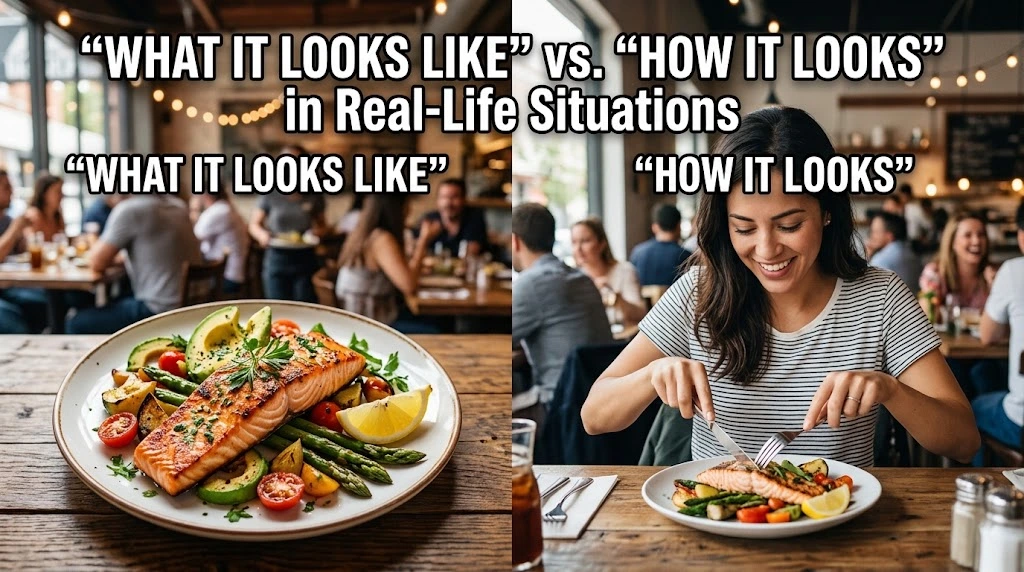
Grammar rules become easier to remember when you connect them to everyday experiences. Let’s look at situations where both expressions are useful but emphasize different things.
Talking About Clothes
Imagine you’re shopping online and your friend buys a jacket you’ve never seen.
You might ask:
“What does your new jacket look like?”
Your friend could answer, “It’s a dark blue denim jacket with silver buttons and two chest pockets.”
The question invites a description of the jacket’s features.
Now imagine you’ve tried on a jacket and want your friend’s feedback. You could ask:
“How does this jacket look on me?”
Your friend might respond, “It looks great! The color suits you.”
The second question invites an assessment of how the jacket appears on you.
Here’s a simple comparison:
| What you want to know | Natural question |
| The jacket’s color and design | What does the jacket look like? |
| Whether the jacket suits you | How does the jacket look on me? |
| The jacket’s appearance in a photograph | What does the jacket look like in the picture? |
| Whether the jacket looks good with your shoes | How does the jacket look with these shoes? |
These are useful tendencies rather than strict limits. Either question can sometimes lead to a similar answer.
Describing a Place
Suppose your cousin visits a hotel before you arrive. You want to picture the place before your trip.
You could ask, “What does the hotel look like?”
Your cousin might describe the building, lobby, swimming pool, and guest rooms. You now have a mental picture of the property.
After arriving, you might ask, “How does the hotel look after the renovation?”
This question focuses on its current appearance and the impression created by the renovations.
Both expressions work naturally. The surrounding words help communicate what information matters.
Discussing a Design or Project
Consider a graphic designer who has nearly finished a website.
A client might say:
“Show me what the final design looks like.”
The client wants to see the actual layout, colors, images, and other visual elements.
After viewing the design, the client might ask:
“How does the final design look on a mobile screen?”
Now the focus is on how the design appears in a particular setting. The client may be thinking about readability, spacing, and visual balance.
This distinction is useful in professional conversations because it helps you ask for the right kind of information.
Asking for an Opinion
Imagine you’ve painted your bedroom and aren’t sure whether the new color works.
You could ask a friend, “How does the room look?”
Your friend might say, “It looks brighter and more welcoming.”
You could also ask, “What does the room look like now?” This is grammatically correct, although it may sound less natural if your friend can already see the room and you simply want an opinion.
The lesson is simple: choose the expression that fits your purpose and the situation. Don’t rely on a rigid rule that what always requests facts while how always requests opinions.
How to Choose the Correct Phrase
When you’re unsure which expression to use, start by checking the sentence structure. Then think about the information you want.
<box gap={3}> <row align=start gap={3}> <box background=”surface-secondary” radius=”lg” padding={2} align=center justify=center size=”44px”> <icon name=”message-circle” size=”xl”/> </box> <box flex=”1″ gap={1}> **You want to ask for a description**
Use **“what … look like.”**
Example: “What does the missing dog look like?”
</box>
</row> <divider color=”subtle”/> <row align=start gap={3}> <box background=”surface-secondary” radius=”lg” padding={2} align=center justify=center size=”44px”> <icon name=”eye” size=”xl”/> </box> <box flex=”1″ gap={1}> **You want to ask about appearance or impression**
Use **“how … look.”**
Example: “How does the new haircut look?”
</box>
</row> <divider color=”subtle”/> <row align=start gap={3}> <box background=”surface-secondary” radius=”lg” padding={2} align=center justify=center size=”44px”> <icon name=”book-open” size=”xl”/> </box> <box flex=”1″ gap={1}> **You’re including the question in a longer sentence**
Use embedded-question word order.
Example: “I don’t know what the missing dog looks like.”
</box>
</row> </box>
A Simple Memory Tip for “What It Looks Like” vs. “How It Looks”
Think of these two patterns as separate building blocks.
- WHAT + LOOK LIKE: “What does the creature look like?” You want to know what it resembles.
- HOW + LOOK: “How does the creature look?” You want to know about its appearance, condition, or impression.
A quick memory trick is to remember the complete questions rather than memorizing what and how in isolation.
For example, say these aloud:
- “What does it look like?”
- “How does it look?”
Now turn them into statements:
- “I know what it looks like.”
- “I know how it looks.”
The change in word order becomes easier to recognize when you practice both versions together.
Read More : TSS Meaning in Text: What Does TSS Mean in Chats, Social Media, and Messaging?
Practice Exercises: “What It Looks Like” or “How It Looks”
You’ve seen the grammar rules and real-life examples. Now it’s time to put them into practice.
Try answering the following questions before checking the explanations.
Fill in the Blanks
Complete each sentence with what or how.
- Can you tell me _____ the new apartment looks like?
- _____ does your new haircut look?
- I don’t remember _____ the old restaurant looked like.
- Let’s see _____ the website looks on a tablet.
- Do you know _____ the missing cat looks like?
Answers and Explanations
- What — “Can you tell me what the new apartment looks like?” The speaker wants a description.
- How — “How does your new haircut look?” The speaker is asking for an assessment of its appearance.
- What — “I don’t remember what the old restaurant looked like.” The speaker wants to recall its appearance.
- How — “Let’s see how the website looks on a tablet.” The focus is on its appearance on a particular device.
- What — “Do you know what the missing cat looks like?” The speaker needs identifying details.
Notice that the first and fifth examples use embedded questions. They don’t require the direct-question word order found in “What does the cat look like?”
Correct the Mistakes
Each sentence below contains an error or uses an awkward construction. Rewrite it in standard English.
- How does your new office look like?
- I don’t know what does the painting look like.
- Can you tell me how the new car looks like?
- She asked me what did the building look like.
- How it looks like in the sunlight?
Corrected Sentences and Explanations
- What does your new office look like? Alternatively, “How does your new office look?” Both are correct questions.
- I don’t know what the painting looks like. The embedded question uses statement word order.
- Can you tell me what the new car looks like? Alternatively, “Can you tell me how the new car looks?”
- She asked me what the building looked like. The embedded question doesn’t use did.
- What does it look like in the sunlight? Alternatively, “How does it look in the sunlight?” The correct choice depends on whether you want a description or an assessment.
The fourth example illustrates an especially common mistake. English speakers sometimes keep did in an embedded question because they remember using it in the original direct question.
Compare:
- Direct: “What did the building look like?”
- Embedded: “She asked what the building looked like.”
Once you recognize the pattern, the correction becomes much easier.
A Short Case Study: Choosing the Right Phrase
Consider a situation involving two friends, Emma and Daniel, who are planning to visit a newly opened restaurant.
Emma hasn’t seen the restaurant yet, so she asks Daniel:
“What does the restaurant look like?”
Daniel replies:
“It’s a two-story building with large glass windows, a brick exterior, and a small outdoor patio.”
Emma now has a clear idea of the restaurant’s appearance.
Later, Emma arrives at the restaurant and notices the interior decorations. She turns to Daniel and asks:
“How does the restaurant look inside?”
Daniel responds:
“It looks beautiful. The lighting is warm, and the furniture gives the place a cozy atmosphere.”
Both questions are grammatically correct. The first naturally invites a description of the building. The second focuses on its interior appearance and overall impression.
Now imagine Emma had asked, “How does the restaurant look like?” Daniel would probably understand her meaning. However, the question doesn’t follow the standard English pattern.
What this case study teaches: You can communicate your intended meaning with either correct expression in many situations. The important thing is to use the right grammatical structure.
Frequently Asked Questions
Is “What It Looks Like” Grammatically Correct?
Yes. “What it looks like” is grammatically correct and commonly appears in both spoken and written English.
Use it when asking about or describing the appearance of a person, place, object, or situation.
Examples:
- “I know what your new car looks like.”
- “Can you show me what the finished product looks like?”
- “Nobody knows what the creature looks like.”
In a direct question, use “What does it look like?” In an embedded question, use “I know what it looks like.”
Is “How It Looks” Correct English?
Yes. “How it looks” is also correct English.
It can refer to someone’s or something’s appearance, condition, presentation, or overall impression.
For example:
- “I like how it looks.”
- “Let’s check how the website looks on a phone.”
- “I’m concerned about how the roof looks after the storm.”
In a direct question, you would say, “How does it look?” The phrase doesn’t need like at the end.
Why Is “How It Looks Like” Incorrect?
In standard English, “how it looks like” combines two different grammatical patterns.
The correct alternatives are:
- What it looks like: “I know what it looks like.”
- How it looks: “I know how it looks.”
For direct questions, use “What does it look like?” or “How does it look?”
Although people sometimes use the incorrect combination in conversation, it’s best to avoid it in formal writing, professional communication, and English-language learning.
Can “What It Looks Like” and “How It Looks” Mean the Same Thing?
Sometimes, yes. Both expressions can describe appearance, and their meanings may overlap.
For example:
- “Tell me what the room looks like.”
- “Tell me how the room looks.”
Both sentences are understandable and can invite a description of the room. However, the first more naturally emphasizes its visual characteristics, while the second may emphasize its appearance, condition, or overall impression.
The context determines the precise meaning.
Should I Say “What Does It Look Like” or “How Does It Look”?
Choose the question that best matches what you want to know.
Use “What does it look like?” when you want a description of its appearance.
Example: “What does your new puppy look like?”
Use “How does it look?” when you’re asking about its appearance, condition, or impression.
Example: “How does your new haircut look?”
Both questions are correct. Just remember that how does it look like? is not the standard form.
How Do I Use “What It Looks Like” in an Indirect Question?
Use normal subject-verb word order inside the embedded question.
For example:
- Direct question: “What does the house look like?”
- Indirect question: “I wonder what the house looks like.”
- Direct question: “What did the house look like?”
- Indirect question: “She asked what the house looked like.”
Don’t carry does or did into the embedded clause when the construction doesn’t require it.
Conclusion: “What It Looks Like” vs. “How It Looks”
The difference between “what it looks like” and “how it looks” becomes much easier to understand once you recognize their grammatical patterns.
Both expressions are correct. You can use either to discuss appearance, although each often emphasizes a slightly different aspect of the situation.
Remember these two rules:
- Use “what it looks like” when asking for or introducing a description of appearance.
- Use “how it looks” when discussing appearance, condition, presentation, or the impression something creates.
Avoid “how it looks like” in standard English because it mixes two different constructions. Instead, say “how it looks” or “what it looks like.”
Finally, remember the difference between direct and embedded questions. You ask, “What does it look like?” but say, “I know what it looks like.”
With a little practice, these patterns will start to feel natural. You’ll be able to choose the correct phrase without stopping to think about every word.
Further Reading
For additional explanations of these grammatical patterns, consult these English usage discussions:
- English Language & Usage: “How it looks like” — explains why the two question structures shouldn’t be combined.
- English Language & Usage: “What it looks like” or “How it looks like”? — discusses the distinction between the two correct expressions and the common mistake.