
Have you ever paused before typing goodbye because you weren’t sure whether it should be written as one word, two words, or with a hyphen? You’re not alone. Goodbye, good bye, and good-bye look almost identical, but their histories and modern usage are different. If you want to follow standard English spelling, the answer is simple: goodbye is the normal form today.
The word began as a shortened expression related to phrases such as “God be with you.” Over time, that expression changed through everyday speech and writing until it developed into the familiar farewell we use today. Earlier forms included good-bye and good bye, which explains why you may still encounter them in older books or historical writing.
Today, goodbye functions primarily as a noun, interjection, and farewell expression. You can say “Goodbye!” when leaving, write “She said goodbye,” or describe an emotional farewell between friends.
In this guide, you’ll discover the difference between goodbye vs. good bye vs. good-bye, learn which spelling is considered correct in modern English, explore the word’s etymology and history, and see practical examples that make the rule easy to remember.
Goodbye vs. Good Bye vs. Good-bye: The Quick Answer
Here’s the practical rule:
Use “goodbye” as one word in modern English.
The other forms have a place in English history, but they don’t have equal status in current everyday writing.
| Form | Modern status | Main use | Recommendation |
| goodbye | Standard | Everyday and formal English | Use this form |
| good-bye | Older/historical variant | Older texts, historical reproduction, occasional stylistic use | Usually avoid in modern general writing |
| good bye | Generally nonstandard for the farewell | Occasional informal or mistaken spelling | Avoid when you mean the farewell |
For example:
- Correct: Goodbye, everyone. I’ll see you tomorrow.
- Standard: She said goodbye before leaving.
- Historical/older: He waved good-bye from the train.
- Usually incorrect as the conventional spelling: She said good bye before leaving.
Modern dictionaries treat goodbye as an established English word. Cambridge lists it as an interjection and noun and identifies bye as its informal short form.
So if you’re unsure, don’t overthink it.
Write goodbye.
Why “Goodbye” Is Written as One Word Today
English spelling doesn’t remain frozen. Words that begin as phrases can gradually become fixed units. Linguists often describe this kind of development as lexicalization.
In simple terms, a frequently used phrase can become so familiar that speakers start treating it like a single word.
That’s essentially what happened with goodbye.
The word’s earlier forms were much closer to a full farewell expression. Historical forms included variations such as God be with ye and godbwye. Over time, pronunciation and spelling compressed the expression. By the late 16th century, forms resembling good-bye and related spellings were already in use.
The process wasn’t perfectly neat.
English speakers experimented with spelling. Printers followed different conventions. Sounds shifted. Familiar expressions influenced one another. Eventually, the closed spelling goodbye became the normal modern form.
This isn’t unusual in English.
Consider how many words have developed from combinations or phrases that modern speakers no longer analyze word by word. Once a form becomes established in dictionaries, publishing, education, and everyday writing, its internal history can become almost invisible.
That’s exactly what happened with goodbye.
Today, when someone says goodbye, you don’t normally interpret it as two separate words meaning something like “good” plus “bye.” You recognize it instantly as a complete farewell.
What Happened to “Good-bye”?
The hyphenated spelling good-bye wasn’t invented by people who didn’t know how to spell. In fact, it has a legitimate historical pedigree.
Earlier forms of the word appeared in several spellings. The hyphen helped connect the components of a developing compound while still showing their relationship.
For a long period, good-bye was a familiar spelling.
However, English eventually favored the closed form goodbye.
This pattern appears throughout English. Compound expressions often move through stages:
separate words → hyphenated form → closed compound
Not every compound follows that exact path, but the pattern is common enough to explain why older spelling conventions can look strange to modern readers.
The hyphen in good-bye therefore tells you something about the history of the word. It doesn’t necessarily tell you that the writer made an error.
If you open an older novel and see good-bye, don’t reach for the red pen immediately. Historical spelling conventions were different from today’s conventions.
In modern general writing, however, goodbye is the better choice.
Is “Good Bye” Ever Correct?
This is where things get a little trickier.
When goodbye functions as the familiar farewell, modern English normally treats it as one word.
So this:
Goodbye, Maria.
is standard.
This:
Good bye, Maria.
is generally not the spelling you should choose.
Why People Write “Good Bye”
The confusion makes sense when you look at the word visually.
English has many familiar two-word expressions:
- good morning
- good afternoon
- good evening
- good night
- good luck
- good job
A writer may naturally assume that good bye belongs to the same family.
There’s another source of confusion, too. The word bye exists independently. Cambridge defines bye as an informal way to say goodbye.
That can make good bye look grammatically reasonable.
But spelling doesn’t always follow the logic of individual components. Established words develop their own forms.
A Narrow Literal Use of “Good Bye”
There can theoretically be contexts where good and bye appear next to each other for separate grammatical reasons. That doesn’t make good bye an accepted alternative spelling of the conventional farewell.
The distinction is important.
Compare:
She said goodbye and walked away.
Here goodbye is the established farewell word.
If two words happen to appear next to each other in some unusual context, that doesn’t automatically create an alternative spelling of goodbye.
For ordinary writing, the rule remains straightforward:
If you’re saying farewell, write “goodbye.”
The Real History of “Goodbye”
The history of goodbye is much more interesting than its modern appearance suggests.
At first glance, the word seems to contain good and bye. Historically, however, that isn’t the whole story.
The word developed from a religious farewell expression related to “God be with ye.” The Online Etymology Dictionary traces good-bye to godbwye, recorded in the 1570s, which it identifies as a contraction of God be with ye.
That gives us a rough historical path:
God be with ye → godbwye → good-bye → goodbye
The path wasn’t a perfectly straight line. Several intermediate forms appeared.
Historical examples include forms such as:
- God be wy you
- God b’uy
- God buoye
- God buy
- godbwye
These forms show that English speakers were gradually reshaping the phrase into something shorter and easier to use.
From “God Be With Ye” to Goodbye
The original expression carried a blessing or good wish.
When someone said “God be with ye,” the speaker was essentially expressing a wish that God would remain with the person who was leaving.
That’s quite different from how most people understand goodbye today.
The religious meaning has largely faded from ordinary use. Modern speakers generally use goodbye simply to mark a departure.
That change illustrates an important feature of language: words can outlive the meanings and structures that created them.
You can still use goodbye without thinking about its religious origin.
In fact, most speakers probably never do.
How “God” Became “Good”
The modern spelling can give the impression that the word originally meant something like “good bye.”
Historically, that’s misleading.
According to the etymological record, the spelling was influenced by other expressions containing good, including forms such as good-day and good evening.
In other words, the modern good in goodbye reflects historical reshaping and association. It doesn’t mean the original phrase was simply good bye.
That’s one reason the word’s spelling can feel puzzling.
Its modern form hides its earlier structure.
How the Hyphenated Form Developed
The form good-bye became established during the period when English spelling was still highly variable.
A hyphen could help show that two elements belonged together. Over time, however, writers increasingly treated the expression as a single word.
The closed form eventually won out.
Today, goodbye is the ordinary spelling you’ll encounter in modern dictionaries and general English usage. Cambridge, for example, lists goodbye as the main dictionary headword and describes bye as the informal short form.
Goodbye as a Modern English Word

Modern goodbye has more than one grammatical role.
It commonly functions as an interjection, especially when someone directly says farewell.
For example:
Goodbye! I’ll call you later.
It can also function as a noun.
Consider these sentences:
She said goodbye before getting into the car.
Their final goodbye was emotional.
We exchanged quick goodbyes at the station.
Cambridge recognizes both interjection and noun uses.
That distinction matters because it explains why you may see forms such as goodbyes in writing.
Goodbye as an Interjection
As an interjection, goodbye directly marks a farewell.
Examples include:
- Goodbye, everyone!
- Goodbye, Dad.
- Well, goodbye for now.
- Goodbye! Have a safe trip.
The punctuation can vary according to sentence structure and tone.
Goodbye as a Noun
As a noun, goodbye refers to the act or expression of parting.
Examples:
- She said goodbye to her coworkers.
- He never got to say goodbye.
- Their goodbye lasted only a few seconds.
- We shared our goodbyes before the journey began.
The plural form is goodbyes.
Not good-byes in ordinary modern writing.
Not good bye’s.
Simply:
goodbyes
Goodbye vs. Bye vs. See You
Although these expressions all work as farewells, they don’t create exactly the same impression.
| Expression | Tone | Typical meaning | Common setting |
| Goodbye | Neutral | Farewell | Almost anywhere |
| Bye | Casual | Farewell | Friends, family, everyday conversation |
| See you | Friendly/casual | We’ll meet again | Informal situations |
Goodbye
Goodbye is remarkably flexible.
You can say it to a friend:
Goodbye! Text me when you get home.
You can use it in a serious situation:
They said their final goodbyes.
You can also use it in a professional environment:
Thank you for attending. Goodbye.
So the idea that goodbye is automatically formal doesn’t hold up.
Its emotional effect comes from context.
Bye
Bye is shorter and more casual.
Cambridge labels bye as an informal expression meaning goodbye.
You’ll hear it constantly in everyday speech:
Bye! See you tomorrow.
Okay, bye.
Bye, Mom.
It also appears frequently in text messages and online conversations.
There is nothing improper about using bye in an appropriate informal setting.
See You
See you adds a slightly different idea.
When you say:
See you tomorrow.
you’re usually suggesting that you expect to meet the person again.
Goodbye doesn’t necessarily make that promise.
For example:
Goodbye.
can work when you don’t know when you’ll meet the person again.
Meanwhile:
See you next week.
clearly points toward another meeting.
That’s a small difference, but it can matter in emotional or carefully written dialogue.
Is “Goodbye” Too Formal?
No.
That’s one of the most common misconceptions about the word.
Goodbye can sound formal, neutral, warm, dramatic, sad, playful, or casual depending on how you use it.
Compare these:
Bye! See you later.
Goodbye, everyone.
Goodbye, old friend.
Thank you for everything. Goodbye.
The surrounding language changes the tone.
Even punctuation can affect how a farewell feels:
- Goodbye! — energetic or direct
- Goodbye. — neutral or potentially serious
- Goodbye… — hesitant, emotional, or unfinished
- Goodbye, everyone. — polite and neutral
The word itself doesn’t carry a single fixed emotional temperature.
Goodbye in Different Writing Contexts
Casual Conversation and Texting
In casual communication, bye is often more natural than goodbye.
For example:
Got to go. Bye!
But goodbye remains perfectly acceptable:
Okay, goodbye! Talk to you later.
There’s no spelling rule that says casual writing must use bye.
Professional and Workplace Writing
You can use goodbye in workplace writing when the context calls for it.
Examples include:
We said goodbye to our retiring manager today.
The team gathered to say goodbye before her departure.
However, professional emails often use more specific closing phrases such as:
- Best
- Best regards
- Sincerely
- Thank you
- Kind regards
These aren’t replacements for the spelling of goodbye. They’re simply conventional email closings.
Formal Writing
Goodbye can appear naturally in formal writing when the subject involves departure, farewell, or separation.
For example:
The ceremony marked the official goodbye to the retiring director.
In formal prose, the closed spelling remains the standard choice.
Creative Writing and Dialogue
Writers have more freedom when creating dialogue.
A character might say:
Goodbye.
Another might say:
Bye!
A third could whisper:
See you.
The choice can reveal personality and emotion.
A character who usually says bye might suddenly say goodbye during a serious scene. That shift can make the moment feel heavier without the writer explicitly explaining the character’s emotions.
That’s one of the useful tricks of dialogue: small word choices can carry emotional weight.
American vs. British English: Is There a Difference?
American and British English both use goodbye as the standard modern spelling.
This isn’t a case where American English prefers one spelling while British English requires another.
The major difference you’ll notice comes from historical usage.
Older British and American texts can contain good-bye or other historical variants. That doesn’t mean contemporary British English requires a hyphen.
Modern readers in both varieties will recognize goodbye as the ordinary spelling.
Cambridge’s British and American dictionary entries both use goodbye as the main form.
So:
American English: goodbye
British English: goodbye
The modern spelling is the same.
What Dictionaries Say About Goodbye
Dictionaries provide strong evidence for how English speakers use words today.
Cambridge lists goodbye as an interjection used when someone leaves. Its American entry also identifies it as both an interjection and noun and gives bye as its short form.
That tells us two useful things.
First, goodbye is a fully established word.
Second, bye isn’t merely an informal mistake. It’s an established shortened form.
The historical picture is equally clear. The Online Etymology Dictionary traces good-bye and related forms to godbwye, connecting the expression with “God be with ye.”
This is why modern spelling and historical spelling need to be separated.
A form can be historically genuine without being the preferred spelling today.
Style Guide and Editorial Treatment
Modern editors generally favor the closed spelling goodbye in ordinary prose.
That makes sense because readers now recognize it as one established word.
However, editors may preserve good-bye when reproducing:
- historical documents
- original quotations
- older literary texts
- period dialogue
- intentionally archaic language
The important distinction is between preserving historical language and writing contemporary English.
If you’re writing a modern blog post, business report, school assignment, or email, choose:
goodbye
If you’re quoting an old source that uses good-bye, preserving the original spelling may be appropriate.
Common Misconceptions About Goodbye
Misconception: “Goodbye” Is Too Formal
It isn’t.
The word works in casual conversation, professional settings, emotional farewells, and formal writing.
Misconception: “Good-bye” Is Always Wrong
Not exactly.
Good-bye has a documented history and appears in older English texts. The issue is modern preference, not whether the spelling ever existed legitimately.
Misconception: “Good Bye” Is Just Another Spelling
Modern English doesn’t normally treat it that way.
When you mean the conventional farewell, goodbye is the standard form.
Misconception: “Bye” Is Improper English
It isn’t.
Cambridge explicitly defines bye as an informal way to say goodbye.
It’s simply less formal than some alternatives.
Misconception: “Goodbye” Comes Directly From “Good Bye”
This is perhaps the most interesting mistake.
Historically, goodbye developed from the farewell expression “God be with ye.” Its later form was influenced by other expressions containing good.
The modern spelling makes the original history difficult to see.
Common Errors to Avoid When Writing Goodbye
Several mistakes appear repeatedly.
Writing “Good Bye”
If you’re using the ordinary farewell, write goodbye.
Assuming “Good-bye” Is the Modern Default
It was once common, but modern English overwhelmingly favors the closed form.
Adding an Apostrophe
Don’t write:
goodbye’s
when you simply mean the plural.
Use:
goodbyes
Treating “Bye” as Incorrect
Bye is an established informal farewell.
Assuming Goodbye Is Always Formal
Context determines tone.
A friend can say goodbye. A CEO can say goodbye. A child can say goodbye. A novelist can write goodbye.
The word fits all of these situations.
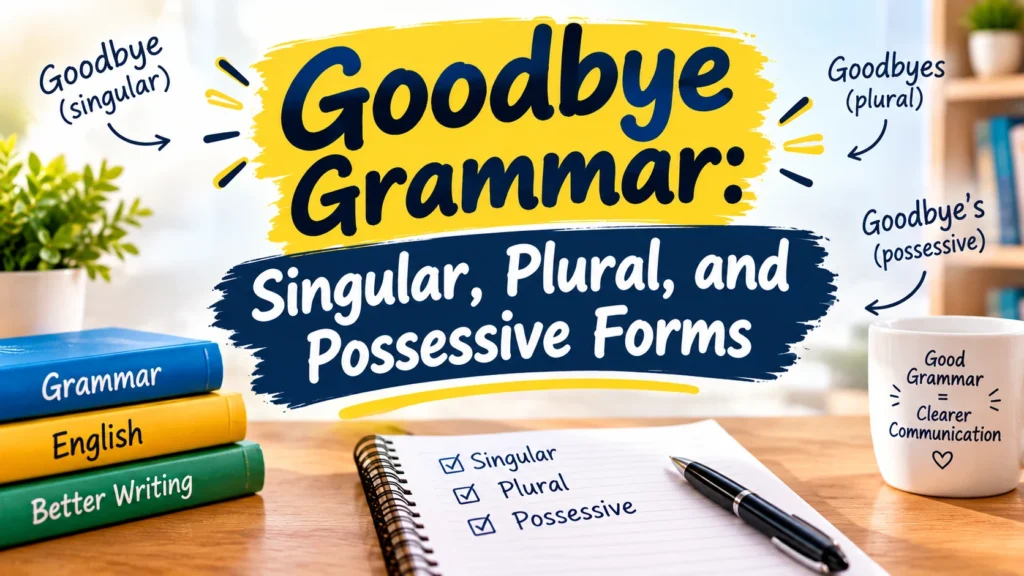
Goodbye Grammar: Singular, Plural, and Possessive Forms
Understanding the related forms can prevent small but distracting errors.
Goodbye
Use goodbye as the singular word.
She said goodbye.
Goodbyes
Use goodbyes for the plural noun.
They exchanged emotional goodbyes.
There were several goodbyes before the group left.
Goodbye’s
An apostrophe should not be used simply to make goodbye plural.
Incorrect:
They exchanged several goodbye’s.
Correct:
They exchanged several goodbyes.
An apostrophe can have grammatical uses in English, but it doesn’t belong in the ordinary plural form.
Read More : That’s vs. Thats: Which Is Correct? A Complete Guide to English Usage
Real-World Examples of Goodbye vs. Good Bye vs. Good-bye
The easiest way to remember the difference is to see the forms in context.
Everyday Conversation
“Goodbye, Sam. See you tomorrow.”
Modern and completely natural.
Text Message
“Okay, I have to go. Bye!”
Casual and appropriate.
Workplace Farewell
“The team gathered to say goodbye to their retiring colleague.”
Professional and natural.
Emotional Farewell
“She struggled to say goodbye.”
Here goodbye carries emotional weight without becoming formally worded.
Historical Text
“He waved good-bye as the carriage disappeared.”
The hyphenated spelling may be appropriate when reproducing or imitating historical usage.
Incorrect Modern Spelling
“She said good bye and left.”
If this is intended as the ordinary farewell, goodbye is the better spelling.
Quick Comparison: Goodbye vs. Good Bye vs. Good-bye
| Feature | Goodbye | Good-bye | Good Bye |
| Written as one word | Yes | No | No |
| Hyphenated | No | Yes | No |
| Standard modern spelling | Yes | Less common | Generally no |
| Historical use | Yes | Yes | Limited |
| Works in casual writing | Yes | Unusual | Usually avoid |
| Works in professional writing | Yes | Usually avoid | Usually avoid |
| Can function as a noun | Yes | Historically yes | Not normally as the standard form |
| Plural | goodbyes | Historical variant possible | Not recommended |
| Best choice today | Yes | Only in specific contexts | No |
A Simple Rule to Remember
If you’re writing the normal English farewell, there’s no need to wrestle with three spellings.
Use:
Goodbye
Think of the word as a single established unit.
If you’re reading an older text and encounter good-bye, understand that you’re seeing a historical spelling rather than evidence that modern English requires a hyphen.
And if you see good bye, don’t assume it has equal status simply because good and bye are both independent English words.
English spelling doesn’t always follow simple visual logic.
Why Correct Spelling Matters
You might wonder whether one missing hyphen or extra space really matters.
In casual texting, probably not much. People will understand what you mean.
In polished writing, however, standard spelling matters because it makes your work look deliberate and consistent.
Compare:
Thank you for reading. Goodbye.
with:
Thank you for reading. Good bye.
The second version may not prevent comprehension, but it can look like a spelling mistake.
That matters in situations such as:
- academic assignments
- published articles
- business documents
- professional emails
- marketing copy
- edited books
- websites
- formal presentations
Good writing isn’t only about whether readers understand you. It’s also about whether the language feels natural and dependable.
Using the established spelling removes an unnecessary distraction.
Goodbye in Historical and Modern Contexts: A Mini Case Study
The history of goodbye provides a neat example of how English changes.
Historical Stage
The expression began with the religious farewell “God be with ye.”
The phrase expressed a blessing or wish for the departing person.
Transitional Stage
Speakers shortened and reshaped the phrase.
Historical forms such as godbwye and other variants appeared during the 16th century.
Hyphenated Stage
Forms such as good-bye became established.
The hyphen helped represent the developing compound.
Modern Stage
The spelling gradually settled into:
goodbye
At the same time, bye emerged as a shorter informal form. The Online Etymology Dictionary dates bye as a shortened form of good-bye to around 1709.
That sequence gives us a useful snapshot of language change:
phrase → shortened expression → variant spellings → hyphenated form → closed compound → shorter everyday form
It’s a reminder that spelling isn’t always designed from scratch. Much of it is inherited.
Why “Goodbye” Still Confuses Writers
The confusion survives because the modern spelling hides the word’s history.
If you didn’t know anything about its development, good bye might seem perfectly logical. After all, good is a word and bye is a word.
But English doesn’t work entirely by logic.
Words develop through centuries of speech, writing, pronunciation, cultural influence, and convention. Once a particular form becomes standard, speakers learn that form as a unit.
That’s why you write:
- already, not all ready when you mean the adverb
- altogether, not always all together
- goodbye, not normally good bye
The individual pieces can sometimes appear separately in other contexts. That doesn’t mean the established word should be split apart.
Frequently Asked Questions About Goodbye
What is the correct spelling: goodbye, good-bye, or good bye?
Goodbye is the standard modern spelling. Good-bye is an older or less common variant. Good bye is generally not the standard spelling when you mean the conventional farewell.
Is “good-bye” still correct?
It can be considered a historical or variant spelling. You’ll find it in older writing and historical sources. However, goodbye is the preferred form for normal modern writing.
Why is goodbye no longer hyphenated?
The word gradually became established as a single lexical unit. As English spelling conventions developed, the closed form goodbye became the normal modern spelling.
Is “good bye” ever acceptable?
When goodbye functions as the ordinary farewell, good bye is generally not the preferred spelling. Use goodbye instead.
Where did the word goodbye come from?
It developed from the farewell expression “God be with ye.” Historical forms included godbwye and other variations.
Does goodbye literally mean “God be with you”?
Not in modern English.
Historically, the word traces back to that religious farewell expression. Modern speakers normally use goodbye simply to mean farewell.
Is goodbye too formal for casual conversation?
No.
You can use goodbye in casual conversation. Bye is simply a shorter and more informal alternative.
Is “bye” a proper English word?
Yes.
Cambridge lists bye as an informal exclamation meaning goodbye.
What is the plural of goodbye?
The standard modern plural is goodbyes.
For example:
They exchanged their goodbyes.
Is goodbye the same in American and British English?
Yes. Goodbye is the standard modern spelling in both American and British English. Cambridge provides both US and UK entries using the closed spelling.
Should you use goodbye in a professional email?
You can, depending on the context. However, conventional email closings such as Best, Sincerely, or Kind regards may sound more natural at the end of a professional message.
Why do older books spell it “good-bye”?
Because good-bye was a recognized spelling before the closed form goodbye became the dominant modern convention. Historical texts preserve many spellings that look unusual today.
Final Takeaway
The Goodbye vs. Good Bye vs. Good-bye debate has a surprisingly deep history, but the modern rule is easy.
Goodbye is the standard spelling you should use today.
Good-bye is a historical or less common variant that you may encounter in older books, quotations, and deliberately old-fashioned writing.
Good bye is generally not the standard spelling when you’re using the conventional farewell.
The word itself also has an intriguing origin. It developed from the expression “God be with ye” and passed through several historical forms before becoming the familiar goodbye used today.
So when you’re writing an email, article, essay, message, or story, keep the rule simple:
When you mean the ordinary farewell, write “goodbye.”
No hyphen. No space.
Just goodbye.